Roll Overs Into V Sits
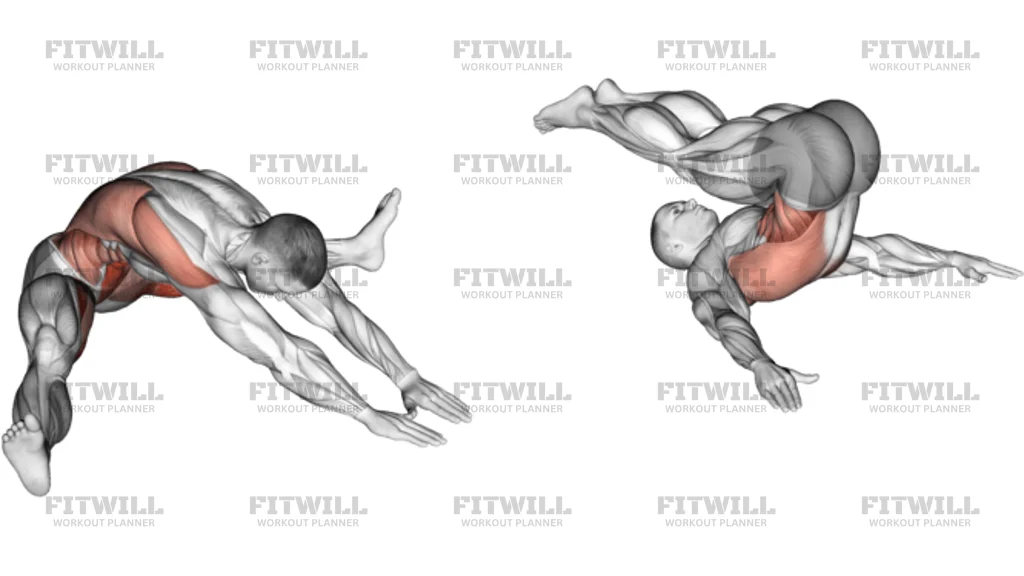
Roll Overs Into V Sits is a bodyweight floor exercise that combines a controlled roll-over with a V-sit balance. It asks you to move from a long, braced body position into an inverted rollover and then into a compact seated shape without letting momentum take over. The drill is useful for building trunk control, hip flexor strength, spinal articulation, and the shoulder stability needed to manage your body through a long lever.
The image shows a movement that lives between Pilates and gymnastics: you are not just crunching, and you are not just stretching. The roll-over phase demands that the pelvis lift and travel smoothly while the legs stay organized, and the V-sit phase asks you to hold a strong, hollowed torso while balancing on the sit bones. That combination is why the setup matters so much. If your shoulders, neck, or low back are loose at the start, the rep tends to turn into a swing instead of a controlled transition.
Set up on a mat with your body aligned and ready to move in one piece. Keep the legs together and the feet pointed or relaxed, depending on your style, and keep the arms close enough to help with balance without turning the drill into a push-off. From there, the goal is to roll the hips over, stack the body under control, and then uncurl into the V-sit with the torso staying organized. The rep should look smooth, not forceful.
Breathing and tempo are a big part of the exercise. Exhale as you move through the hardest part of the rollover and keep the ribs from flaring as the legs travel overhead. The return should be just as deliberate, with the spine lowering one segment at a time instead of dropping out of position. If the movement changes shape from rep to rep, shorten the range before you add speed or volume.
Roll Overs Into V Sits fits best in core-focused sessions, gymnastics prep, Pilates-inspired conditioning, or accessory work for athletes who already have enough trunk strength to control their bodyweight. It is an advanced-feeling movement for many people, so quality matters more than repetition count. If you cannot keep the pelvis controlled or the neck relaxed, reduce the range, bend the knees, or switch to a simpler core drill until the full pattern is clean.
Fitwill
Log Workouts, Track Progress & Build Strength.
Achieve more with Fitwill: explore over 9600 exercises with images and videos, access built-in and custom workouts, perfect for both gym and home sessions, and see real results.
Start your journey. Download today!




Instructions
- Lie on a mat with your legs straight and together, and place your arms close to the floor so you can use them for light balance if needed.
- Set your shoulders down and away from your ears, and keep your chin slightly tucked so the neck stays long before the first rep.
- Brace your abs, then lift your legs and pelvis so the lower body can start rolling overhead without a swing.
- Keep the legs straight and together as you roll your hips up and over, letting the toes travel behind you under control.
- Stack your hips over your shoulders as far as your mobility allows, keeping the movement smooth instead of throwing the legs.
- Reverse the motion by uncurling the spine and lowering the legs in one controlled path back toward the floor.
- Finish the rep by settling into a balanced V-sit position with the torso tall and the core still active.
- Reset your body fully before the next repetition and keep the same controlled pace on every rep.
Tips & Tricks
- Keep the legs glued together; separating them turns the rollover into a loose swing and makes the V-sit harder to control.
- Use your hands only as a light guide. If you are pushing hard through the arms, the core is no longer doing the main work.
- Stop the rollover before your low back or neck loses position. A shorter, cleaner range is better than forcing toes to the floor.
- Move one segment at a time through the spine instead of snapping the hips over all at once.
- Exhale as the legs travel overhead or as you come through the hardest point of the rep to keep the ribcage from flaring.
- If the V-sit collapses, keep the chest lifted and bend the knees slightly rather than letting the lower back round hard.
- Keep the gaze soft and the neck long; looking around or throwing the head back usually breaks the line of the roll.
- Use a slow eccentric return so the abs have to control both directions of the movement.
Frequently Asked Questions
What muscle does Roll Overs Into V Sits target most?
It mainly trains the abs and hip flexors, with the shoulders and deep trunk stabilizers helping control the rollover and V-sit.
Is this more of a strength move or a mobility move?
It is both. The rollover asks for spinal articulation and hamstring range, while the V-sit demands strong core and hip-flexor control.
Should my legs stay straight the whole time?
Yes if your hamstrings and low back allow it. If not, bend the knees slightly so you can keep the roll smooth and the pelvis controlled.
What is the most common mistake with this exercise?
People usually swing the legs overhead and lose the controlled transition. The rep should feel like a smooth roll, not a kip.
Where should I feel Roll Overs Into V Sits working?
You should feel a strong effort through the lower abs, hip flexors, and deep core, with the shoulders helping you stay organized through the floor.
Can I use my hands to help?
Yes, but only for balance. If the arms are doing the lifting, the movement stops being a controlled core drill.
Is this exercise safe for beginners?
Only if they already have good body control. Most beginners should start with easier roll-backs, tuck work, or reverse crunches first.
How should I progress the movement?
Progress by cleaning up the tempo, increasing the range only as control improves, and adding reps only after the rollover and V-sit stay crisp.