Side To Side Leg Swings
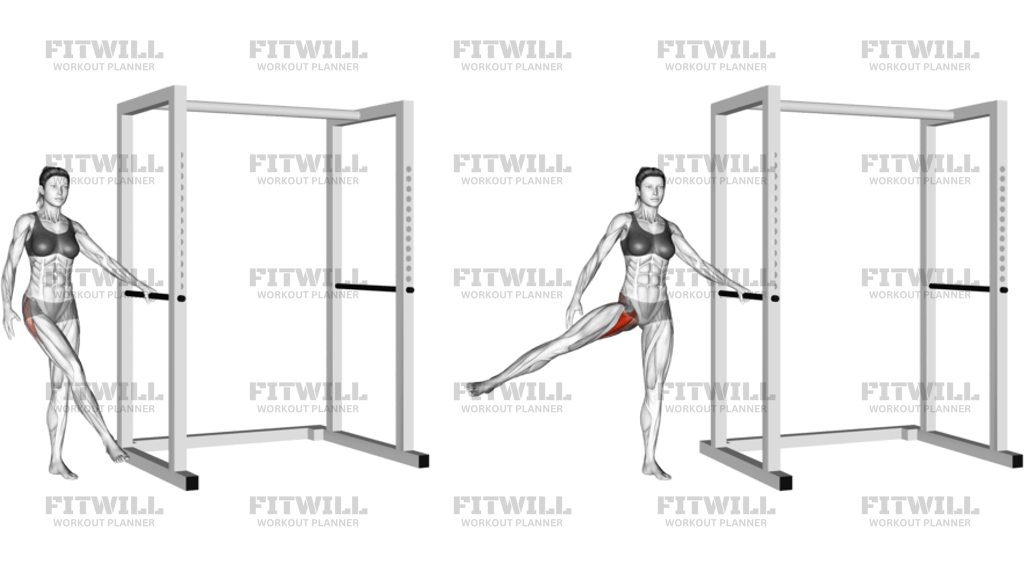
Side to Side Leg Swings is a standing hip mobility drill done with one light hand on a rack, upright post, or machine frame for balance. From that supported stance, you swing one leg laterally across the body and back out to the side in a smooth pendulum path. The goal is not to force a huge kick; the goal is to keep the pelvis steady, the torso quiet, and the arc clean enough that the hip moves freely without the lower back taking over.
This movement is most useful when you want to wake up the hip complex before squats, lunges, running, or any session where the legs need to move in the frontal plane. The inside leg stays planted while the swinging leg loads the adductors on the cross-body portion and the outer hip on the return to the side. The standing hip, glute medius, and trunk muscles work hard to prevent leaning, twisting, or collapsing into the support hand.
The setup matters because a loose start turns this into a sloppy sway. Stand tall beside the support, keep the standing foot rooted, and let the free leg begin with a small amount of tension rather than a hard swing. Keep the ribs stacked over the pelvis, soften the standing knee, and hold the support only as much as you need to stay balanced. If the body starts drifting sideways, the swing is probably too large.
During the rep, think about moving from the hip joint instead of throwing the leg with momentum. The swinging foot should trace a controlled path across the midline and then out to the side, with the pelvis staying level and the shoulders square. A shorter, quieter swing usually produces a better hip-opening effect than a high, fast one. Exhale as the leg moves through the active portion of the swing and inhale as it returns under control.
Use Side to Side Leg Swings as a warm-up drill, an activation sequence between heavier lower-body sets, or a low-fatigue mobility option on recovery days. It is beginner-friendly when the arc is kept small and the support is used correctly. If you feel pinching in the hip, low back strain, or a tug from the support arm, reduce the range immediately and keep the movement pain-free and repeatable.
[ Workout Log & Planner ]
Put your next workout in Fitwill
Keep your plan and training log ready when you are.


Instructions
- Stand sideways next to a rack, upright post, or machine frame and hold it lightly with the hand closest to the support.
- Plant the standing foot firmly under your hip, keep the standing knee soft, and let the free leg hang relaxed beside you.
- Stack your ribs over your pelvis and keep your hips square before the first swing.
- Begin with the swinging leg slightly in front of the body and the toes pointing mostly forward.
- Sweep the free leg across the midline and then out to the side from the hip joint, not from a twist in the lower back.
- Keep the torso tall, the pelvis level, and the standing foot grounded as the leg changes direction.
- Reverse the swing smoothly and avoid snapping the leg back with momentum.
- Exhale as the leg swings through the active portion and inhale as it returns.
- After the final rep, lower the leg under control and release the support before switching sides.
Tips & Tricks
- Hold the support with just enough pressure to balance; pulling hard with the arm usually means the leg swing is too big.
- Keep the standing foot heavy through the heel, big toe, and little toe so the ankle does not rock with every rep.
- A smaller, quieter arc is usually better than a high kick because the hip keeps the work instead of the torso.
- Let the swinging leg move from the hip socket; if your lower back is rotating, reduce the range and slow down.
- Keep the pelvis level as the leg crosses the body so the opposite hip does not hike upward.
- If the inner thigh feels pinched, shorten the cross-body portion and stay in a pain-free range.
- Use a smooth rhythm instead of a pause at the top so the motion stays fluid and controlled.
- Do a few easy swings first, then open the arc only if the trunk stays still and the support hand remains light.
Frequently Asked Questions
What muscles do Side to Side Leg Swings work most?
They primarily challenge the hip abductors and adductors, with the glute medius, deep hip stabilizers, and core helping keep the pelvis steady.
Should I hold the rack or frame with one hand or both?
One light hand is usually enough. The support should help you balance, not turn the movement into a pull.
How high should the swinging leg go?
Only as high as you can keep the torso upright and the standing hip quiet. A controlled mid-height swing is better than a forced high one.
What is the biggest form mistake in this leg swing?
The most common mistake is letting the body sway or twist to create range. The leg should move, but the trunk should stay almost still.
Can beginners do Side to Side Leg Swings?
Yes. Beginners should start with a small arc, slow tempo, and a very light touch on the support until balance feels automatic.
Why do I feel this in my inner thigh?
The swinging leg lengthens the adductors as it crosses the midline, so a gentle stretch there is normal. Sharp groin pain is not.
When is the best time to use this exercise?
It fits well in a warm-up before lower-body training, before sprinting or change-of-direction work, or between sets as a light hip reset.
What should I do if the swing pinches my hip or back?
Reduce the arc immediately, keep the pelvis level, and slow the tempo. If the pinch stays, stop the drill and use a smaller, pain-free range.