Dumbbell Over Bench One-Arm Neutral Wrist Curl
Dumbbell Over Bench One-Arm Neutral Wrist Curl is a single-arm forearm exercise done with the working forearm supported on a bench and the hand hanging just past the edge. The thumb-up, neutral grip keeps the wrist in a stable line so the movement comes from the wrist itself rather than from swinging the elbow, rotating the forearm, or using the shoulder to help.
This variation is useful when you want direct loading for the forearm muscles that help with wrist strength, grip endurance, and control in rows, carries, pull-ups, and barbell work. Because the bench removes most body movement, it is a clean isolation drill for finishing a session, building forearm size, or strengthening a weak side one arm at a time.
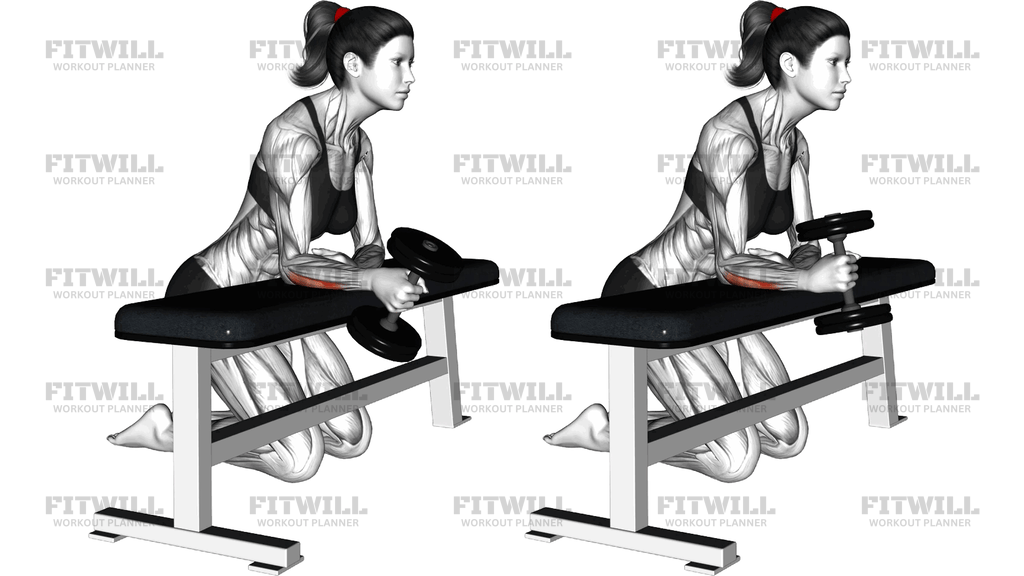
The setup matters because the bench is what keeps the repetition honest. In the image, the lifter kneels beside a flat bench, plants the working forearm across the pad, and lets the dumbbell travel below the edge of the bench. That support should stay fixed from rep to rep; if the elbow slides, the chest lifts, or the shoulder rolls forward, tension leaks out of the forearm and the wrist path gets sloppy.
At the bottom, let the hand lower under control until you feel a manageable stretch through the forearm, then curl the dumbbell back up by bending only the wrist. Keep the upper arm quiet, keep the grip neutral, and move the weight in a smooth arc rather than snapping it. The cleanest reps come from a controlled lower, a short squeeze at the top, and a return that never bounces off the bench edge.
Use a light to moderate dumbbell and a range you can repeat without twisting the handle or shortening the motion. This is not a movement for cheating through fatigue; it works best when the wrist stays lined up, the bench position stays fixed, and the forearm does the work. It fits well after your main lifts or on a forearm-focused day when you want direct wrist and grip training with low technique noise.
[ Workout Log & Planner ]
Put your next workout in Fitwill
Keep your plan and training log ready when you are.


Instructions
- Kneel beside a flat bench and place one forearm across the pad with the wrist and hand hanging just past the front edge.
- Hold a dumbbell in one hand with a neutral, thumb-up grip so the handle stays aligned with the forearm.
- Plant the opposite knee and foot for balance, then keep the chest low and the shoulder relaxed.
- Let the hand lower slowly until the dumbbell drops under control and you feel a forearm stretch.
- Exhale and curl the wrist upward, moving only the hand while the forearm stays glued to the bench.
- Keep the elbow, upper arm, and torso still so the dumbbell rises in a clean wrist arc.
- Squeeze briefly at the top without rolling the forearm or shrugging the shoulder.
- Inhale and lower the dumbbell back to the start under control, then finish the set and switch arms.
Tips & Tricks
- Use a dumbbell that lets you keep the wrist path smooth; if the handle twists in your hand, it is too heavy.
- Keep the forearm fully on the bench so the elbow does not slide forward when the set gets hard.
- Let the hand travel straight up and down; if the dumbbell starts drifting inward or outward, reset the grip.
- Slow the lowering phase to build forearm endurance and make the top range feel cleaner.
- Stop the descent before the weight pulls the wrist into an uncomfortable stretch at the bottom.
- Keep the thumb-up grip the whole set; rotating the forearm changes the exercise and shifts the load.
- Use the opposite knee and foot to stay braced so your torso does not rock to help the curl.
- If your shoulder starts to tense, move closer to the bench and reduce the load before the form breaks down.
Frequently Asked Questions
What does the Dumbbell Over Bench One-Arm Neutral Wrist Curl work?
It mainly trains the forearm muscles that control wrist flexion and extension, along with grip support.
Why is the forearm supported on the bench?
The bench removes body swing and keeps the movement isolated to the wrist so the forearm does the work.
What does the neutral, thumb-up grip change?
It keeps the wrist aligned with the forearm and prevents extra rotation from turning the set into a different curl variation.
How heavy should the dumbbell be for this bench curl?
Use a load that lets you control the lower and keep the wrist path clean for every rep.
Should my elbow move during the rep?
No. The elbow stays planted on the bench while only the wrist moves.
Can beginners do the one-arm neutral wrist curl?
Yes, as long as they start light and keep the forearm fixed on the bench without swinging.
What is the most common mistake with this dumbbell bench setup?
Letting the forearm slide off the pad or using the shoulder to finish the curl is the biggest breakdown.
How can I progress the exercise without losing form?
Add reps first, then increase the dumbbell slightly, or slow the lowering phase before making it heavier.