Dumbbell Over Bench One-Arm Wrist Curl
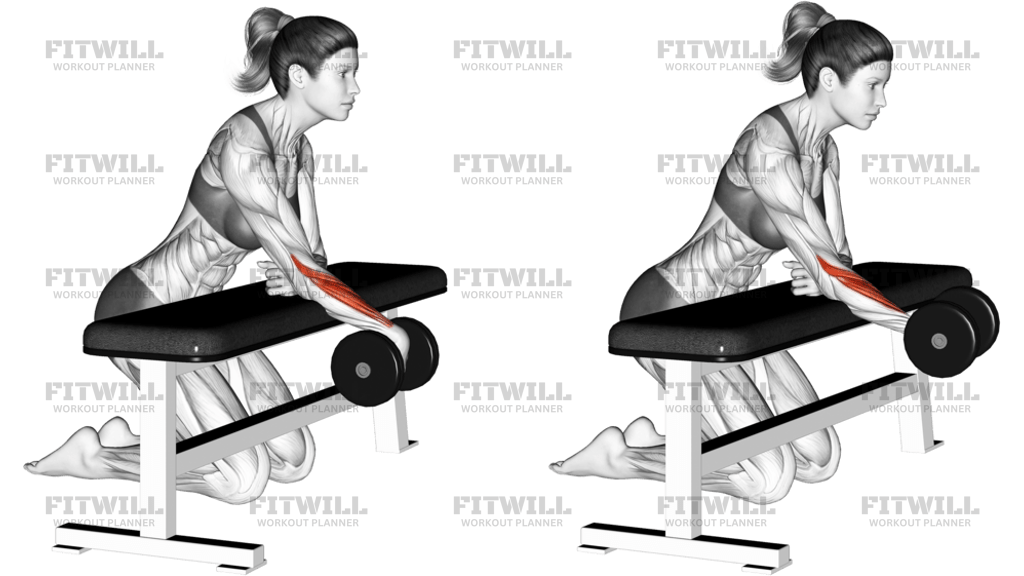
Dumbbell Over Bench One-Arm Wrist Curl is a focused forearm exercise that isolates wrist flexion while the upper arm and shoulder stay quiet. The setup matters because the forearm needs solid support on the bench and the wrist needs room to move past the edge, otherwise the rep turns into a shoulder or elbow swing instead of a true wrist curl.
This movement is useful when you want to build stronger, thicker forearms and improve grip endurance for pulling work, racket sports, climbing, and general lifting. Because it uses a single dumbbell and a very small range of motion, the challenge comes from precision, not from loading the exercise heavily. That makes it a good accessory lift after bigger compound movements.
Start by kneeling or leaning beside a flat bench with one forearm resting on the pad and the wrist and dumbbell hanging just past the edge. The elbow should stay planted while the hand moves freely. A neutral, steady torso helps keep the forearm fixed so the wrist flexors do the work without help from body English.
Curl the dumbbell by closing the hand and bending the wrist upward, then lower it slowly into a full stretch under control. The rep should feel smooth and deliberate, with the dumbbell moving through a short arc and the forearm staying glued to the bench. Exhale as you curl up and inhale as you lower, keeping the shoulder relaxed instead of shrugging toward the ear.
This exercise is especially useful for lifters who want a direct forearm finisher after rows, pull-ups, deadlifts, or arm work. It also helps identify side-to-side imbalances because each arm works alone. If the wrist starts bending at the elbow, the bench is too high or your body position is drifting.
Keep the load modest and the wrist path clean. The goal is not to bounce the dumbbell or chase a huge range from the shoulder, but to build repeatable tension through the forearm flexors. When done well, Dumbbell Over Bench One-Arm Wrist Curl is a simple, precise accessory that adds useful arm strength without a lot of joint stress.
Fitwill
Log Workouts, Track Progress & Build Strength.
Achieve more with Fitwill: explore over 9600 exercises with images and videos, access built-in and custom workouts, perfect for both gym and home sessions, and see real results.
Start your journey. Download today!




Instructions
- Kneel or lean beside a flat bench and place one forearm on the pad with your wrist and hand hanging just past the edge.
- Hold a dumbbell in that hand with your palm facing up and let the weight sit below the bench so the wrist starts in a stretched position.
- Keep your elbow, forearm, and upper arm pinned to the bench while the free hand steadies your body if needed.
- Set your torso still and keep your shoulder relaxed so the movement starts at the wrist, not from the arm or trunk.
- Curl the dumbbell upward by flexing the wrist and closing the hand until you feel a strong contraction through the forearm.
- Pause briefly at the top without letting the elbow lift or the shoulder roll forward.
- Lower the dumbbell slowly until the wrist drops back into a full stretch over the edge of the bench.
- Keep the tempo controlled and breathe out on the curl, then breathe in as you return to the bottom.
- Complete the planned reps, then place the dumbbell down before switching sides.
Tips & Tricks
- Let the wrist hang slightly off the bench edge at the bottom; if your hand is supported too high, you lose the stretch that makes the rep effective.
- Keep the palm facing up through the whole set so the exercise stays on the wrist flexors instead of turning into a rotating forearm drill.
- Use a lighter dumbbell than you would expect; this movement gets hard fast because the lever arm is short and the forearm muscles fatigue quickly.
- Do not let the elbow slide forward or your upper arm turn the rep into a curl. The bench should anchor the forearm the entire time.
- Move the dumbbell with the wrist only and keep the fingers relaxed enough to hold on without squeezing so hard that the forearm cramps early.
- Lower the weight more slowly than you lift it. The eccentric phase is where the wrist flexors get a strong training stimulus.
- If your shoulder creeps up toward your ear, reset your torso position and keep the working side relaxed over the bench.
- Stop the set when you can no longer control the bottom stretch; bouncing out of the bottom usually means the load is too heavy.
Frequently Asked Questions
What does Dumbbell Over Bench One-Arm Wrist Curl train most?
It mainly trains the forearm flexors that bend the wrist, with the grip muscles working hard to hold the dumbbell.
How should I position my arm on the bench for Dumbbell Over Bench One-Arm Wrist Curl?
Rest the forearm on the bench with the wrist and dumbbell hanging just past the edge so the wrist can flex through a clean range of motion.
Should my palm face up or down during the curl?
Keep the palm facing up. That setup keeps the focus on wrist flexion instead of turning the movement into a reverse wrist curl.
Can beginners use Dumbbell Over Bench One-Arm Wrist Curl?
Yes, as long as they start light and keep the forearm fixed on the bench. The range is small, so control matters more than load.
Why is my shoulder taking over this exercise?
Usually the bench is too high, the torso is moving, or the elbow is lifting off the pad. Keep the forearm anchored and let only the wrist move.
How heavy should the dumbbell be?
Light to moderate loads work best. If you have to swing the wrist or lift the elbow to finish reps, the dumbbell is too heavy.
What is the biggest mistake people make on the bench?
Letting the forearm drift off the pad or letting the wrist curl from a loose elbow position. The bench should stabilize the arm, not just support the hand.
Can I do this after rows or deadlifts?
Yes. It fits well as a forearm finisher after pulling work when your grip and wrist flexors are already warm.
What should I do if my wrist feels irritated?
Reduce the load, shorten the range slightly, and avoid forcing the bottom stretch. If the joint pain continues, skip the set and reassess the position.