Dumbbell Single Leg Deadlift
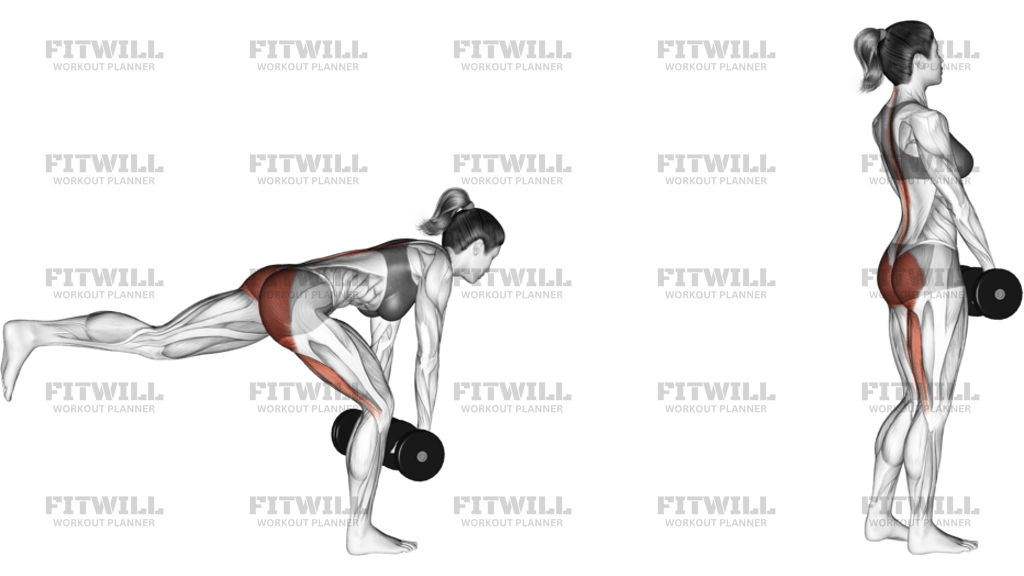
Dumbbell Single Leg Deadlift is a unilateral hip-hinge exercise built around balance, control, and posterior-chain strength. In the image, the lifter balances on one leg while the other leg reaches long behind the body and one dumbbell hangs close to the working leg. That setup makes the movement especially useful for training glutes, hamstrings, and the smaller stabilizers that keep the pelvis, knee, and torso organized through the hinge.
The exercise works best when the standing foot feels rooted and the hips stay square as you fold forward. The dumbbell should travel in a straight line near the shin or foot of the support leg, not swing away from the body. A clean rep is less about touching a specific depth and more about keeping the torso long, the free leg active, and the working hip doing the job instead of the lower back or momentum.
Setup matters because the whole movement is a balance test before it becomes a strength test. Start tall, soften the knee of the stance leg, and send the opposite leg back as a counterweight. Keep your ribs stacked over your pelvis, let the chest tip forward from the hip, and maintain a steady neck position. If the hips start to open or the dumbbell drifts far from the leg, the set has usually become more about wobbling than loading the target muscles.
Use Dumbbell Single Leg Deadlift when you want unilateral posterior-chain work that also exposes side-to-side differences in balance, hip control, and hamstring length. It fits well in lower-body strength sessions, athletic prep, accessory work, and warmups when performed with light to moderate load and strict form. Beginners can use bodyweight, fingertip support, or a light dumbbell first. Stop the range where alignment breaks down, and keep each rep smooth enough that you could repeat it the same way on the next side.
Fitwill
Log Workouts, Track Progress & Build Strength.
Achieve more with Fitwill: explore over 9600 exercises with images and videos, access built-in and custom workouts, perfect for both gym and home sessions, and see real results.
Start your journey. Download today!




Instructions
- Stand tall holding one dumbbell at your side, then shift your weight onto the working leg.
- Soften the knee of the stance leg and let the other leg float back behind you.
- Brace your torso, keep your hips square, and set your gaze a few feet in front of you.
- Hinge at the hip and let your chest move forward as the free leg reaches long behind you.
- Lower the dumbbell close to the standing shin or foot instead of letting it swing away from your body.
- Keep your back flat and stop the descent when your balance, hamstring stretch, or hip position starts to break down.
- Drive through the heel and midfoot of the stance leg to stand back up.
- Finish tall by bringing the hips through without leaning backward or locking out aggressively.
- Reset your balance and repeat for the planned reps before switching sides.
Tips & Tricks
- Keep the dumbbell close to your leg on every rep; a drifting weight turns the hinge into a balance fight.
- Think about sending the free heel straight back instead of lifting the leg high behind you.
- A soft knee on the stance leg usually helps the hamstrings load without forcing the pelvis to tuck under.
- Square the hip of the lifted leg toward the floor so the working hip does not rotate open.
- Use a light fingertip touch on a wall or rack if your balance limits the quality of the hinge.
- Lower only as far as you can keep the spine long and the standing foot planted.
- Exhale as you drive up and keep the ribs from flaring at the top.
- Choose a load based on balance and hamstring control, not on what you could deadlift with both feet on the floor.
Frequently Asked Questions
What muscles does Dumbbell Single Leg Deadlift train?
It mainly trains the glutes and hamstrings, with the standing foot, hips, and core working hard to keep you stable.
Do I need a full touch to the floor on every rep?
No. Lower until you can keep the dumbbell close, the spine long, and the hips square.
Should the free leg stay straight behind me?
It should reach long behind you with a soft knee if needed, but the important part is that it acts as a counterbalance rather than a swing.
What is the most common form mistake?
Letting the dumbbell drift away from the standing leg or rotating the hips open usually removes tension from the target hip.
Can I use support if I keep losing balance?
Yes. A wall, rack, or fingertip support is a good way to learn the hinge before loading it harder.
Is this the same as a two-leg Romanian deadlift?
No. This version loads one leg at a time, so balance and hip control matter much more than total load.
Can beginners do Dumbbell Single Leg Deadlift?
Yes, but many beginners should start with bodyweight or a very light dumbbell until they can hinge without twisting.
How do I make the exercise harder without just adding weight?
Slow the lowering phase, pause briefly near the bottom, or reduce support while keeping the same strict hip hinge.