Barbell Rollout
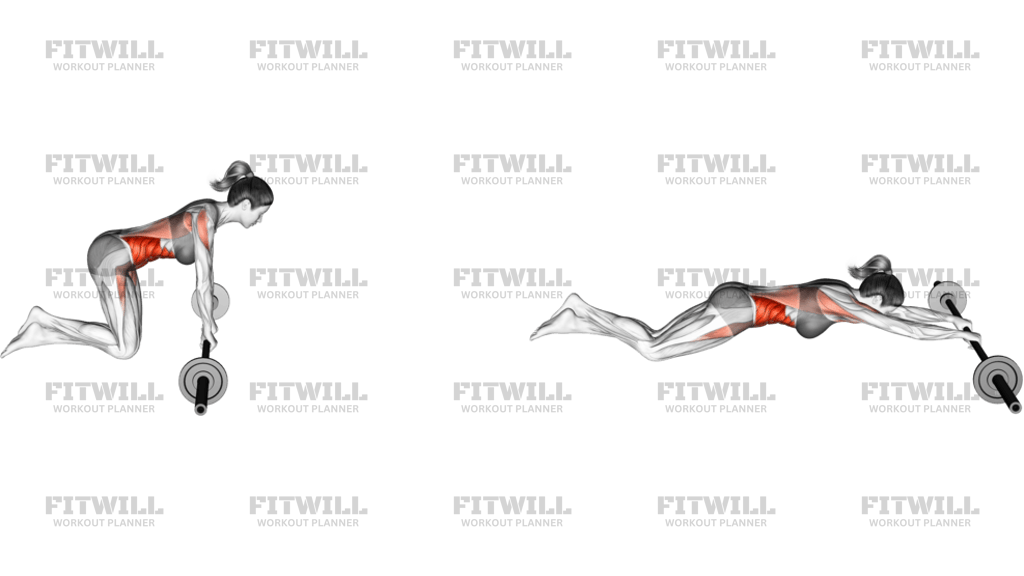
Barbell Rollout is a kneeling anti-extension core exercise that uses a barbell as the rolling implement. It trains the front of the trunk, the lats, serratus, and hip control by forcing you to resist low-back collapse while the bar travels away from your knees.
The setup matters because the movement gets much harder as soon as your arms reach forward and your body gets longer. In the image, the knees stay on the floor, the hands stay on the bar, and the torso moves from a compact start to a long, almost straight line from shoulders to knees. The bar stays in contact with the floor the whole time and should roll smoothly rather than wobble or swing.
This exercise is useful when you want real core strength, not just ab fatigue. It fits well in accessory work, core-focused sessions, and strength programs that need better trunk stiffness for pressing, pulling, running, or bracing under load. Because the leverage changes quickly, a small increase in range can turn a manageable set into a failed one, so conservative loading and short, controlled ranges are the right place to begin.
A good rollout keeps the ribs tucked, the pelvis steady, and the neck relaxed while the shoulders stay active. The goal is to reach only as far as you can without letting the low back arch or the hips drop forward. Then you pull the bar back underneath you by tightening the abs and lats together. If the bar drifts, the hips sag, or the return turns into a yank, the set is too hard or the range is too long.
[ Workout Log & Planner ]
Put your next workout in Fitwill
Keep your plan and training log ready when you are.


Instructions
- Kneel on a pad with the barbell on the floor in front of you, hands on the bar just outside shoulder width, shoulders stacked over the bar and hips above your knees.
- Keep your ribs pulled down, lightly squeeze your glutes, and set your neck in a neutral position before the bar moves.
- Brace your abs, then inhale as you begin to roll the bar forward in a straight line.
- Reach both arms out together and let your torso follow the bar without letting your lower back arch.
- Stop the rollout before your hips tip forward or your shoulders lose control of the bar path.
- Pause briefly in the longest position with your body stretched from shoulders to knees.
- Exhale and pull the bar back under your shoulders by tightening your abs and lats together.
- Finish in the stacked kneeling start position, reset your brace, and repeat for the next rep.
Tips & Tricks
- Shorten the range first; the last few inches of forward travel are usually where the low back wants to arch.
- Keep pressure even through both hands so the bar does not twist or drift to one side.
- Use a thick pad under the knees if the floor position makes you shift or rush the rep.
- Think of pulling your ribs back toward your pelvis on the return, not just dragging the bar with your arms.
- Keep the elbows softly extended, but do not slam into a locked, passive shoulder position.
- Smooth plates make the rollout more predictable; unstable or noisy rolling usually means the set is too ambitious.
- If your hips shoot back first, the movement is too hard or the range is too long for your current strength.
- End the set as soon as you cannot pull the bar home without a lumbar arch or a hard hip pike.
Frequently Asked Questions
What muscles does the barbell rollout train?
It mainly trains the abs and deep core, with strong help from the lats, serratus, and hip stabilizers that keep the torso from collapsing.
Should the barbell stay on the floor the whole time?
Yes. The plates roll on the floor while your hands stay on the bar, so the bar never leaves contact with the ground.
How far should I roll the bar forward?
Only as far as you can keep your ribs tucked, hips steady, and lower back from arching. For most people, that is a shorter range than they expect.
Why does my lower back feel like it is taking over?
That usually means you rolled out too far or lost your brace. Shorten the range, squeeze your glutes, and pull your ribs down before every rep.
Can a beginner do barbell rollouts?
Yes, but only with a very short range and strict control. If you cannot keep the pelvis steady, start with a smaller rollout or a simpler core drill.
Should my elbows bend during the rollout?
They should stay mostly straight with a soft elbow, so the movement comes from the trunk and shoulders rather than a pressing motion.
What if the bar rolls unevenly or drifts sideways?
Reset your hand width, press evenly through both hands, and slow the tempo. Side drift usually means one shoulder is taking over.
How do I make barbell rollouts harder?
Increase the rollout range first, then add more reps or slower tempo. A longer reach changes the leverage far more than loading the bar.