Frog Hip Thrust
Frog Hip Thrust is a bodyweight glute bridge variation performed on the floor with the soles of the feet pressed together and the knees opened out like a frog. That hip position shortens the leverage on the hamstrings and shifts more of the work toward the glutes, especially when you drive the hips to full extension and keep the ribs from flaring. It is a simple exercise, but the setup matters because small changes in foot distance, knee angle, and pelvic position can change where the effort goes.
The exercise is useful when you want direct glute work without a barbell, bench, or machine. It can be used as a warm-up activation drill, a higher-rep accessory movement, or a low-load option when you want to train the glutes while keeping spinal loading low. Because the movement is performed on the floor, it is also easy to scale by adjusting range of motion, tempo, or adding a pause at the top.
The key rep pattern is to start with your back flat on the floor, press the feet together, let the knees fall open, and then drive the hips upward by squeezing the glutes. At the top, the thighs and torso should form a strong line without over-arching the lower back. Lower under control until the hips touch down or nearly touch down, then reset the brace before the next rep. Breathing should stay calm and repeatable so the torso does not lose position as the hips move.
Frog Hip Thrust works best when every rep looks the same. If the knees collapse inward, the feet slip apart, or the lower back takes over at the top, the glutes lose tension and the set becomes less effective. Keep the movement smooth, stay within a pain-free range, and stop the set when you can no longer maintain the frog position and controlled hip extension.
[ Workout Log & Planner ]
Put your next workout in Fitwill
Keep your plan and training log ready when you are.


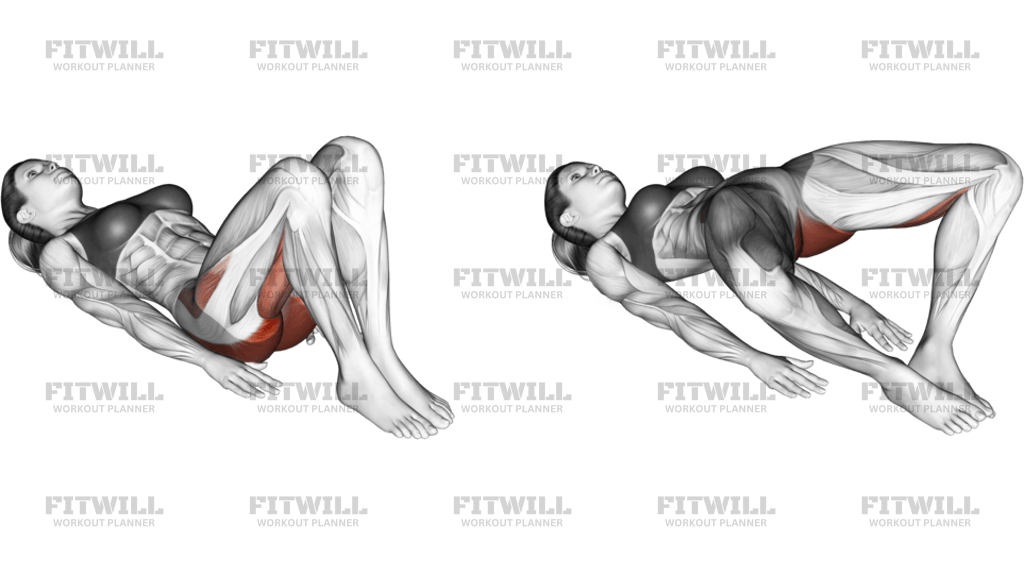
Instructions
- Lie on your back on the floor with your knees bent and the soles of your feet pressed together in front of you.
- Let your knees open out to the sides and place your arms on the floor for balance with your palms down.
- Set your feet close enough to your hips that you can lift without sliding or overreaching.
- Brace your ribs down and lightly tuck your pelvis so your lower back stays controlled.
- Drive your hips up by squeezing your glutes until your torso and thighs form a strong line.
- Keep the soles connected and the knees turned out as you reach the top of the rep.
- Pause briefly at full hip extension without leaning into your lower back.
- Lower your hips back to the floor under control and reset before starting the next rep.
- Breathe out as you lift and inhale as you return to the floor.
Tips & Tricks
- Keep the soles of your feet lightly pressed together so the frog position stays consistent from rep to rep.
- If your knees drift inward, reset the feet before you continue; the open-knee position is what makes this variation different from a standard bridge.
- Stop the ascent when your hips are fully extended and your ribs start to pop up; that usually means the lower back is taking over.
- A short pause at the top makes the glutes do more work than fast bouncing repetitions.
- Do not walk the feet farther away just to get a bigger lift; a longer lever often shifts the effort into the hamstrings.
- Keep your head and neck relaxed on the floor instead of chin-jutting toward your chest.
- If the inner thighs cramp, reduce the range slightly and focus on a smoother squeeze rather than forcing the knees farther open.
- Use slow lowering if you want more time under tension, but keep the knees open and the feet together throughout the descent.
Frequently Asked Questions
What muscles does a Frog Hip Thrust work most?
It mainly trains the glutes, with the inner thighs and core helping to stabilize the frog position.
Can beginners perform this exercise?
Yes. The floor setup is beginner-friendly, and the bodyweight version is a good way to learn glute-driven hip extension.
Where should my feet and knees be in the frog position?
Press the soles together, let the knees fall open, and keep the feet close enough to your hips that you can lift without sliding.
How high should I lift my hips?
Lift until your torso and thighs make a strong line, then stop before your lower back starts to arch and take over.
Should I feel this in my hamstrings or inner thighs?
Some inner-thigh work is normal because the knees are turned out, but the main effort should still come from the glutes.
Why use this instead of a regular glute bridge?
The frog position shortens the hamstrings and often makes it easier to isolate the glutes with less load.
What is a common mistake in Frog Hip Thrusts?
Letting the knees collapse inward or finishing the rep by arching the lower back instead of squeezing the glutes.
How can I make the exercise harder without adding weight?
Use a slower lowering phase, add a brief pause at the top, or keep constant tension by not resting fully on the floor between reps.