Dumbbell Single Leg Deadlift With Stepbox Support
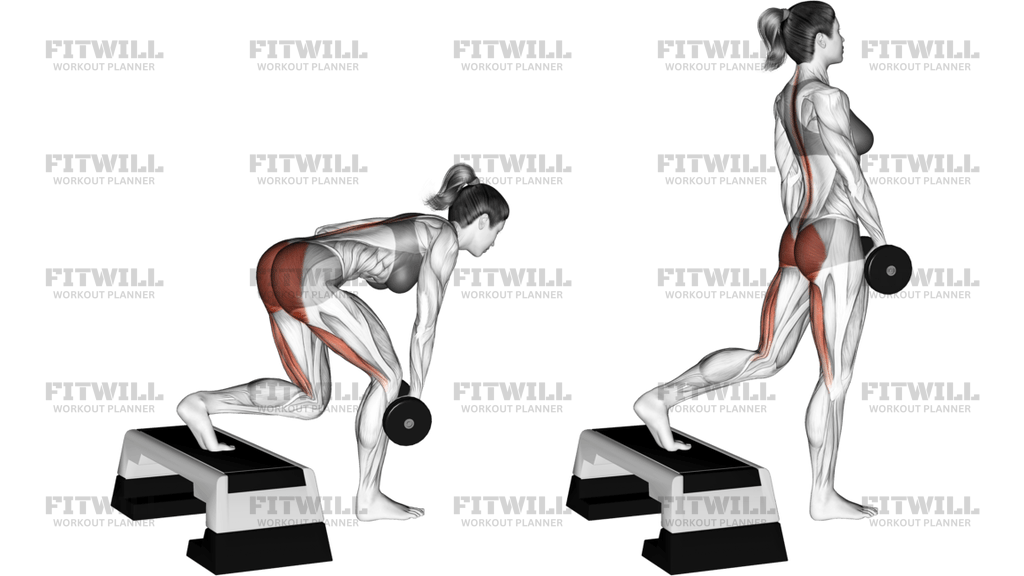
Dumbbell Single Leg Deadlift With Stepbox Support is a supported single-leg hip hinge built to train the posterior chain without demanding perfect balance from the first rep. The stepbox gives the rear foot a light point of contact so you can focus on the hinge, the hip shift, and the path of the dumbbell instead of fighting to stay upright. In the image, the dumbbell is held on the working-leg side while the opposite toes rest on the box behind you, which helps keep the pelvis organized as you load one leg.
This movement is a practical way to train hamstrings, glutes, and trunk stability with less wobble than a free single-leg deadlift. The front leg does most of the work, but the back toes on the stepbox can help you learn the pattern, match left and right sides, and build confidence before progressing to a less-supported hinge. It is especially useful when you want unilateral work for glute strength, hamstring control, or balance-friendly accessory training.
Setup matters because a small change in stance changes the whole exercise. Keep the working foot planted flat, the back toes resting lightly on the box, and the dumbbell hanging close to the standing leg. Hinge by sending the hips back and keeping the spine long, not by reaching the weight away from the body or turning the movement into a squat. The rear foot is there for balance, not for a push-off.
A good rep should feel like the torso and back leg are moving together as one controlled unit while the standing hip loads and then extends. Lower only as far as you can keep the hips square and the back neutral, then drive the floor away and stand tall by squeezing the glute of the working leg. Breathe in on the way down, exhale as you stand, and reset fully before the next rep.
Use this exercise as a technique builder, a warm-up hinge, or an accessory lift when you want single-leg loading with a little extra stability. It works well for beginners who need help learning the hinge, and it also fits more advanced training when you want strict unilateral posterior-chain tension without the instability of a free-standing version.
Fitwill
Log Workouts, Track Progress & Build Strength.
Achieve more with Fitwill: explore over 9600 exercises with images and videos, access built-in and custom workouts, perfect for both gym and home sessions, and see real results.
Start your journey. Download today!




Instructions
- Stand on one leg with the other toes resting lightly on the stepbox behind you and a dumbbell hanging in the hand on the working-leg side.
- Keep the front foot flat, the rear toes relaxed on the box, and your hips and shoulders square before you start the rep.
- Brace your torso and let the dumbbell hang close to the standing thigh, not out in front of your body.
- Push your hips straight back as you lower the dumbbell and let the torso tip forward with a long, neutral spine.
- Keep a soft bend in the standing knee while the back leg stays relaxed and the box foot remains a light balance point.
- Lower until you feel a clear hamstring stretch and can still keep the pelvis level and the dumbbell close to the leg.
- Drive through the standing heel and midfoot to stand back up, bringing the hips forward without leaning back at the top.
- Exhale as you return to standing, pause to reset balance, and repeat for the planned reps before switching sides.
Tips & Tricks
- Treat the rear foot on the box as a kickstand only; if you can feel it pushing, the working leg is not doing enough work.
- Keep the dumbbell on the same side as the standing leg so your trunk has to resist side-bending during the hinge.
- Let the hips travel back in a straight line instead of opening the pelvis toward the box or twisting the shoulders.
- If the dumbbell drifts away from the shin, the lower back usually takes over and the balance gets worse.
- A slight bend in the standing knee is fine, but too much knee travel turns the lift into a squat pattern.
- Lower only until the standing hamstring, not your back, limits the range of motion.
- Use a slow descent and a smooth stand-up so the box support does not become a bounce out of the bottom.
- Keep the chin tucked slightly and the neck long so the upper back does not round as you reach forward.
Frequently Asked Questions
What does Dumbbell Single Leg Deadlift With Stepbox Support train?
It mainly trains the glutes and hamstrings of the standing leg, with the core working hard to keep the torso from tipping or rotating.
Why is the rear foot on a stepbox?
The box gives light balance support so you can learn the single-leg hinge pattern without needing perfect stability on every rep.
Should the dumbbell stay in the same hand as the standing leg?
Yes, that setup matches the image and makes the standing side work harder to resist side-bending during the hinge.
How much pressure should I put through the back toes on the box?
Only enough to keep your balance. The standing leg should still do almost all of the lifting and lowering.
How low should I hinge on this exercise?
Go only as low as you can while keeping the spine long, the hips square, and the dumbbell close to the standing leg.
What is the most common mistake with this movement?
People usually push off the box, rotate the hips open, or let the dumbbell drift away from the leg instead of hinging straight back.
Is this a good beginner exercise?
Yes. The stepbox support makes it easier to learn the hinge and build unilateral strength before trying a completely unsupported single-leg deadlift.
Can I use this instead of a regular single-leg deadlift?
Yes, especially if you need more balance help, want to keep the range of motion strict, or are using it as a regression before the unsupported version.