One-Arm Twisted Clean And Press
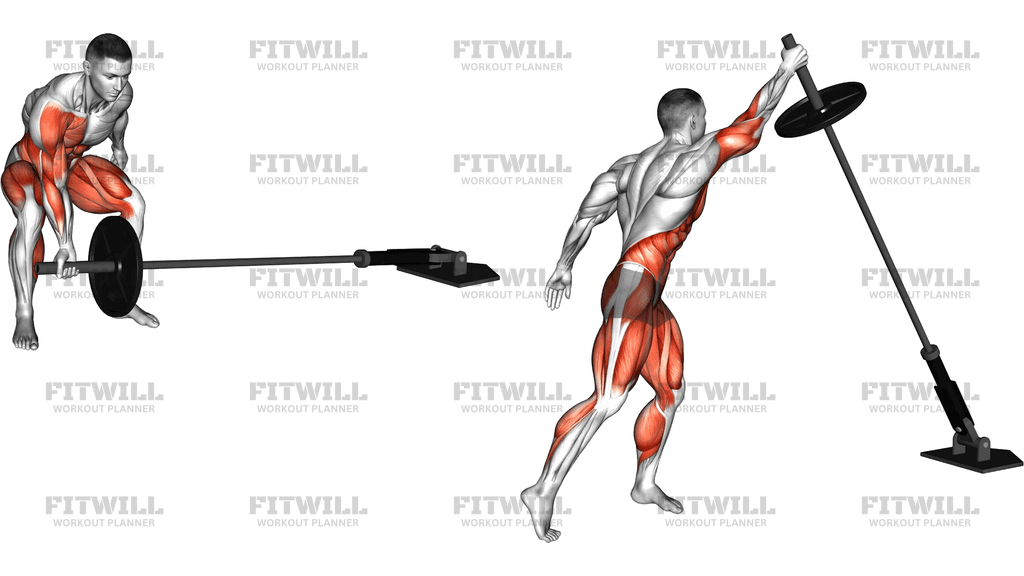
One-Arm Twisted Clean and Press is a landmine-style barbell exercise that combines a one-sided clean with an overhead press. It asks you to drive the sleeve from a low, hinged start to a front rack position, then press it on a diagonal path overhead. That makes it useful for training shoulder strength, triceps, upper chest, legs, and core at the same time while also teaching you to control rotation instead of fighting it.
The setup matters because the bar path is fixed by the anchored end. A stable stance, neutral wrist, and organized torso let the loaded side travel close to your body instead of swinging away from you. When the clean stays tight and the press finishes with the elbow locked out, the movement feels powerful without becoming a sloppy twist through the low back or knee.
This exercise is not a straight-up barbell press. The twisted portion comes from the way your hips and torso open as the sleeve moves from the floor to the shoulder, so the rep should feel coordinated rather than forced. Keep the knees tracking with the toes, keep the ribcage from flaring, and let the bar travel in a smooth arc instead of trying to muscle it vertically.
Because the load is held on one side, the exercise also asks a lot from the obliques, glutes, and upper back. That makes it a good option for athletes and lifters who want unilateral power and anti-rotation strength, or for anyone looking for a more athletic pressing pattern than a basic standing press. It also works well as accessory work after a main lift or as part of a full-body circuit.
Use a load you can clean without yanking with the arm and press without leaning back. The best reps are crisp: the bar stays close, the body turns only as much as needed, and the return to the start is controlled. If the shoulder feels pinched, the torso starts spinning, or the low back arches to finish the press, reduce the load and shorten the range until the pattern is clean again.
[ Workout Log & Planner ]
Put your next workout in Fitwill
Keep your plan and training log ready when you are.


Instructions
- Anchor one end of the barbell in a landmine attachment or secure corner and stand facing the loaded sleeve with your feet about shoulder-width apart or in a slight split stance.
- Hinge at your hips, bend your knees, and grip the sleeve with one hand at about shin to mid-thigh height while keeping your wrist straight and your free hand ready to counterbalance.
- Set your chest over your hips, keep your shoulders square enough to control the twist, and brace your abs before the first pull.
- Drive through your feet and extend your hips and knees to clean the sleeve up in a close arc toward the front rack at your working-side shoulder.
- Let your torso and hips rotate just enough to follow the bar, but keep your knees tracking over your toes and avoid spinning the back foot around.
- From the rack, press the bar diagonally upward until your arm is straight and the load finishes slightly in front of or beside your head, not drifting away from you.
- Lower the sleeve back to the front rack under control, then hinge again to guide it to the start position without letting the plate crash.
- Reset your stance and breathing between reps, then switch sides after the planned set if you are training both arms.
Tips & Tricks
- Keep the sleeve close to your torso on the clean. If the bar swings out in front of you, the twist usually becomes a yank instead of a controlled drive.
- A small hip and torso turn is enough. If your back foot is spinning hard or your knee is collapsing inward, the load is too heavy.
- Press on the landmine angle, not straight overhead. Forcing a vertical path usually turns the rep into a shoulder grind.
- Finish the press with your ribs stacked over your pelvis. If you have to lean back to lock out, shorten the range or reduce the load.
- Use your legs to start the clean, then let the arm guide the sleeve. Curling the bar up with the biceps makes the rep choppy and unstable.
- Keep your wrist stacked over your forearm in the rack. A bent wrist is common with landmine work and usually shows up before the shoulder gets tired.
- Exhale as you drive the clean and press, then inhale as you lower back to the hinge. That rhythm helps keep the trunk from overextending.
- If the sleeve keeps pulling you off balance, use a slightly wider stance or step the opposite foot back a little for more room to rotate.
Frequently Asked Questions
What muscles does One-Arm Twisted Clean and Press work?
It primarily trains the shoulders, triceps, upper chest, legs, and core. The obliques and glutes help control the twist from the clean into the press.
Is One-Arm Twisted Clean and Press beginner friendly?
Yes, if you start with a very light load and learn the landmine arc first. It is usually easier to learn than a free barbell clean and press because the anchored end guides the path.
Where should the bar end up in the press?
The sleeve should finish on a diagonal overhead line with the elbow locked out and the load slightly in front of or beside your head. You should not need to lean back to make it reach.
What is the biggest mistake in One-Arm Twisted Clean and Press?
Most people yank the bar with the arm or spin the torso too aggressively. The clean should be driven by the legs and hips, with only enough rotation to follow the bar path.
Do I need a landmine attachment for this exercise?
A landmine attachment is the cleanest setup, but a securely anchored barbell in a protected corner can work too. The key is that the free end must move smoothly without slipping.
Should my feet rotate during the clean?
Your feet should stay planted or only make a small adjustment. The torso can rotate slightly, but the knees should still track over the toes instead of collapsing into a spin.
What should I do if the press bothers my lower back?
Reduce the load and keep the ribs stacked over the pelvis instead of leaning back to finish the rep. If needed, shorten the press range until you can lock out without arching.
Can I use One-Arm Twisted Clean and Press for conditioning?
Yes. It works well in low-to-moderate rep sets or circuits because the clean, twist, and press demand coordination as well as strength.