Cable Rear Lunge From Stepbox
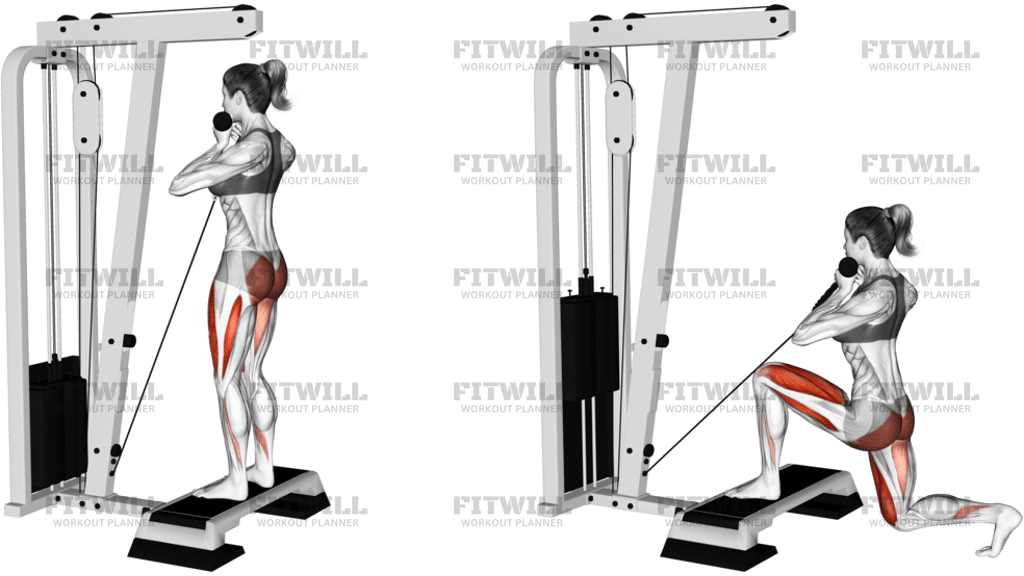
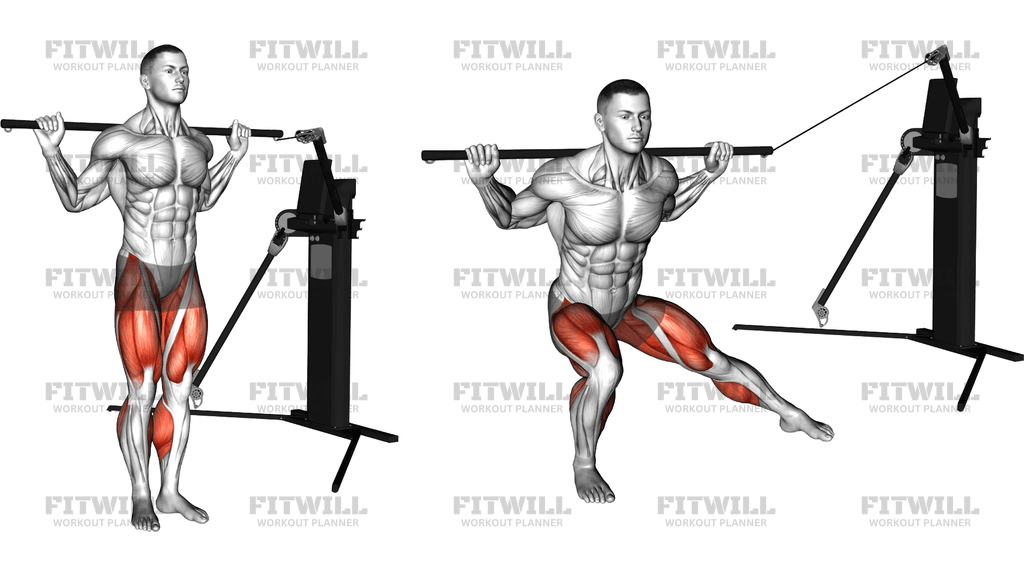
Cable Rear Lunge From Stepbox is a single-leg lower-body exercise that combines a rear lunge with cable resistance and a raised starting position. It is useful when you want to train the legs through a controlled split stance while also challenging balance, torso position, and hip stability. The cable adds a forward pull that makes the front leg work harder to stay upright and organized through the descent.
The stepbox changes the feel of the lunge by giving you a fixed, elevated base for the working leg. That setup can help you get into a cleaner stance and a deeper rear-leg drop without turning the rep into a rushed step-back. It also shifts more of the work into the front leg, especially the quadriceps and glutes, while the core and supporting hip muscles keep the pelvis steady.
Good execution starts before the first rep. The foot on the box should be planted firmly, the handle should stay close to the chest, and the cable should create a controlled line of pull rather than dragging you off balance. From there, the rear leg reaches back and lowers under control until the trailing knee approaches the floor, while the front knee tracks in line with the toes and the torso stays tall.
This exercise is best used for strength work, single-leg accessory training, or lower-body sessions where you want a challenging but measurable lunge pattern. It is especially valuable for lifters who need more balance and control than a free lunge variation provides, because the cable and stepbox make small alignment errors obvious. If the torso folds forward or the front heel lifts, the load is usually too heavy or the box stance is too short.
Cable Rear Lunge From Stepbox can be scaled for beginners with a lighter cable setting and a smaller range of motion, but the setup still needs to be precise. Use a stable box, keep the handle path close to the body, and finish each rep by driving through the front foot to stand tall without bouncing off the back leg. The goal is smooth, repeatable reps that load the working leg without losing control of the pelvis, knee, or trunk.
Fitwill
Log Workouts, Track Progress & Build Strength.
Achieve more with Fitwill: explore over 9600 exercises with images and videos, access built-in and custom workouts, perfect for both gym and home sessions, and see real results.
Start your journey. Download today!




Instructions
- Set a stable stepbox beside a low cable pulley, clip on a single handle, and stand on the box with the working foot planted flat and the handle held at chest height with both hands.
- Keep the cable slightly taut, square your hips, and brace your midsection before you move so the box leg stays stacked over a firm foot.
- Reach the free leg straight back and begin lowering into the rear lunge while the front knee bends and the torso stays tall against the cable's pull.
- Descend until the back knee hovers just above the floor or the box height allows, keeping the front heel down and the front knee tracking over the middle toes.
- Pause briefly in the bottom position without resting on the back knee or letting the cable pull your shoulders forward.
- Press through the front foot and extend the front hip and knee to stand back up on the box under control.
- Keep the handle close to your chest on the way up so the cable stays steady and the torso does not twist toward the pulley.
- Reset your stance at the top, re-brace, and repeat on the same side for the planned reps before switching legs.
Tips & Tricks
- Start with a light cable setting; the forward pull is strongest when you are lowest in the lunge and can make the torso tip if the load is too heavy.
- Keep the handle pinned near the chest so the cable does not turn the rep into a twisting pull across your shoulders.
- If the front heel lifts on the box, shorten the rear step and widen the stance slightly before adding more load.
- Let the back knee travel down rather than backward, which keeps the motion vertical instead of turning it into a long split squat.
- Drive up through the full foot on the box, not just the toes, to keep the front thigh and glute doing the work.
- Stop the descent when the pelvis starts to tuck or the front knee caves inward; both usually mean the stance is too aggressive.
- Keep your ribcage stacked over your pelvis so the cable does not pull you into a leaned-forward torso.
- Use a steady tempo on the way down; dropping fast makes the stepbox lunge feel unstable and reduces control at the bottom.
Frequently Asked Questions
What muscles does Cable Rear Lunge From Stepbox work most?
It primarily loads the quads and glutes on the front leg, with the hamstrings, adductors, and core helping you stay stable on the box.
Is Cable Rear Lunge From Stepbox good for beginners?
Yes, if the cable is light and the box is stable. Beginners should use a shorter range at first and keep the handle close to the chest.
Why use a stepbox instead of doing a normal rear lunge?
The box gives you a fixed elevated base and makes the front leg do more of the work. It also helps keep the rep consistent from side to side.
Should the handle stay in front of my chest or move with my body?
Keep it close to the chest and move as one unit. Letting the handle drift away makes the cable pull your torso forward and can rotate the shoulders.
How low should I go in the rear lunge?
Lower until the back knee is just above the floor or the box height limits the range, while keeping the front heel down and the knee tracking cleanly.
What is the most common mistake on Cable Rear Lunge From Stepbox?
Leaning forward into the cable is the biggest issue. If your torso tips, reduce the load and keep your ribs stacked over your hips.
Can I use this exercise as a glute movement?
Yes, but it is still a quad-dominant lunge variation for most people. The glutes help most as you drive up through the front foot.
What should I do if the box feels unstable during the rep?
Use a lower, sturdier stepbox and reset the foot position before each rep. If the box shifts or wobbles, the setup is too unstable for loaded lunges.