Kettlebell Kneeling One-Arm Shoulder Press
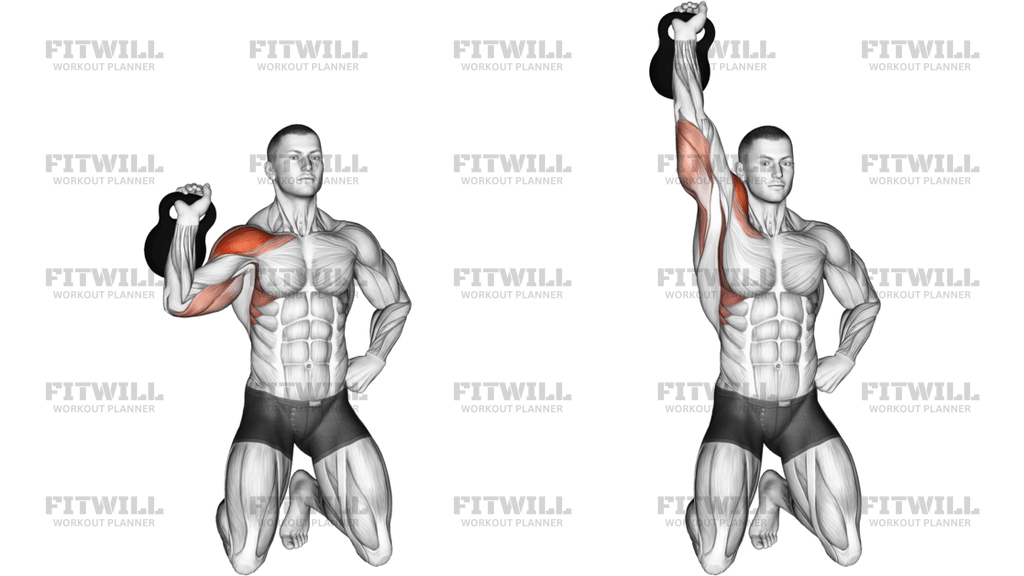
Kettlebell Kneeling One-Arm Shoulder Press is a half-kneeling overhead press that builds shoulder strength while forcing the torso to stay stacked and still. Because one knee is on the floor, you cannot rely on leg drive or a big back lean to move the bell. That makes it useful for lifters who want cleaner pressing mechanics, better rib control, and a stronger connection between the shoulders and trunk.
The main work comes from the delts, with the triceps finishing the press and the upper back helping keep the shoulder stable as the kettlebell moves overhead. The kneeling position also asks the core and glutes to stay organized so the pelvis does not tip forward or twist under load. In practice, that means the exercise can expose side-to-side differences very quickly, which is one reason it is popular in accessory work and warmups for overhead training.
Set the bell in the rack at shoulder height before the first rep, with the forearm vertical and the wrist neutral instead of bent back. Stack the ribs over the pelvis, squeeze the glute on the kneeling side, and keep the front foot flat so the body does not drift forward as the press starts. The better the setup, the less the torso has to compensate when the kettlebell leaves the shoulder.
Press the kettlebell in a smooth line until the arm is straight and the biceps finish close to the ear, then lower it under control back to the rack. A clean rep should feel like the shoulder is moving the bell while the torso stays tall and quiet, not like the body is throwing the weight upward. Exhale as you press, inhale as you lower, and reset the rack position before the next repetition instead of bouncing straight into it.
Kettlebell Kneeling One-Arm Shoulder Press works well as a strength accessory, a shoulder stability drill, or a controlled unilateral press on upper-body days. It can also be a useful variation for beginners learning overhead position because the kneeling stance removes a lot of momentum and makes compensation easier to spot. Keep the load modest, stop the set if you start leaning away from the bell, and use the movement to build repeatable overhead control rather than chasing the heaviest weight possible.
[ Workout Log & Planner ]
Put your next workout in Fitwill
Keep your plan and training log ready when you are.


Instructions
- Drop into a half-kneeling stance with one knee on the floor, the other foot planted in front, and the torso tall.
- Hold the kettlebell in one hand at shoulder height with the forearm vertical and the bell resting in the rack position.
- Square the hips and ribs forward, then squeeze the glute on the kneeling side so the lower back stays neutral.
- Brace your abs and keep the free hand on your hip or held out for balance without twisting the torso.
- Press the kettlebell overhead in a smooth line until the elbow reaches full extension and the biceps finish near the ear.
- Keep the shoulder from shrugging up as the bell passes your forehead, and avoid leaning away from the working arm.
- Lower the kettlebell slowly back to the shoulder, letting the elbow return under the wrist instead of dropping forward.
- Reset the rack position before the next rep, then complete all reps on one side before switching sides.
Tips & Tricks
- If your lower back arches as the bell leaves the shoulder, squeeze the kneeling-side glute harder and bring the ribs back over the pelvis.
- Keep the kettlebell deep in the palm instead of letting it roll onto the fingertips, especially at the rack position.
- A stacked wrist and forearm should look almost straight from elbow to knuckles; if the wrist bends back, the load is probably too heavy.
- Press slightly back so the bell finishes over the shoulder, not out in front of the face.
- The free hand can stay on the hip to help you feel rotation; if the torso turns, the load is drifting too far from your control.
- Use a brief pause in the rack to remove bounce and make each rep start from a dead stop.
- Stop the set when the bell starts to chase your head or you have to lean away from it to finish the press.
- Half-kneeling makes asymmetries obvious, so begin with the weaker side and match the stronger side to that same rep quality.
Frequently Asked Questions
What does Kettlebell Kneeling One-Arm Shoulder Press train most?
It mainly trains the shoulders, especially the delts, with the triceps and upper back helping stabilize and finish each rep.
Why use the half-kneeling position for Kettlebell Kneeling One-Arm Shoulder Press?
The half-kneeling stance reduces leg drive and makes it easier to keep the ribs and pelvis stacked while you press overhead.
Which knee should be on the floor?
Either side can work, but the key is to keep one knee down, the other foot planted, and the torso square without twisting.
How should the kettlebell sit before I press?
Start with the bell in the rack at shoulder height, forearm vertical, wrist neutral, and the handle resting securely in the palm.
Is Kettlebell Kneeling One-Arm Shoulder Press good for beginners?
Yes, if the load is light enough to keep the torso still. The kneeling setup is often easier to learn than a standing one-arm press because it limits momentum.
What is the most common mistake with this press?
Leaning back or rotating the torso to help the kettlebell overhead is the biggest issue. Keep the ribs down and press with the shoulder instead.
How heavy should I go on Kettlebell Kneeling One-Arm Shoulder Press?
Choose a weight you can press for smooth reps without wrist collapse, shoulder shrugging, or a big arch in the lower back.
Can I use a dumbbell instead of a kettlebell?
Yes, a dumbbell can work well if you want a similar single-arm overhead press, though the kettlebell rack position gives more feedback about shoulder and wrist control.