Scapular Slide Back To Wall
Scapular Slide Back to Wall is a standing wall drill for shoulder control, scapular upward rotation, and postural awareness. You set your back against the wall, organize your ribs and pelvis, then slide the arms from a bent, goalpost-like position into a higher Y without losing the wall contact that keeps the movement honest. It looks simple, but the exercise asks the shoulder blades to rotate and glide smoothly while the torso stays quiet.
The biggest training value comes from how precisely you can keep the body stacked. When the low back arches or the ribs flare, the arms usually travel farther than the shoulder can control. When the head, rib cage, and pelvis stay aligned, the scapulae can move on the rib cage instead of being pinned by compensations. That makes the drill useful for warm-ups, shoulder-prep work, overhead training preparation, and accessory sessions focused on cleaner mechanics.
This movement usually emphasizes the serratus anterior, lower trapezius, and the muscles that help the shoulder blades rotate upward and stay centered on the ribs. The rear delt, rotator cuff, and upper back assist, but they should not dominate the rep. The point is not to force a big stretch or crank the hands overhead. The point is to find a smooth, repeatable path where the arms lift because the shoulder blades are doing their job.
Use a range you can control while keeping the forearms, elbows, or hands as close to the wall as your mobility allows. If the shoulders pinch, the neck tightens, or the low back starts arching, shorten the range and slow the slide down. Performed well, Scapular Slide Back to Wall is a low-load corrective-style exercise that helps teach better overhead positioning and cleaner scapular motion before pressing, pulling, or sports work.
[ Workout Log & Planner ]
Put your next workout in Fitwill
Keep your plan and training log ready when you are.


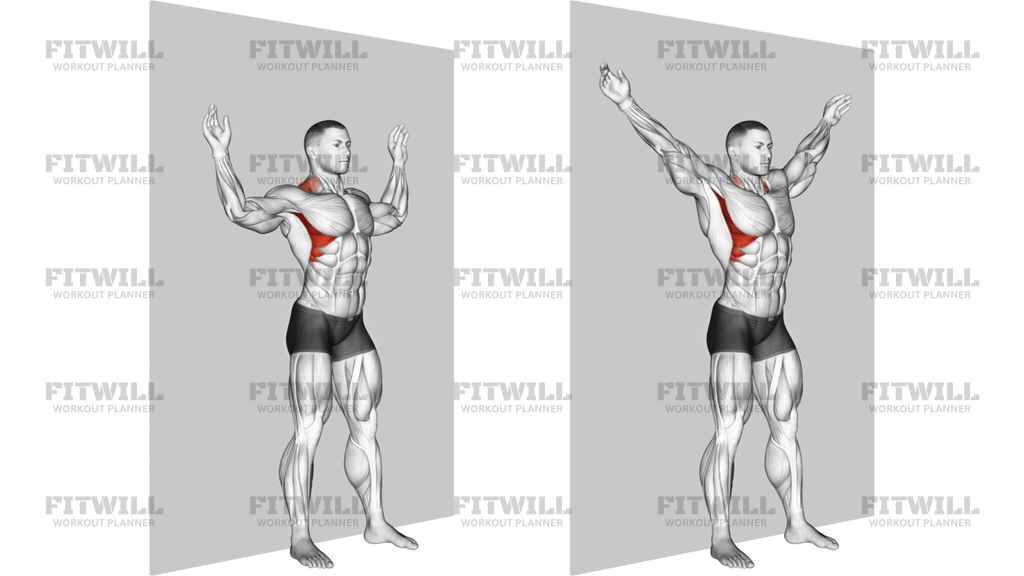
Instructions
- Stand with your back, head, and pelvis against a wall, feet a short step forward, and your elbows bent about 90 degrees in a goalpost position.
- Set your forearms, wrists, or the backs of your hands against the wall as close as your mobility allows without shrugging.
- Exhale and tuck the ribs down so the lower back stays gently supported instead of arching away from the wall.
- Keep the shoulders relaxed and slide the arms upward, letting the shoulder blades rotate and glide as the elbows move higher.
- Bring the hands toward an overhead Y position only as far as you can keep the torso quiet and the neck long.
- Pause for a beat at the top while keeping the wall contact and the rib cage stacked over the pelvis.
- Lower the arms back to the starting goalpost position under control, keeping the same contact points and posture.
- Breathe out on the slide up and breathe in as you return to the start.
- Repeat for the planned reps, stopping the set if the back starts to arch or the shoulders lose control.
Tips & Tricks
- If your wrists leave the wall immediately, move the feet a little farther forward and shorten the range before chasing overhead height.
- Keep the chin gently tucked so the neck does not jut forward as the arms rise.
- Think about sliding the shoulder blades up and around the rib cage instead of pressing the hands harder into the wall.
- Do not let the ribs flare to fake extra range; the rep should come from the shoulders, not a low-back arch.
- A slower top half usually reveals whether the lower traps and serratus are actually controlling the slide.
- If one arm tracks worse than the other, use the weaker side as the limiter and match the cleaner side to it.
- Stop the set when the elbows start drifting far forward and the upper traps take over.
- This works best with body weight only; adding speed or resistance usually defeats the purpose of the drill.
Frequently Asked Questions
What does Scapular Slide Back to Wall train most?
It mainly trains scapular control for overhead motion, especially the serratus anterior and lower trapezius, with the rotator cuff and upper back assisting.
Should my back stay on the wall the whole time?
Yes. Keep the head, rib cage, and pelvis stacked against the wall so the movement comes from the shoulders instead of a back arch.
Should my forearms or hands stay on the wall?
Keep whichever contact points your mobility allows: forearms, wrists, or the backs of the hands. The goal is consistent wall contact without shrugging.
Why does my lower back arch when I raise my arms?
That usually means the ribs are flaring and the shoulders are running out of usable range. Move the feet slightly forward, reduce the height, and keep the exhale active.
Can beginners do this safely?
Yes. It is usually a beginner-friendly drill as long as the range stays small enough to avoid neck tension, shrugging, or back extension.
What should I do if the shoulders pinch overhead?
Shorten the slide and keep the arms in the pain-free zone. The exercise should feel like smooth shoulder-blade motion, not a forced stretch.
What is the most common mistake on this exercise?
The usual mistake is turning it into a low-back arch or a shrug. The torso should stay quiet while the shoulder blades do the work.
Where does this fit in a workout?
It works well in a warm-up, shoulder-prep block, or accessory session before pressing, overhead work, or throwing drills.