Resistance Band Foot Inversion
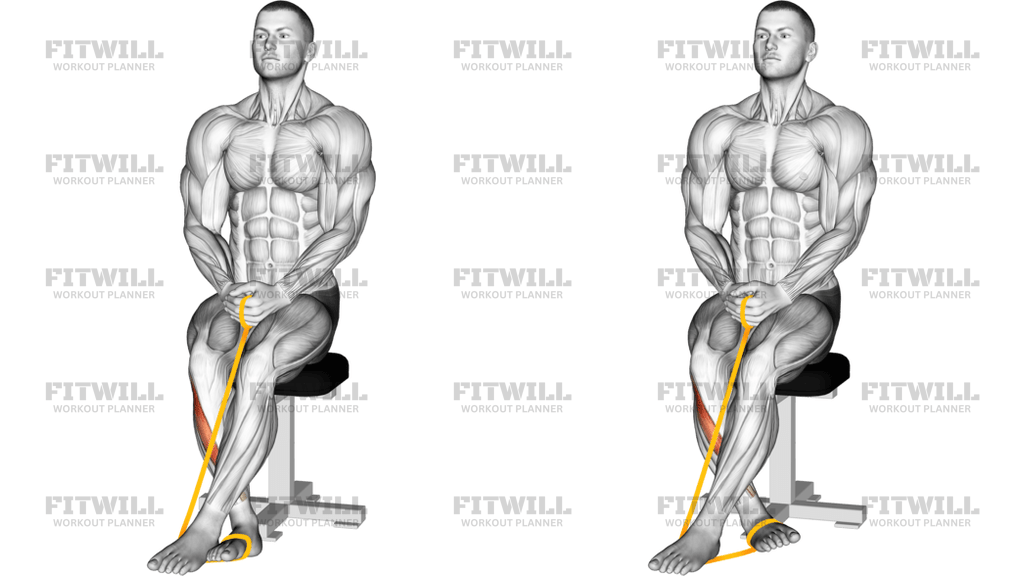
Resistance Band Foot Inversion is a seated ankle exercise that trains the small muscles responsible for turning the sole inward and helping the foot stay controlled under load. In practice, it is less about big visible movement and more about clean ankle motion, steady band tension, and keeping the rest of the leg quiet while the foot works through the range.
The image shows a seated setup on a bench with the band looped around the forefoot and the hands helping maintain tension. That setup matters because it lets you isolate the ankle instead of swinging the whole leg. The working leg should stay long and relaxed enough to move freely, while the heel remains planted or lightly supported so the motion comes from the foot and ankle rather than the knee or hip.
The goal of each repetition is to draw the forefoot inward against the pull of the band, then return slowly to the start without letting the band snap the foot open. That controlled inward path is what makes the exercise useful for lower-leg strength, ankle stability, and foot control. If the band is too heavy or the setup is awkward, the movement turns into a twist of the whole leg instead of a true inversion pattern.
This exercise is useful as accessory work, rehab-style control work, or a warm-up before running, cutting, jumping, or lower-body lifting. It can also be paired with ankle eversion, calf work, or balance drills to build a more complete lower-leg routine. The best reps are smooth, symmetrical, and pain-free, with the ankle doing the work and the torso staying tall.
Treat resistance and range conservatively. Light tension and precise control usually produce better results than chasing a bigger band or forcing extra motion. If you feel cramping in the foot or the band is pulling your body out of position, reduce the load and shorten the range until the movement stays clean.
Fitwill
Log Workouts, Track Progress & Build Strength.
Achieve more with Fitwill: explore over 9600 exercises with images and videos, access built-in and custom workouts, perfect for both gym and home sessions, and see real results.
Start your journey. Download today!




Instructions
- Sit tall on a bench and loop the band around the forefoot of the working foot, keeping the hands on the band so it stays under light tension.
- Set the heel down and let the ankle start near neutral or slightly turned outward so the foot has room to invert.
- Keep the thigh, knee, and hip still while the lower leg stays relaxed and long.
- Draw the forefoot inward against the band, bringing the sole toward the midline without twisting the whole leg.
- Pause briefly at the top of the inversion when you feel the foot working, not the hip.
- Lower the foot back to the start slowly and keep tension on the band instead of letting it go slack.
- Breathe out as you pull inward and inhale as you return.
- Complete all reps on one side before switching feet.
Tips & Tricks
- Keep the heel planted so the motion stays at the ankle instead of turning into a hip rotation.
- Use a light band first; this exercise should feel precise before it feels hard.
- Do not curl the toes to fake extra range, because that shifts work away from the inversion muscles.
- Hold the band just tight enough to keep it from slipping off the forefoot, but not so tight that the setup pulls your shoulders forward.
- Move slowly on the way back to the start; the return phase is where a lot of the control work happens.
- If the outside of the lower leg cramps, shorten the range and reduce band tension.
- Keep the knee pointing forward so the leg does not drift into a twisting pattern.
- Stop the set if the ankle pinches or if the foot rolls so far that the arch collapses.
Frequently Asked Questions
What does Resistance Band Foot Inversion train?
It trains the muscles that pull the sole of the foot inward and help control ankle position, along with the smaller stabilizers around the lower leg.
Should I feel this more in the foot or the lower leg?
You should usually feel it around the ankle, the inner or lower shin area, and the supporting muscles around the foot rather than in the hip.
Can beginners do this exercise?
Yes. It is best started with very light band tension so you can learn the path and keep the ankle from twisting.
What is the most common mistake with the band setup?
The band is often too tight or too loosely placed on the forefoot, which makes the foot slip or turns the movement into a whole-leg rotation.
How many repetitions should I use?
This exercise usually works well in moderate to higher reps because it is a small-range control movement, not a maximal strength lift.
Is it okay if my toes move a little?
A small amount of toe movement is normal, but the main action should come from the ankle rather than from gripping the band with your toes.
Where does this fit in a workout?
It fits well in a warm-up, rehab-style block, ankle-prep session, or lower-body accessory circuit.
How do I progress Resistance Band Foot Inversion?
Progress by using a slightly stronger band, slowing the lowering phase, or adding a short pause at the top while keeping the ankle path clean.