Band Lying Leg Curl
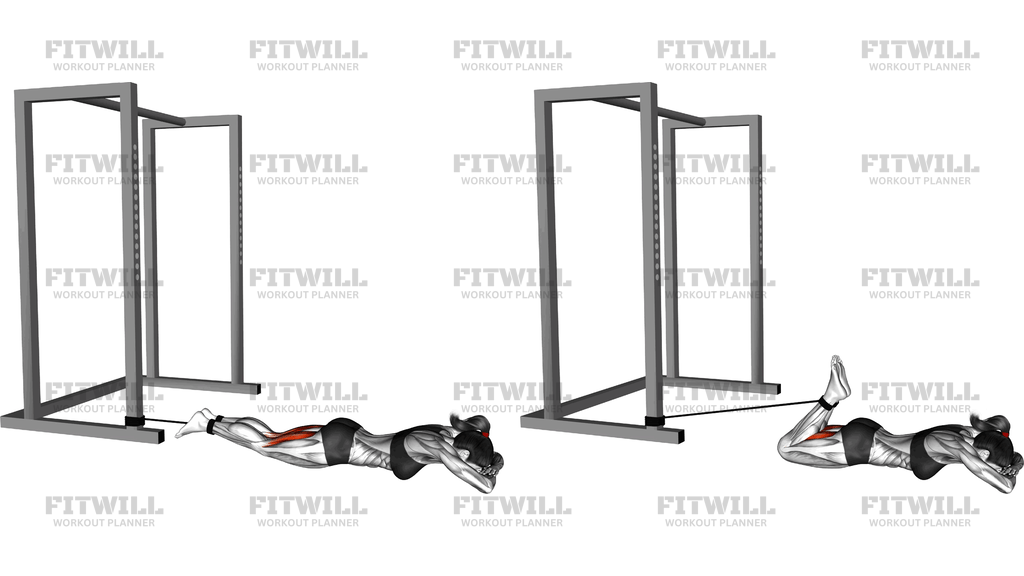
Band Lying Leg Curl is a prone hamstring curl done with a resistance band anchored low in front of the bench and looped around the ankles. The image shows the lifter lying face down with the thighs supported on the bench, the knees starting almost straight, and the heels curling up toward the glutes against the band tension. That setup matters because it fixes the line of pull: the band wants to straighten the knees, so the hamstrings have to control both the curl and the return.
This exercise is a direct knee-flexion hamstring movement. It trains the hamstrings to shorten hard at the top of the rep and to resist the band on the way back down. The glutes, calves, and trunk help stabilize the pelvis, but the set should feel like the back of the thighs is doing the work. If the hips drift off the bench or the lower back starts to arch, the band is usually too heavy or the range of motion is too aggressive.
A clean rep starts before the knees move. Lie prone with the hips close to the bench edge, keep the pelvis level, and set the band so it stays centered on both ankles. From there, curl the heels upward by bending the knees only. Keep the thighs in contact with the bench, pause when the knees are fully bent, and avoid kicking the feet or using momentum to get higher.
On the way down, lower the legs slowly until the knees are nearly straight again while keeping tension in the band. The return should feel deliberate rather than relaxed, because that eccentric phase is where a lot of the training stimulus comes from. Breathe out as you curl and breathe in as you lower, but keep the torso quiet the entire time.
Band Lying Leg Curl is useful as an accessory exercise, a hamstring finisher, or a lower-load option when machines are unavailable. It is also a practical choice for home training because the resistance can be scaled by changing band thickness, anchor distance, or tempo. Keep the movement pain-free, stop short of any hip lift or low-back strain, and use the smallest range that still lets you feel the hamstrings contract cleanly.
[ Workout Log & Planner ]
Put your next workout in Fitwill
Keep your plan and training log ready when you are.


Instructions
- Anchor the band low in front of the bench and loop it around both ankles.
- Lie face down on a flat bench with your hips close to the edge and your legs hanging free behind you.
- Keep your thighs pressed into the bench, set your pelvis level, and brace your trunk so your low back stays still.
- Start with your knees almost straight and the band already under light tension.
- Curl your heels toward your glutes by bending only at the knees.
- Keep your hips down and your thighs on the bench as you lift.
- Squeeze at the top for a brief pause without kicking or swinging.
- Lower your feet slowly until your legs are almost straight again, then repeat for the planned reps.
Tips & Tricks
- Keep the movement at the knee joint; if your hips lift, the band is overpowering the curl.
- Place the bench so your knees can bend freely off the edge instead of getting blocked by the padding.
- Center the band on both ankles before each set so one leg does not take more tension than the other.
- Use a band that lets you control the final third of the lowering phase without snapping back.
- A brief pause near full knee bend makes the hamstrings work harder without needing extra speed.
- Do not chase a bigger range if your pelvis tilts or your lower back arches at the top.
- If the band pulls your feet outward, reset the anchor and keep the ankles parallel.
- Slow eccentrics are useful here; the return should look as controlled as the curl.
Frequently Asked Questions
What muscle does Band Lying Leg Curl target most?
The hamstrings are the main target because the exercise is driven by knee flexion against band resistance.
Can beginners perform this exercise?
Yes. Beginners can start with a light band, a short range, and a slow lowering phase until they can keep the hips down.
Where should the band be anchored for this version?
Anchor it low in front of the bench so the band pulls the ankles toward extension as you curl the heels up.
Why do my hips keep lifting off the bench?
That usually means the band is too heavy, the range is too big, or you are trying to finish the rep by arching the low back.
Should my feet stay pointed or flexed?
A neutral ankle is fine. Slightly flexing the feet can help you feel the hamstrings more clearly if it does not cramp the calves.
Can I do this one leg at a time?
Yes, a single-leg version is a good way to match sides and make the set harder if the anchor and band setup allow it.
What is the main form cue to remember?
Keep your thighs on the bench and bend only at the knees so the hamstrings do the work instead of momentum.
How can I make the exercise harder without changing bands?
Slow the lowering phase, add a pause at the top, or start from a slightly farther anchor point to increase tension.