Right Hook Boxing
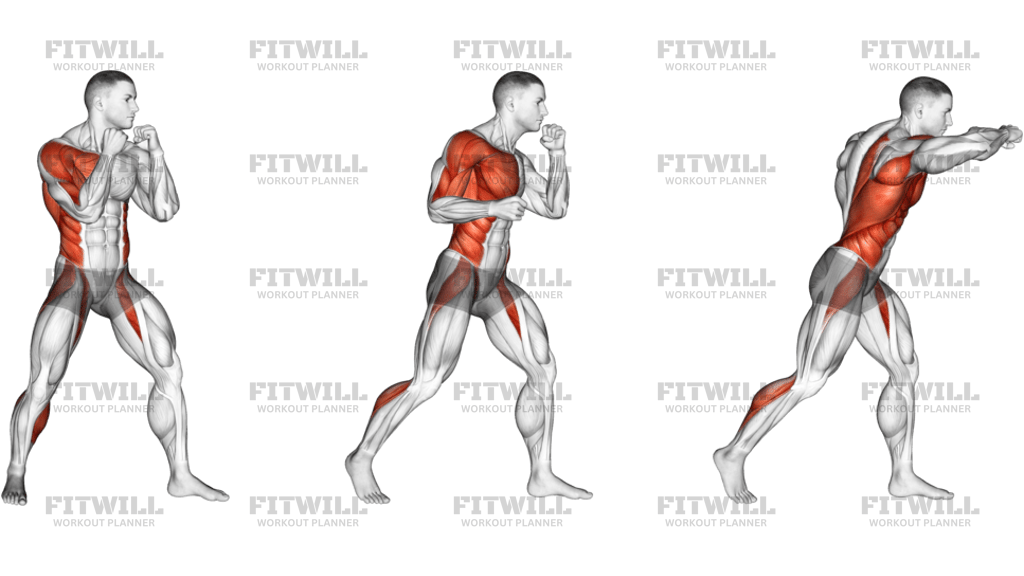
Right Hook Boxing is a rotational punching drill built around a compact hook path, a stable stance, and a fast return to guard. The punch is not just an arm swing; it starts from the floor, travels through the hips and torso, and finishes with the fist and shoulder lined up at about chin or shoulder height. The image shows the rear hand driving across the body while the other hand stays near the face, which is the key to keeping the punch sharp and balanced.
This movement trains boxing coordination, trunk rotation, shoulder control, and the ability to transfer force through the whole kinetic chain. The main work comes from the legs and hips creating the turn, the obliques and core controlling the torso, and the shoulder and arm delivering the hook without letting the elbow collapse or the wrist fold. It is useful for shadowboxing, mitt work, bag work, or any conditioning round where you want a clean, repeatable right-side hook.
The setup matters because a hook becomes sloppy as soon as the stance is too narrow, the chin lifts, or the torso overreaches. Start in a staggered boxing stance with soft knees, weight centered enough to pivot, and the non-punching hand high for protection. Keep your chin tucked behind the lead shoulder, load the right side just enough to create tension, and let the rear foot and hip turn together so the punch has drive instead of being thrown only from the arm.
On each rep, keep the hook short and level. Turn the rear hip, let the elbow travel on a compact horizontal arc, and rotate the fist through the target line without reaching past your own shoulder. Exhale as the punch lands or snaps to the end of the path, then pull the hand straight back to guard before the next rep. The best repetitions feel snappy, balanced, and controlled, with no lunging, no wild swing, and no loss of posture on the return.
Use this exercise when you want better striking mechanics, rotational power, or boxing-specific conditioning. It works well in warm-ups, technique rounds, intervals, and light power work, especially when you are practicing clean mechanics instead of chasing fatigue. Beginners can use it as a slow shadowboxing drill first, then add speed, volume, or external resistance only after the stance, guard, and punch path stay consistent.
Fitwill
Log Workouts, Track Progress & Build Strength.
Achieve more with Fitwill: explore over 9600 exercises with images and videos, access built-in and custom workouts, perfect for both gym and home sessions, and see real results.
Start your journey. Download today!




Instructions
- Stand in a staggered boxing stance with your knees soft, chin tucked, and both hands up at cheek level.
- Keep your right elbow bent and load a little tension into the right hip and shoulder without leaning forward.
- Press the lead foot into the floor and begin the punch by turning the rear foot, knee, and hip together.
- Swing the right fist across your body on a short horizontal arc at about chin or shoulder height.
- Keep the wrist straight and the knuckles stacked so the punch stays aligned through the target line.
- Hold the opposite hand tight to your face while the punching shoulder rolls slightly forward at the end.
- Do not overreach past your own shoulder; finish compact and balanced instead of long and loose.
- Exhale sharply as the hook snaps out, then pull the right hand straight back to guard under control.
- Reset your stance before the next rep and repeat for the planned number of punches.
Tips & Tricks
- Think of the hook as a hip turn first and an arm action second.
- Keep the punching elbow bent; a straight-arm swing turns the hook into a wild slap.
- Pivot the rear foot with the hip so the knee does not twist awkwardly in place.
- Aim for a short, level path instead of looping the fist around in a big circle.
- Keep the non-punching hand glued to your face to protect the jaw and keep your torso stacked.
- If your shoulder takes over, shorten the punch and feel more rotation through the ribs and hips.
- Stay tall through the torso; bending at the waist usually robs the punch of power.
- Use a crisp exhale on each rep so the trunk can brace and relax in the right places.
- Practice slowly in shadowboxing before adding speed, mitts, or bag impact.
- Stop the set if the hook starts drifting high, the chin lifts, or your balance shifts onto the front foot.
Frequently Asked Questions
What does a right hook train the most?
It trains boxing-specific rotation, with the hips, obliques, shoulders, and upper back helping deliver and control the punch.
Is the right hook supposed to come from the arm or the body?
The body should drive it. The hip turns first, the torso follows, and the arm simply guides the compact hook path.
Do I need a heavy bag to do this exercise?
No. Shadowboxing works well for technique, and mitts or a bag are optional if you want impact feedback.
How far should the right hand travel?
Only far enough to reach a compact hook at chin or shoulder height. A long looping swing usually loses speed and balance.
Which foot should pivot on the punch?
The rear foot pivots with the hip so the lower body can turn smoothly and the knee stays aligned.
Can beginners learn the right hook safely?
Yes, if they start slowly, keep the guard high, and practice the punch in shadowboxing before adding speed or load.
What is the most common form mistake?
Leaning forward, swinging too wide, or letting the opposite hand drop are the biggest problems.
What should I feel if the hook is done well?
You should feel a sharp turn through the hips and ribs, with the shoulder finishing the punch rather than powering it alone.