Lying Upper Body Rotation
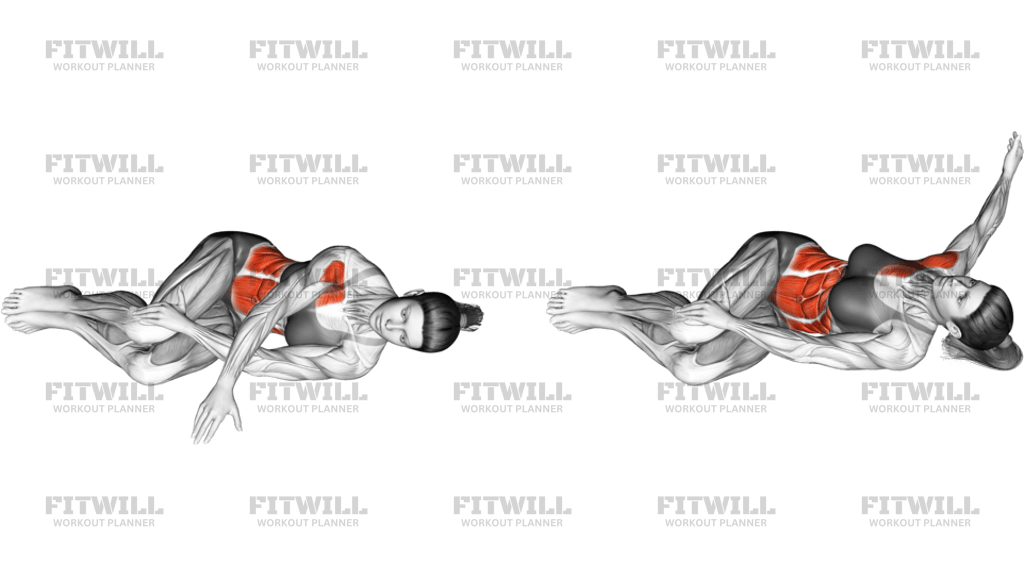
Lying Upper Body Rotation is a floor-based rotation drill that opens the chest, upper back, and shoulders while asking the trunk to stay organized. The position is simple, but the value comes from how cleanly you rotate from a closed side-lying posture into a wide, open chest position without letting the hips roll with the torso. For many lifters it works well as a warm-up, mobility drill, or light accessory movement before pressing, pulling, or overhead work.
The main purpose of Lying Upper Body Rotation is to restore or train rotational control through the ribcage and thoracic spine. The movement also asks the obliques, deep core, and shoulder stabilizers to guide the motion so the arm sweep feels smooth instead of forced. When the setup is right, you should feel the front of the chest, the side of the torso, and the upper back lengthen and contract in a controlled way.
Start by lying on your side with your knees bent, feet together, and the lower body stacked so the hips stay quiet. The top arm crosses the body first, then opens in a wide arc as the chest turns away from the floor. That sequencing matters: the pelvis should stay mostly in place while the ribcage and shoulders do the turning, which keeps the repetition focused on upper-body rotation rather than a full-body roll.
The exercise is best performed slowly enough that you can breathe into the opening position and return without snapping back. A smooth exhale as the chest opens usually helps the ribcage rotate a little farther while keeping the neck and lower back relaxed. If the opening position feels cramped, shorten the range and keep the knees stacked until the torso can move cleanly from rep to rep.
Use Lying Upper Body Rotation when you want a low-load movement that improves rotational awareness and shoulder-friendly chest opening without requiring equipment. It is especially useful before pressing sessions, after long periods of sitting, or whenever the upper back feels stiff and the trunk has lost easy rotation. Treat it like a precision drill: the best reps are quiet, controlled, and repeatable rather than big, fast, or forced.
[ Workout Log & Planner ]
Put your next workout in Fitwill
Keep your plan and training log ready when you are.


Instructions
- Lie on one side on the floor with your knees bent, feet together, and your hips stacked one on top of the other.
- Keep your lower arm resting in front of your chest and place the top hand across your torso to start the rotation closed.
- Draw your ribs down lightly so your lower back does not twist before the upper body moves.
- Keep your knees and feet together as you let the top shoulder and arm sweep open in a wide arc behind you.
- Turn your chest toward the ceiling while keeping the hips mostly still and the head following the shoulder, not leading the movement.
- Pause briefly in the open position and feel the chest and upper back finish the rotation without pinching the lower back.
- Exhale as you open and inhale as you bring the top arm back across your body.
- Return slowly to the starting side-lying position, then reset the ribs and shoulders before the next repetition.
- Repeat for the planned reps, then roll to the other side if the program calls for both sides.
Tips & Tricks
- Keep the knees stacked; if they separate, the pelvis is starting the rotation instead of the ribcage.
- A small exhale at the open position usually helps the chest turn farther without forcing the lower back.
- If the shoulder feels crowded, bend the top elbow a little more so the arm can arc without scraping the floor.
- Do not chase a huge reach behind you; the cleanest rep is the one that keeps the hips quiet and the chest open.
- Move slowly enough that you can feel the ribs, not just the arm, doing the work.
- If the floor blocks your range, stop when the shoulder blade starts to shrug or the neck starts to tense.
- Keep the head relaxed and let it follow the torso instead of cranking it independently.
- On tighter days, reduce the rotation range and keep the feet glued together for better control.
- This works better as a controlled mobility drill than as a fast conditioning movement.
Frequently Asked Questions
What does Lying Upper Body Rotation work?
It mainly trains thoracic rotation and chest opening, with the obliques, core stabilizers, and shoulder muscles helping control the turn.
Why are the knees bent in Lying Upper Body Rotation?
Bent knees help lock the lower body into place so the movement comes from the ribcage and shoulders instead of the hips.
How far should I open the top arm in Lying Upper Body Rotation?
Open only until the chest turns comfortably and the lower back stays quiet. A smaller range with clean rotation is better than forcing the hand to the floor.
Should my hips move during Lying Upper Body Rotation?
They should stay mostly stacked and quiet. A little natural shift is fine, but the pelvis should not roll fully with the upper body.
Is Lying Upper Body Rotation good before pressing workouts?
Yes. It can help wake up the chest, upper back, and shoulder rotation before benching or overhead pressing, especially if you feel stiff through the torso.
Can beginners do Lying Upper Body Rotation?
Yes. It is a good beginner-friendly mobility drill because it uses body weight and teaches controlled trunk rotation without heavy loading.
What is the most common mistake in Lying Upper Body Rotation?
Letting the hips and lower back twist first. Keep the knees together and let the chest and shoulder open before anything else moves.
Do I need equipment for Lying Upper Body Rotation?
No. The floor is enough, which makes it easy to use as a warm-up, reset drill, or recovery movement anywhere.