V-Sit On Floor
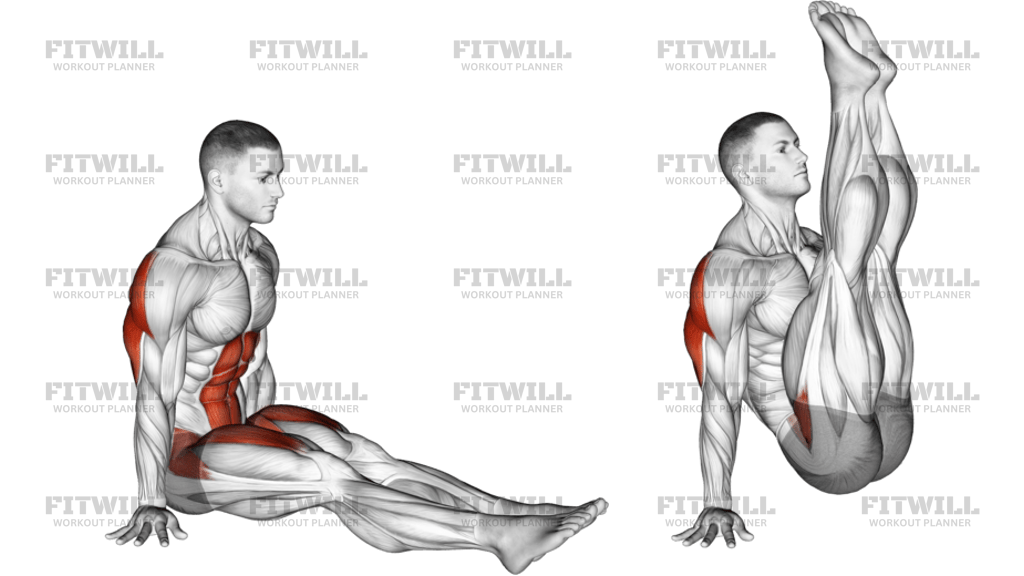
V-Sit On Floor is a bodyweight core exercise built around a seated compression lift from the floor. You start with your hands braced behind you and your legs extended forward, then raise the torso and legs together until the body forms a controlled V shape. The movement asks for more than abdominal strength alone: the hip flexors, lower abs, shoulders, and triceps all help keep the position organized while the spine stays long.
The exercise is useful when you want direct work on trunk flexion control, hip compression, and coordinated midline strength. It also exposes weak links quickly. If the hips are tight, the hamstrings will try to pull the pelvis under you; if the abs and hip flexors cannot coordinate, the lower back will round and the lift becomes a flop instead of a controlled raise.
The setup matters because the hands, hips, and shoulder position determine how much of your bodyweight the core has to manage. Sit tall on the floor with the palms slightly behind the hips, fingers pointed out or back for support, and the legs straight or slightly bent if needed. Press the floor away, keep the chest open, and start each rep from a braced seated position instead of collapsing into the shoulders.
As you lift, exhale and bring the legs and torso toward each other without yanking through momentum. The goal is a clean compression at the top, not a huge swing. Keep the neck relaxed, the ribs from flaring, and the shoulder blades stable while the hands stay planted. Lower under control so the torso and legs return together rather than dropping separately.
V-Sit On Floor fits well in a core block, gymnastic-style conditioning work, or accessory training when you want more than a simple plank. It can be scaled by bending the knees, shortening the range, or keeping the feet closer to the floor on the way up. Done well, it teaches body control that carries over to hanging raises, hollow-body work, and other exercises that demand strong trunk positioning.
[ Workout Log & Planner ]
Put your next workout in Fitwill
Keep your plan and training log ready when you are.


Instructions
- Sit on the floor with your legs straight in front of you and place your hands slightly behind your hips for support.
- Turn your fingers slightly outward or back, then press your palms into the floor so your shoulders stay lifted and stable.
- Lengthen through your spine, keep your chest open, and set your torso tall before you initiate the lift.
- Brace your abs and lightly shift weight into your hands so you are ready to move without collapsing backward.
- Exhale as you lift your legs and upper body together toward a V shape, keeping the movement smooth and controlled.
- Squeeze through the midline at the top without shrugging your shoulders or rounding your lower back.
- Lower your torso and legs together under control until your heels are close to the floor or you return to the seated start.
- Reset your hands, re-brace, and repeat for the planned number of reps.
Tips & Tricks
- If your hamstrings pull your pelvis under you, keep a soft bend in the knees instead of forcing straight legs.
- Place your hands close enough behind you that you can support your body without dumping all the load into the shoulders.
- Keep the ribs from flaring up at the top; the lift should come from the abs and hip flexors, not from arching the lower back.
- A short pause at the top is better than kicking the legs higher with momentum.
- If the shoulders shrug, slide the hands a little farther back and press the floor away more firmly.
- Lower the legs and torso together; dropping the feet first usually means the core is losing the compression position.
- Use a smaller range before you try to straighten the legs fully.
- Breathe out through the lift and inhale as you lower so the trunk stays braced without holding your breath too long.
Frequently Asked Questions
What muscles does V-Sit On Floor work most?
It mainly trains the abs and hip flexors, with the shoulders and triceps helping support your body on the floor.
Is V-Sit On Floor good for beginners?
Yes, but many beginners need bent knees or a shorter lift at first. That keeps the low back from rounding while they build compression strength.
Should my legs stay straight during V-Sit On Floor?
Straight legs are the classic version, but a slight knee bend is fine if your hamstrings are tight. The important part is keeping the lift controlled.
Why do my lower back and hips feel it so much?
That usually means the hip flexors and abs are working hard to compress the body. If the feeling turns into a pinch, reduce the range and bend the knees a little.
How high should I lift in the V position?
Lift only as high as you can while keeping the torso and legs moving together. A clean, smaller V is better than a bigger shape with momentum.
Why do my shoulders get tired during this exercise?
Your shoulders are supporting part of your bodyweight through the hands. Keep the palms planted, press the floor away, and avoid sinking into the shoulders.
What is a common mistake in V-Sit On Floor?
The most common mistake is swinging the legs up and losing the compression shape. If that happens, slow the rep down and shorten the range.
Can I use V-Sit On Floor as part of a core workout?
Yes. It works well in a core block after warm-up work, especially when you want an exercise that combines ab strength with body control.
How many reps should I do on V-Sit On Floor?
Use 6-12 controlled reps or short holds of about 10-20 seconds, depending on the workout. Stop the set when you can no longer keep the torso and legs moving together.