Warrior Pose
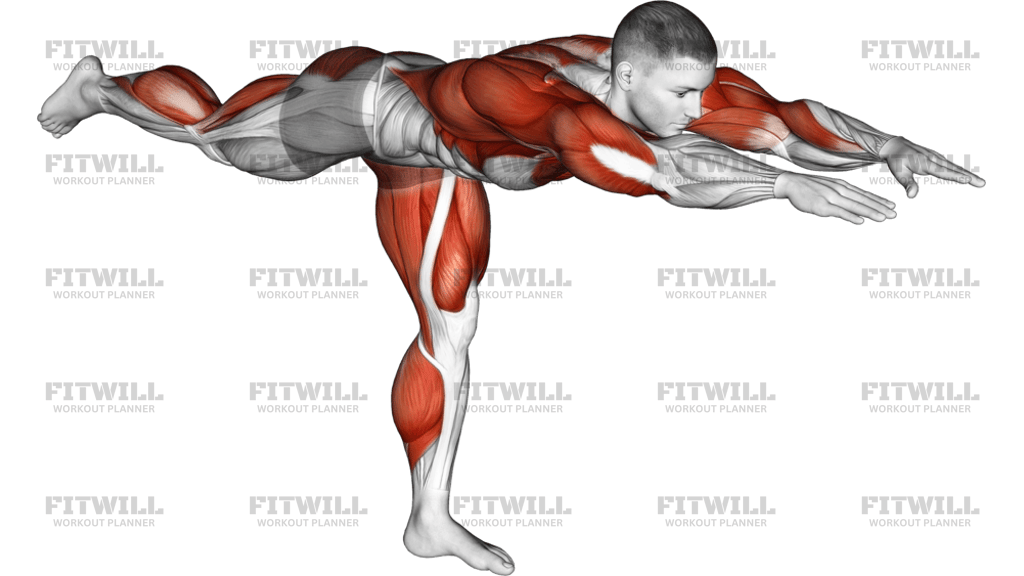
Warrior Pose is a standing single-leg balance that asks you to hinge forward from the hips while the back leg reaches long behind you. In the image, the torso is almost parallel to the floor, the lifted leg stays in line with the body, and the arms reach forward to create a long, controlled lever. That position turns the exercise into a full-body stability drill rather than a simple stretch, because every part of the body has to stay organized while only one foot supports you.
This movement trains balance, hip control, posterior-chain tension, and shoulder positioning at the same time. The standing leg has to stabilize the ankle, knee, and hip while the glute and hamstring help keep the pelvis level. The trunk and upper back work to keep the torso from twisting or collapsing, and the shoulders stay active as the arms reach out in front. The result is a useful body-weight pattern for developing coordination, posture, and single-leg control.
The setup matters more than most people think. Start from a tall stance, shift your weight onto one foot, and square the hips before you tip forward. A small bend in the standing knee is normal, especially if it helps you find a flatter back and a steadier pelvis. From there, think about reaching the back heel away from you while lengthening the crown of the head forward. The goal is not to dive toward the floor; it is to create one long line from fingertips to back foot without losing control of the standing side.
Use a slow, deliberate tempo and keep the breath steady. Inhale as you prepare and lower into position, then exhale as you settle into the hold. If you are working for repetitions, return to the upright start with control before repeating on the same side or switching sides. If your balance breaks down, shorten the reach, soften the standing knee, or use a wall lightly for reference. The exercise should feel demanding but clean, with the standing hip and trunk doing the real work, not a rushed swing of the lifted leg.
Fitwill
Log Workouts, Track Progress & Build Strength.
Achieve more with Fitwill: explore over 9600 exercises with images and videos, access built-in and custom workouts, perfect for both gym and home sessions, and see real results.
Start your journey. Download today!




Instructions
- Stand tall with your feet hip-width apart, then shift all of your weight onto one foot and keep the standing foot tripod-flat on the floor.
- Soften the standing knee slightly, square your hips to the ground, and brace your midsection before you start tipping forward.
- Reach both arms forward at shoulder height and begin hinging from the hip, not the lower back.
- Let the back leg travel straight behind you as the torso lowers until your body forms a long line from fingertips to heel.
- Keep the lifted leg active and pointed straight back, with the toes and hips staying level rather than opening to the side.
- Pause briefly in the balance position and keep the neck long while you look at a spot on the floor a few feet ahead.
- Lower only as far as you can hold a flat back, controlled hips, and steady standing foot pressure.
- Press through the standing foot to return to the upright start, then reset your balance before the next rep or side.
Tips & Tricks
- Think about sending the back heel far away instead of lifting it high; a smaller reach is usually better than a crooked pelvis.
- Keep the standing foot active through the big toe, little toe, and heel so the ankle does not roll inward.
- If you wobble, bend the standing knee a little more and shorten the torso reach before you try to go deeper.
- The ribcage should stay stacked over the pelvis as much as possible; arching the low back turns the pose into a hinge from the spine.
- Use the arms as a counterbalance, not as a way to yank yourself forward.
- Keep the lifted hip level with the standing hip; opening the pelvis usually means the back leg is doing too much work.
- A wall or rack can be a smart balance assist, especially when you are learning the position or holding longer reps.
- Stop the set if the standing ankle starts collapsing, because that usually means control has been lost before the rest of the body fails.
Frequently Asked Questions
What muscles does Warrior Pose work?
It mainly challenges the standing leg, glutes, hamstrings, core, and upper back while the shoulders help hold the reach.
Can beginners perform this exercise?
Yes, but beginners should keep the torso higher, use a wall for balance, and shorten the reach until the standing leg is stable.
How do I know if my torso is low enough?
Lower only until you can keep the back flat and the hips square. If your lower back rounds or the lifted hip opens, you have gone too far.
Should my back leg be bent or straight?
A slight bend is fine, but the intention is to send the leg long behind you. Avoid swinging it up with momentum.
Why is my balance so unstable in the standing foot?
This pose asks the ankle, foot, and hip to stabilize together. Focus on a tripod foot, a softer knee, and a fixed point on the floor.
What is the biggest form mistake in this pose?
Opening the hips and twisting the torso away from the floor. That usually turns the movement into a sloppy balance instead of a controlled hinge.
Can I use this as a warm-up or finisher?
Yes. It works well as a warm-up for single-leg stability or as a controlled finisher when you want balance and posture work.
How can I make Warrior Pose harder?
Hold the end position longer, reduce the amount of knee bend on the standing leg, or remove light wall support once your balance improves.