Kettlebell Backward Lunge
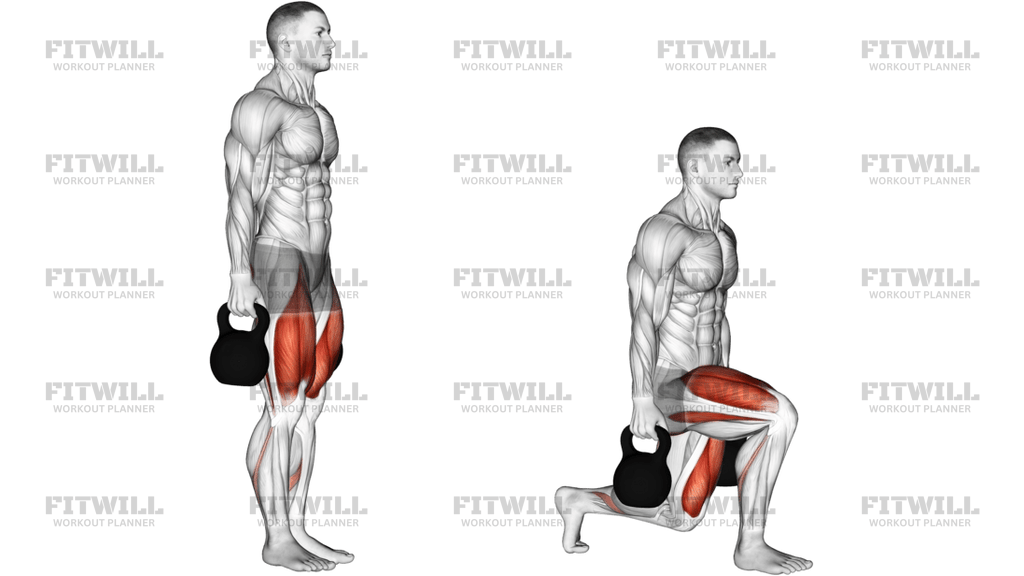
Kettlebell Backward Lunge is a unilateral lower-body strength exercise performed by stepping one leg back while holding a kettlebell at your side in a suitcase-style carry. The backward step makes it easier to keep the front foot planted and the torso organized, so the working side can load the glutes, hamstrings, and quads without the movement turning into a balance scramble.
This version is especially useful when you want to train single-leg control, hip stability, and clean knee tracking at the same time. The primary emphasis in this payload is the glutes, with the hamstrings, core, and lower back assisting to keep the pelvis level and the trunk steady. In anatomy terms, the main work centers on the Gluteus maximus, with help from Biceps femoris, Rectus abdominis, and Erector spinae.
The suitcase hold matters because the kettlebell tries to pull the body off center. That offset load makes the trunk work harder to stay upright and teaches the hips to resist shifting side to side. Keep the shoulders square, the ribs stacked over the pelvis, and the front knee tracking over the middle toes so the repetition stays driven by the legs instead of the lower back.
A good repetition starts with a tall stance, a controlled backward step, and a smooth descent until both knees are bent and the back knee moves close to the floor. From there, drive through the front foot to stand back up without rocking forward. The return should feel deliberate, not explosive, and the kettlebell should stay quiet at your side instead of swinging.
Use this exercise when you want a practical lunge pattern for strength work, accessory training, or lower-body conditioning with moderate loading. It fits well in leg sessions, full-body sessions, and unilateral stability blocks. Beginners can learn it safely with bodyweight first or a very light kettlebell, then add load only when the step-back, knee path, and balance stay consistent rep after rep.
[ Workout Log & Planner ]
Put your next workout in Fitwill
Keep your plan and training log ready when you are.


Instructions
- Stand tall with your feet about hip-width apart and hold the kettlebell at your side in one hand, letting the arm hang long and relaxed.
- Stack your ribs over your pelvis, keep your chest open, and set your shoulders level before you move.
- Brace lightly through your midsection so your torso stays steady when the kettlebell pulls to one side.
- Step one leg straight back, landing on the ball of the foot without crossing behind your front leg.
- Lower into the lunge until the front knee and back knee are both bent and the back knee moves close to the floor.
- Keep most of your weight on the front foot and let the front knee track over the middle toes.
- Press through the front heel and midfoot to stand back up, finishing tall without leaning backward.
- Bring the back foot forward to reset, then repeat for the planned reps before switching sides if required.
Tips & Tricks
- Keep the kettlebell close to the outer thigh so it does not swing and pull you sideways.
- Take a long enough step back that the front heel stays planted and the front knee does not shoot far past the toes.
- Let the rear knee travel down and slightly forward rather than driving the hips straight back like a hinge.
- Use a controlled tempo on the way down; rushing the descent usually makes the torso tip and the front foot wobble.
- Exhale as you stand up so the trunk stays braced through the hardest part of the rep.
- Choose a load that allows the shoulders and hips to stay square instead of twisting toward the kettlebell.
- If your balance is the limiter, shorten the set and own each rep instead of chasing speed or extra depth.
- Stop the set when the front knee caves inward, the heel lifts, or the kettlebell starts dragging your torso off line.
Frequently Asked Questions
What muscles does the kettlebell backward lunge work?
It mainly trains the glutes, with strong help from the quads and hamstrings. The suitcase hold also makes the core work to keep the torso from leaning.
Why step backward instead of forward?
Stepping back usually keeps the front foot more stable and makes it easier to load the working leg without crashing into the floor. It is often friendlier on balance and knee control than a forward lunge.
Should the kettlebell stay in one hand?
Yes, in this version the kettlebell hangs at your side like a suitcase. That offset load is part of the exercise because it challenges the hips and trunk to stay square.
How far back should I step?
Step far enough that you can lower under control while keeping the front heel down and the front shin reasonably stacked. If the front knee feels jammed, make the step slightly longer.
How deep should I go?
Go as low as you can while keeping the torso tall, the front foot flat, and the back knee under control. Depth should come from clean knee and hip bend, not from collapsing onto the floor.
What is the most common mistake?
A common error is letting the kettlebell pull the torso sideways or letting the front knee cave inward. Both usually mean the load is too heavy or the stance is too narrow.
Can beginners use this exercise?
Yes. Beginners often do best starting with bodyweight or a very light kettlebell so they can learn the step-back path, balance, and knee tracking first.
How can I make it harder?
Add load, slow the lowering phase, pause briefly at the bottom, or perform more controlled reps on one side before switching. Keep the torso and pelvis steady as the challenge increases.