Kettlebell Single Leg Deadlift
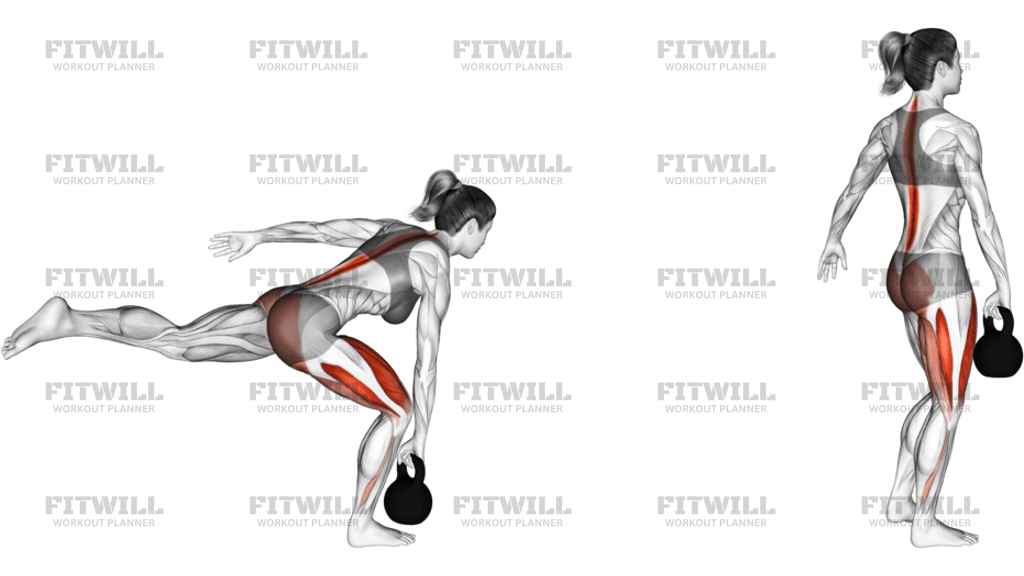
Kettlebell Single Leg Deadlift is a unilateral hip hinge that trains the glutes, hamstrings, and deep core while challenging balance and pelvic control. Because only one foot stays on the floor, the exercise exposes side-to-side differences quickly and rewards a slow, deliberate setup. It is a useful choice for lifters who want stronger hips, cleaner single-leg stability, and better control in running, jumping, and lower-body training.
The kettlebell stays in the working hand while the free leg reaches behind you as a counterbalance. That long line from head to heel helps you hinge without twisting, which is the main reason the setup matters so much. If the hips drift open or the shoulders rotate, the load stops training the hinge and starts turning into a balance fight.
A good rep begins with a soft knee, a flat foot, and the bell close to the standing leg. From there, send the hips back, lower the torso, and keep the spine long as the free leg lifts behind you. The bell should travel down along the inside of the standing shin, not swing away from the body. At the bottom, stop when you still own the position, then drive the floor away and stand tall by squeezing the glute of the working side.
This exercise works well as an accessory lift, a warm-up pattern, or a lower-body strength drill when you want single-leg control without the spinal loading of heavier barbell work. It is especially useful when you need cleaner hip symmetry or when a bilateral deadlift is too easy but heavy loading is not the priority. The best repetitions look steady from start to finish, with the pelvis level, the neck relaxed, and the return just as controlled as the lowering phase.
Use a light to moderate kettlebell at first and earn range of motion before chasing load. If balance limits the movement, keep fingertips near a wall or rack for support and shorten the descent until you can keep the hips square. The goal is not to touch the floor or reach maximum depth; the goal is to keep the hinge clean, the standing leg honest, and the torso connected to the working hip through the full rep.
Fitwill
Log Workouts, Track Progress & Build Strength.
Achieve more with Fitwill: explore over 9600 exercises with images and videos, access built-in and custom workouts, perfect for both gym and home sessions, and see real results.
Start your journey. Download today!




Instructions
- Stand tall holding a kettlebell in one hand beside your thigh, plant the working foot flat, and let the other leg hover lightly behind you.
- Keep a slight bend in the standing knee, square your hips and chest to the floor, and reach the free arm out for balance.
- Set your shoulder blades down and back, then brace your trunk before you start the descent.
- Hinge at the hips and send them straight back as the free leg reaches long behind you and the torso tips forward.
- Lower the kettlebell close to the inside of the standing shin while keeping your back long and your weight centered over the standing foot.
- Stop the descent when the pelvis starts to open, the back wants to round, or you feel a strong hamstring stretch you can still control.
- Drive through the standing foot, squeeze the glute on the way up, and stand tall without swinging the kettlebell or twisting the torso.
- Reset your balance at the top, lower into the next rep, and finish by placing the free foot down with control.
Tips & Tricks
- Keep the kettlebell close to the standing leg so the load does not pull you forward and away from your hip.
- Let the free leg reach straight back instead of lifting high; that long reach helps the torso stay level and the pelvis square.
- If your hips open toward the floor, shorten the range of motion before you add more load.
- A slight bend in the standing knee is enough; turning it into a squat usually steals tension from the hinge.
- Use the wall, rack, or a fingertip touch for balance if the standing foot is stable but the upper body starts to wobble.
- Exhale as you drive to standing and avoid holding your breath through the whole descent.
- The rep should feel loaded in the hamstring of the standing leg, not in the lower back or the toes.
- Choose a lighter kettlebell than you would for a two-leg deadlift, because balance usually fails before strength does.
Frequently Asked Questions
What muscles does Kettlebell Single Leg Deadlift work?
It primarily targets the glutes and hamstrings of the standing leg, with the deep core and hip stabilizers working hard to keep the pelvis square.
Is Kettlebell Single Leg Deadlift good for beginners?
Yes, if you start light and use a wall or rack for balance. Beginners should keep the range short until they can hinge without rotating the hips.
How low should the kettlebell go in Kettlebell Single Leg Deadlift?
Lower it toward mid-shin or just below the knee as long as your back stays long and the standing hip remains level. Depth matters less than control.
Why does my free leg keep drifting open to the side?
That usually means the pelvis is rotating instead of staying square. Reach the free leg straight back, keep the hips facing the floor, and reduce the load if needed.
Should my standing knee stay bent or straight?
Keep a soft bend in the standing knee throughout the rep. Locking it out makes the hinge harder to control and can shift too much stress into the lower back.
Can I hold onto a wall during Kettlebell Single Leg Deadlift?
Yes. A light fingertip touch on a wall, rack, or upright is a good way to keep the hip hinge clean while you build balance and hamstring strength.
What is the most common mistake with this exercise?
The biggest mistake is letting the kettlebell swing away from the body and twisting the torso open. Keep the bell close to the shin and the chest pointed toward the floor.
How is Kettlebell Single Leg Deadlift different from a regular deadlift?
A regular deadlift lets both feet share the load, while this version forces one hip to stabilize the whole body. That makes it more of a balance and hip-control exercise with less total weight.