Side Lying Hip Adduction
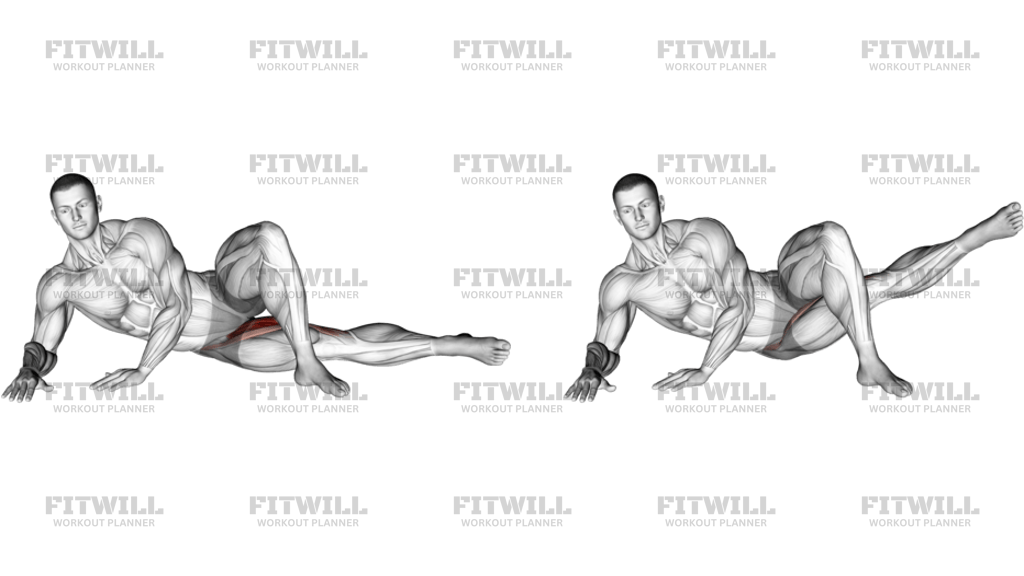
Side Lying Hip Adduction is a bodyweight inner-thigh exercise performed on your side with the top leg bent in front for support. The moving leg stays long and lifts upward toward the body’s midline, so the exercise trains hip adduction without needing a machine or band. It is a small, controlled movement, but the setup matters a lot: if your pelvis rolls back or your torso twists, the lift turns into a momentum drill instead of a clean adductor strength exercise.
This movement primarily targets the hip adductors, which include the muscles that pull the thigh inward and help control leg position during walking, cutting, landing, and single-leg work. The glutes, obliques, and other stabilizers still matter, but they should be holding the body quiet while the inner thigh does the actual lifting. That makes Side Lying Hip Adduction useful for lower-body accessory work, rehabilitation-style strength work, and focused conditioning when you want direct adductor loading with very little equipment.
The best rep starts with a stacked position: shoulder over shoulder, hips mostly stacked, bottom leg straight, and the top foot planted on the floor in front of you so it does not block the lift. From there, the bottom leg rises in a controlled arc, usually until the thigh reaches the height that lets you stay square through the torso and pelvis. A short pause at the top helps you feel the adductors finish the rep, and a slow return keeps tension on the inner thigh instead of dropping out of position.
This exercise is especially useful if you want to build adductor strength without compressing the spine or loading the knees heavily. It can be paired with squats, lunges, lateral work, or core training, and it also works well as a warmup or accessory drill when the groin needs a lower-load stimulus. Clean execution matters more than range here: move only as high as you can without rotating, arching, or yanking the leg upward, and stop the set if the pelvis starts to drift or the neck and trunk begin to compensate.
[ Workout Log & Planner ]
Put your next workout in Fitwill
Keep your plan and training log ready when you are.


Instructions
- Lie on one side with your bottom leg straight, your top knee bent, and the top foot planted on the floor in front of your body for support.
- Stack your shoulder and hip as much as possible, then rest your lower head on your arm or hand so your neck stays long and relaxed.
- Set the bent top leg far enough forward to leave room for the bottom leg to lift without your torso rolling backward.
- Keep the bottom leg long with the toes pointing forward or slightly up so the inner thigh stays active.
- Brace gently through your trunk and start with the bottom leg resting close to the floor.
- Exhale and lift the bottom leg upward in a smooth arc toward the bent top leg without swinging the pelvis.
- Pause briefly near the top when you feel the adductors working and the torso still square to the floor.
- Lower the leg slowly until it is back near the starting position, keeping tension on the inner thigh the whole way down.
- Complete all reps on one side, then switch sides and repeat with the same setup.
Tips & Tricks
- Place the top foot in front of your body, not behind it, so it does not block the bottom leg’s path.
- If your pelvis keeps rolling open, reduce the lift height instead of forcing a bigger rep.
- Keep the bottom leg straight and quiet; bending the knee turns the exercise into a different pattern.
- Think about lifting from the inner thigh rather than kicking the leg upward with the hip flexor.
- A small top-leg bend is enough support; a huge stride forward usually makes the setup unstable.
- Slow lowering matters here because the adductors do a lot of work on the way down.
- Stop the set when you start pressing through the floor with your torso or shoulder to cheat the lift.
- Ankle weights can make the exercise harder, but only after you can keep the pelvis stacked and the movement smooth.
Frequently Asked Questions
What does Side Lying Hip Adduction train most?
It primarily trains the hip adductors, which are the inner-thigh muscles that pull the leg toward the body’s midline.
Why is the top knee bent in front of the body?
The bent top leg creates space for the bottom leg to lift and helps you keep the pelvis from rolling backward as you move.
How high should the bottom leg lift on each rep?
Lift only as high as you can keep the hips stacked and the torso quiet. A smaller range with clean tension is better than a bigger rep with trunk rotation.
What is the most common mistake with this side-lying setup?
The usual mistake is letting the pelvis roll open so the lift comes from body sway instead of the inner thigh.
Is this exercise suitable for beginners?
Yes. It is a simple bodyweight drill, and beginners can keep it effective by using a short range and slow control.
Should I feel the floor shoulder and upper body working too?
A little support is normal, but the shoulder and trunk should mostly stay quiet. If the upper body is straining, the set is probably too hard or too rushed.
Can I add ankle weights or a cable to make it harder?
Yes, but only after you can lift the leg without twisting the torso or losing the stacked side-lying position.
Where does this fit in a workout?
It works well as accessory work after compound leg training, or earlier in a session if you are using it as a warmup or activation drill.