Squat Thrust
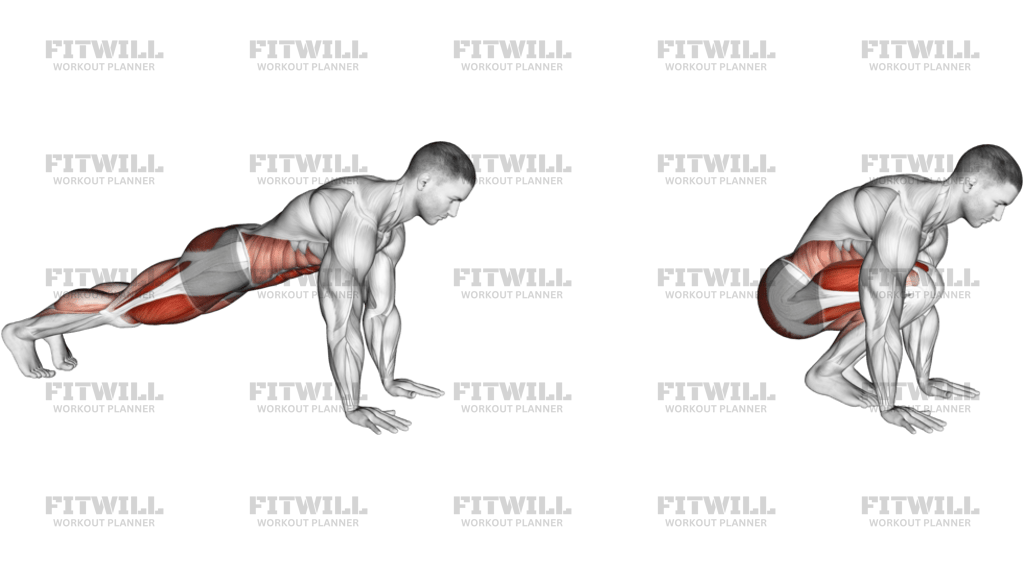
Squat Thrust is a bodyweight plyometric drill that links a low crouch to a straight-arm plank and back again. It is useful when you want a fast conditioning movement that also teaches clean bracing, coordinated footwork, and control through the hands, shoulders, and trunk. Even though the exercise looks simple, the setup matters because the quality of each rep depends on how well you can stabilize the plank and land back in the crouched position.
The movement is short, but it demands a lot from the midsection, shoulders, chest, quads, and hip flexors. From the crouch, you kick or jump the feet back to a strong plank, then return them quickly underneath the body. That transition is where the exercise gets its training effect: the torso has to stay organized while the legs switch from folded to extended and back again.
A good Squat Thrust begins with the hands planted firmly on the floor under or just in front of the shoulders and the chest angled over the hands. Once the feet shoot back, the body should look long from head to heels, with the glutes lightly engaged and the ribs tucked so the lower back does not sag. When the feet come back in, land softly and stay low rather than collapsing onto the floor or rushing into a loose stand.
Squat Thrust is commonly used in warm-ups, circuit training, conditioning work, and athletic finishers because it raises the heart rate without needing equipment. It can be scaled up or down easily: step the feet back and forward for a lower-impact version, or move more explosively if you are training speed and power. The best reps are crisp, quiet, and repeatable, with enough control that your shoulders, core, and hips stay in sync from the first rep to the last.
Safety comes from respecting the transitions. If your lower back sags in the plank, your shoulders drift behind your wrists, or the landings get loud and sloppy, the pace is too fast for your current control. Keep the neck long, breathe through the rhythm of the drill, and stop the set when the feet stop landing under the body or the plank loses its shape.
[ Workout Log & Planner ]
Put your next workout in Fitwill
Keep your plan and training log ready when you are.


Instructions
- Start in a low crouch with your hands flat on the floor under or slightly in front of your shoulders, feet about hip-width apart.
- Spread your fingers, press through the whole hand, and stack your shoulders over your wrists before you move.
- Brace your midsection and keep your chest over your hands as you prepare to shift weight forward.
- Kick or jump both feet straight back to a straight-arm plank, landing on the balls of your feet.
- Squeeze your glutes and keep your body in a long line from head to heels without letting your lower back sag.
- Hold the plank only long enough to stay organized, then snap or step both feet back underneath your hips.
- Land softly in the crouch with your knees bent, chest still slightly forward, and heels ready to settle if mobility allows.
- Repeat the back-and-forth transition for the planned reps, breathing out as the feet move and resetting your posture each time.
Tips & Tricks
- Keep the hands just ahead of the shoulders so the plank feels stacked instead of drifting into a slanted press.
- If the plank turns into a banana shape, shorten the kick-back and tighten your ribs toward your pelvis before the next rep.
- Land the feet under your hips rather than far behind your hands so the return to the crouch stays quick and balanced.
- Use a step-back, step-in version when the jump makes the transition noisy or your wrists start to feel jammed.
- Think of the floor contact as a quick spring, not a collapse; the rep should look sharp rather than heavy.
- Keep your head in line with your spine so you do not reach forward with the chin during the plank phase.
- Stay low in the crouch on the return instead of standing up between reps, which turns the drill into a different movement.
- If your shoulders burn before your legs do, slow the cadence and make the plank cleaner before chasing speed.
Frequently Asked Questions
What muscles does Squat Thrust work most?
Squat Thrust mainly trains the core, shoulders, chest, quads, and hip flexors, with the glutes helping keep the plank rigid.
Is Squat Thrust the same as a burpee?
Not exactly. Squat Thrust is the low-bodyweight transition between crouch and plank, usually without the push-up or jump finish that a full burpee adds.
Can beginners do Squat Thrusts?
Yes. Beginners should step the feet back and forward instead of jumping so they can keep the plank stable and the landings quiet.
Should my heels touch the floor in the crouch?
They can, but they do not have to. The important part is keeping your weight balanced over the feet and staying low enough to snap back into the plank.
How do I keep my lower back from sagging?
Tighten your abs before the feet leave the floor, squeeze your glutes in the plank, and stop the rep if your ribs start to drop toward the mat.
Where should I feel Squat Thrusts most?
You should feel the drill in your shoulders and core first, with the quads and hip flexors working hard during the kick-back and return.
Do I need to stand up between reps?
No. The classic Squat Thrust stays low and cycles between crouch and plank, which keeps the drill faster and more conditioning-focused.
How can I make Squat Thrust harder?
Add speed only after the plank stays solid, or turn the movement into a jump-back, jump-in version if you want a more explosive conditioning drill.