Standing Back Extension And Flexion
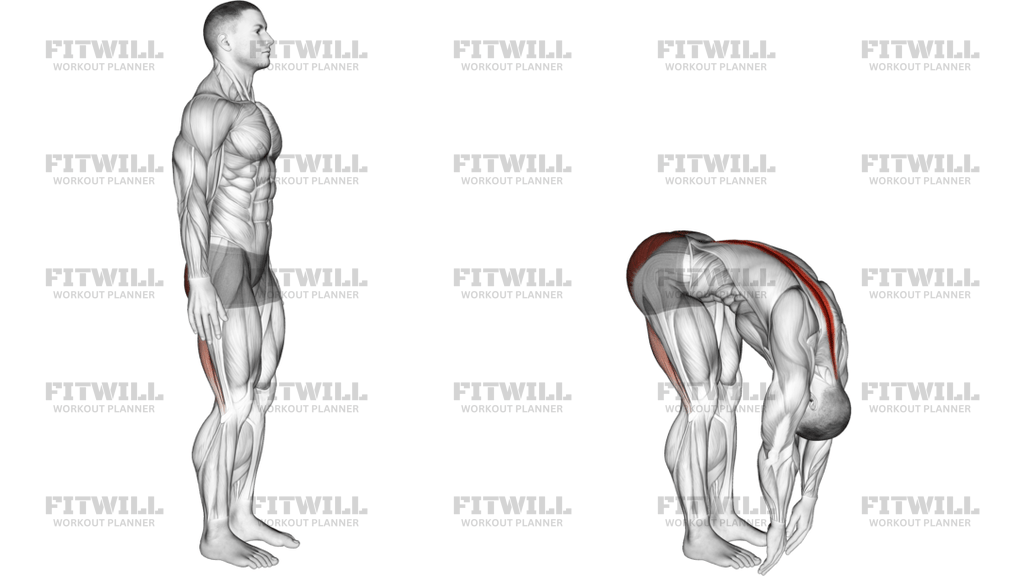
Standing Back Extension And Flexion is a body-weight standing spinal control drill that moves you from an upright posture into a controlled forward fold and back again. It is useful when you want to train coordinated movement through the trunk, hips, and posterior chain without loading the spine externally. The goal is not to chase a deep stretch or a big arch, but to keep the movement smooth, repeatable, and deliberate from rep to rep.
This exercise is most valuable for learning how the spine, pelvis, and ribcage move together. As you fold forward, the hamstrings and glutes lengthen while the spinal erectors and deep core muscles control the descent. As you come back up, the torso should stack gradually instead of snapping open with momentum. That makes Standing Back Extension And Flexion a good choice for warm-ups, movement prep, and light accessory work when you want better body awareness and cleaner hinge mechanics.
The standing setup matters because it keeps the exercise honest. Start with your feet about hip-width apart, knees soft, and weight spread evenly through the whole foot. From there, create a gentle extension by lifting the chest and lengthening through the front of the torso, then reverse into flexion by exhaling and rolling the upper back, mid-back, and pelvis forward under control. If your hamstrings limit the fold, keep a small knee bend instead of forcing the bottom position.
Quality reps should feel smooth rather than jerky. The forward phase should be slow enough that you can feel each segment of the spine close in sequence, and the return should be just as controlled as you stack back to standing. Keep the neck relaxed, let the arms hang naturally, and stop the range before your lower back pinches or your balance shifts toward the toes. When performed well, Standing Back Extension And Flexion can be a simple but valuable way to improve trunk control, posterior-chain awareness, and readiness for other hip-hinge or torso-dominant training.
Fitwill
Log Workouts, Track Progress & Build Strength.
Achieve more with Fitwill: explore over 9600 exercises with images and videos, access built-in and custom workouts, perfect for both gym and home sessions, and see real results.
Start your journey. Download today!




Instructions
- Stand tall with your feet about hip-width apart, knees softly unlocked, arms hanging by your sides, and your weight balanced over the midfoot.
- Stack your ribs over your pelvis, lift your chest slightly, and take one steady breath before you begin the first rep.
- Fold forward by letting your head, upper back, mid-back, and pelvis move together instead of collapsing all at once.
- Reach toward your shins or the floor only as far as you can keep the motion smooth and controlled.
- Pause briefly in the bottom position without bouncing or hanging on the joints.
- Exhale and reverse the movement by rolling up through the spine until you are back in a tall standing position.
- If the drill includes a gentle back extension on the return, finish by opening the chest without leaning hard into the low back.
- Reset your stance and breathing at the top before starting the next repetition.
Tips & Tricks
- Keep a slight bend in the knees so tight hamstrings do not pull you out of position.
- Think about rolling down one section at a time instead of hinging abruptly from the hips.
- Do not let the shoulders drop and yank the torso forward; let the spine and pelvis control the descent.
- If your heels start to lift, shorten the range and keep pressure through the whole foot.
- Use a slower return than you think you need so the standing position does not become a snap-up.
- Exhale through the flexion phase to help the ribcage and pelvis organize together.
- Stop before the lower back rounds aggressively or feels pinchy at the bottom.
- If the movement feels more like a stretch than a control drill, reduce the range and smooth out the tempo.
Frequently Asked Questions
What muscles does Standing Back Extension And Flexion work?
It mainly trains the spinal erectors, glutes, hamstrings, and deep core muscles that control trunk position during the fold and return.
Is Standing Back Extension And Flexion a stretch or a strength exercise?
It is best treated as a control drill. You should feel lengthening in the posterior chain, but the goal is smooth spinal and hip control rather than forcing a maximal stretch.
Should my knees stay straight during Standing Back Extension And Flexion?
Keep them softly bent rather than locked out. A small knee bend helps the pelvis tip forward without yanking hard on the hamstrings.
How far should I bend forward?
Go only as far as you can keep the movement smooth and balanced through your feet. If your low back rounds sharply or your heels lift, the range is too deep.
Can beginners do Standing Back Extension And Flexion?
Yes. Beginners should use a slow tempo, a small range, and a soft knee bend so they can learn the sequence without straining the lower back.
Where should I feel the movement most?
You should feel a controlled stretch and release through the hamstrings and glutes, with the trunk muscles working to slow the descent and bring you back upright.
Is this the same as a standing toe touch?
No. A toe touch usually chases the floor, while Standing Back Extension And Flexion should stay controlled and segment by segment through the torso and pelvis.
How should I breathe during the rep?
Exhale as you fold forward and inhale as you stack back up. A steady breath helps keep the ribcage from flaring and the return from becoming jerky.