Jump Box Over
Jump Box Over is a bodyweight plyometric that trains quick force production, coordination, and landing control by moving from one side of a box to the other with an explosive jump. It is a simple drill on paper, but the quality of the rep depends on how well you load the hips, clear the box, and absorb the landing without losing balance. That makes it useful for athletes, conditioning circuits, and warmups when you want fast, crisp lower-body work instead of slow strength reps.
The setup matters because the box should help the movement, not force you to improvise it. Stand beside a stable box on a flat surface with your feet about hip-width apart and enough space on both sides to land safely. Keep the box low enough that you can jump onto it and across it without having to tuck your knees aggressively or chase the top with your chest.
Start each repetition by sitting back into a shallow athletic crouch, keeping your chest slightly forward, your spine long, and your arms ready to swing. Drive through both feet, jump onto the top of the box, and land with the whole foot under you instead of letting your heels hang off the edge. From that landing, absorb the impact through your hips and knees, then rebound across to the far side or step down and reset if the drill calls for a slower, cleaner version.
When Jump Box Over is done well, the glutes, quads, calves, and core all work together to create a fast but controlled transition from takeoff to landing. The drill also teaches cleaner knee tracking and better body awareness under speed, which is why it fits well into sprint sessions, plyometric blocks, and lower-body power work. The goal is not to see how high you can jump; the goal is to keep every contact sharp, stable, and repeatable.
Use a stable surface and enough open space around the box so you are never forced into a rushed landing or an awkward bailout. If the landing gets loud, your knees cave inward, or you feel yourself reaching for the floor on the far side, lower the box or slow the rep and regain control. Stop the set when the jumps turn sluggish or the rebound loses shape, because this drill pays off most when the technique stays springy from the first rep to the last.
Fitwill
Log Workouts, Track Progress & Build Strength.
Achieve more with Fitwill: explore over 9600 exercises with images and videos, access built-in and custom workouts, perfect for both gym and home sessions, and see real results.
Start your journey. Download today!




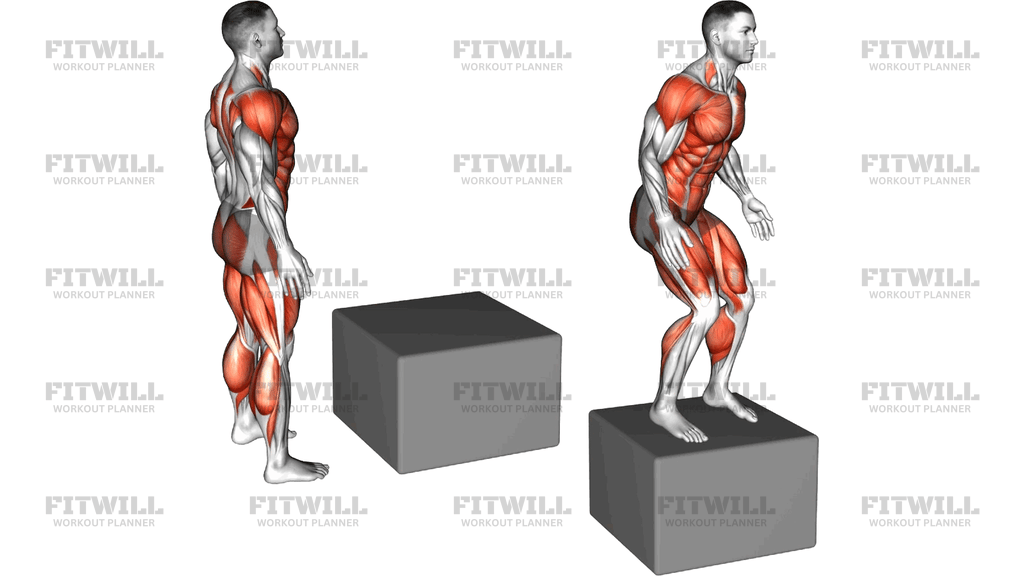
Instructions
- Place a stable plyo box or low platform on a flat surface and stand beside it with your feet about hip-width apart.
- Square your shoulders and hips to the box, and leave enough room on the far side to land safely after the jump.
- Sit back into a shallow crouch, keep your chest slightly forward, and load your arms behind you.
- Drive hard through both feet and jump onto the top of the box with a two-foot takeoff.
- Land softly on the box with your feet flat, knees tracking over your toes, and your torso braced.
- Absorb the landing for a moment, then rebound across the box or step down and reset, depending on the variation.
- Land on the far side with quiet feet and hips back instead of collapsing forward.
- Pause long enough to regain balance before the next rep, or step away safely if the set is complete.
Tips & Tricks
- Use a box height that lets you land on top without a hard knee tuck; if you have to fold sharply, the box is too high.
- Keep the top landing quiet. Loud contact usually means you are dropping onto the box instead of controlling it.
- Swing the arms once to help the jump, then let them reset so they do not throw you off balance on the landing.
- Hold your ribcage over your pelvis on the box; leaning back is a common way to miss the far-side landing.
- If your knees drift inward on takeoff or landing, lower the box and slow the rep until the line is clean.
- Treat each rep like a power single or a short set of crisp contacts, not a conditioning sprint.
- Step down instead of rebounding when your landing quality starts fading; sloppy rebounds train sloppy mechanics.
- Wear shoes with a stable forefoot and make sure the box surface is dry so you do not slip on the top landing.
Frequently Asked Questions
What does Jump Box Over train most?
It mainly trains lower-body power, coordination, and landing control, with the glutes, quads, calves, and core doing most of the work.
Is Jump Box Over the same as a box jump?
It is similar, but the goal is to get onto the box and clear or transition across it instead of just finishing on top.
How high should the box be for Jump Box Over?
Use a height you can land on smoothly without knee collapse or a big tuck. Lower boxes are usually better for cleaner reps and safer rebounds.
Should I step down or jump back off the box?
Step down if you are learning the drill or if fatigue is building. Rebound only when you can keep the landing quiet and the direction change sharp.
What is the biggest mistake on Jump Box Over?
The most common mistake is landing hard on the top of the box and then rushing the next takeoff. That usually means the box is too high or the set is too long.
Can beginners do Jump Box Over?
Yes, if they start with a low box, step-down reps, and short sets. The movement should look crisp before it gets faster.
How many reps should I use for Jump Box Over?
Keep reps low, usually in small sets, so each jump stays explosive. Once the contacts get noisy or slow, the set is over.
Can I use Jump Box Over in conditioning work?
Yes, but only if the landing stays controlled. It works best in power or athletic conditioning blocks where quality matters more than fatigue.