Jump On Fit-Box
Jump On Fit-Box is a two-foot box jump performed onto a sturdy platform, emphasizing explosive takeoff and a quiet, balanced landing. It is a plyometric drill that builds lower-body power, coordination, and landing control without adding external load. The main training effect comes from producing force quickly, then absorbing that force safely when both feet hit the top of the box.
The setup matters because box height changes the whole movement. Stand a short step in front of the box with your feet about hip-width apart, eyes on the landing surface, and your weight centered through the midfoot. Pick a box that lets you land with both feet flat and your torso upright rather than forcing you to tuck your knees hard or fold at the waist to clear it.
Each rep should begin from a small, controlled dip. Load your hips back slightly, keep your knees tracking over your toes, swing your arms, and jump upward and forward with both legs at the same time. Bring both feet onto the top of the box together, then land softly by bending at the ankles, knees, and hips to absorb the impact.
Once the landing is stable, stand tall and reset before the next rep. On the way down, step back to the floor one foot at a time unless you are specifically coached to jump down and the box height makes that safe. The goal is a crisp, repeatable jump with a controlled landing, not a maximal-height jump that turns into a scramble.
This exercise fits best in power work, athletic warmups, or low-volume conditioning blocks where speed and quality matter more than fatigue. It is useful for beginners only when the box is low and the landing is fully controlled. If the jump gets noisy, the knees cave inward, or you cannot keep the same landing shape rep after rep, lower the box or end the set.
Fitwill
Log Workouts, Track Progress & Build Strength.
Achieve more with Fitwill: explore over 9600 exercises with images and videos, access built-in and custom workouts, perfect for both gym and home sessions, and see real results.
Start your journey. Download today!




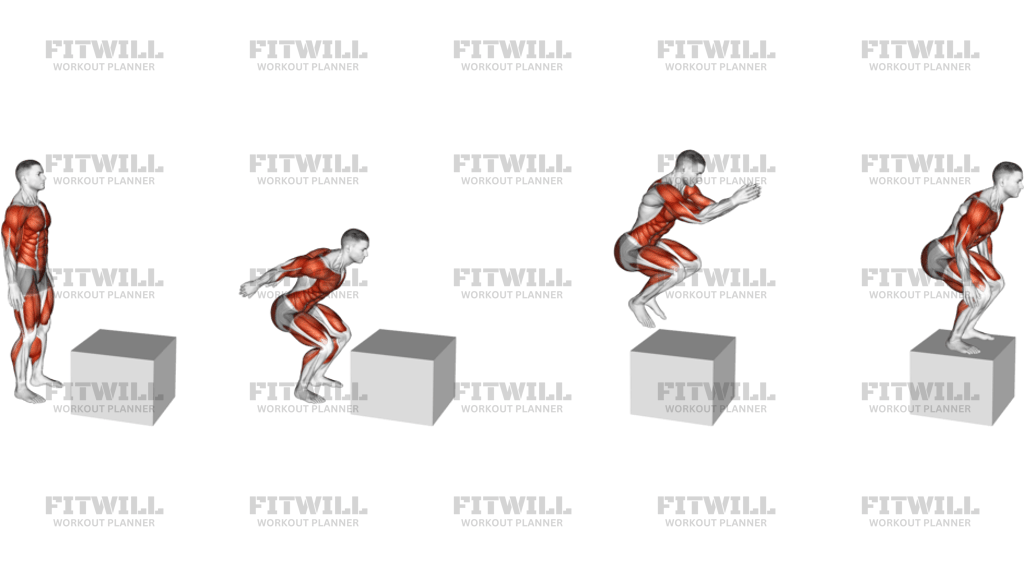
Instructions
- Place a stable box or platform a short step in front of you and stand facing it with your feet hip-width apart.
- Set your toes forward or slightly turned out, keep your chest tall, and look at the top surface of the box.
- Sit your hips back into a shallow quarter squat while keeping your heels down and your knees tracking over your toes.
- Swing your arms behind you, then drive them forward as you explode through both legs at the same time.
- Jump upward and slightly forward so both feet clear the front edge and land on the top of the box together.
- Land softly on the whole foot with bent knees, letting the ankles, knees, and hips absorb the impact.
- Stand tall only after the landing feels balanced, then reset your feet and posture before the next rep.
- Step back down one foot at a time and repeat for the planned number of repetitions.
Tips & Tricks
- Choose a box height you can land on without collapsing your torso forward to clear the edge.
- Keep the landing quiet; a loud strike usually means you are dropping onto the box instead of absorbing the jump.
- Use a quick arm swing to help the jump, but do not throw your chest forward to gain height.
- Keep the box close enough that you jump up and forward, not just straight up in place.
- If your feet do not land flat together, lower the box or shorten the jump distance.
- Step down from the box when you are tired; repeated jump-downs add unnecessary impact.
- Treat each rep like a fresh jump rather than bouncing through a sloppy rebound.
- End the set when jump height, landing control, or knee tracking starts to fade.
Frequently Asked Questions
What does Jump On Fit-Box train?
It trains lower-body power, coordination, and landing control, with the quads, glutes, hamstrings, calves, and trunk all helping the movement.
Is this a box jump or a box step-up?
It is a two-foot box jump. Both feet leave the floor together and land on top of the box together.
How high should the box be?
Use a height that lets you land with both feet flat and your torso controlled. If you have to tuck hard or fold forward, the box is too high.
Should I jump down from the box?
Most people should step down one foot at a time. Jumping down adds impact and is only useful when the box is low and the landing is fully controlled.
What is the biggest form mistake?
The biggest mistake is chasing height and losing the landing. If the knees cave inward or the landing gets noisy, the rep is too aggressive.
Can beginners do this exercise?
Yes, but only with a low box and a controlled landing. Beginners should keep the reps low and stop before technique gets sloppy.
How many reps should I do?
Box jumps usually work best for low reps with full recovery, because power drops quickly once fatigue builds.
How do I progress it safely?
Progress by cleaning up the landing first, then increasing box height or adding reps only if every jump stays crisp and balanced.