Decline Pike Press Between Benches
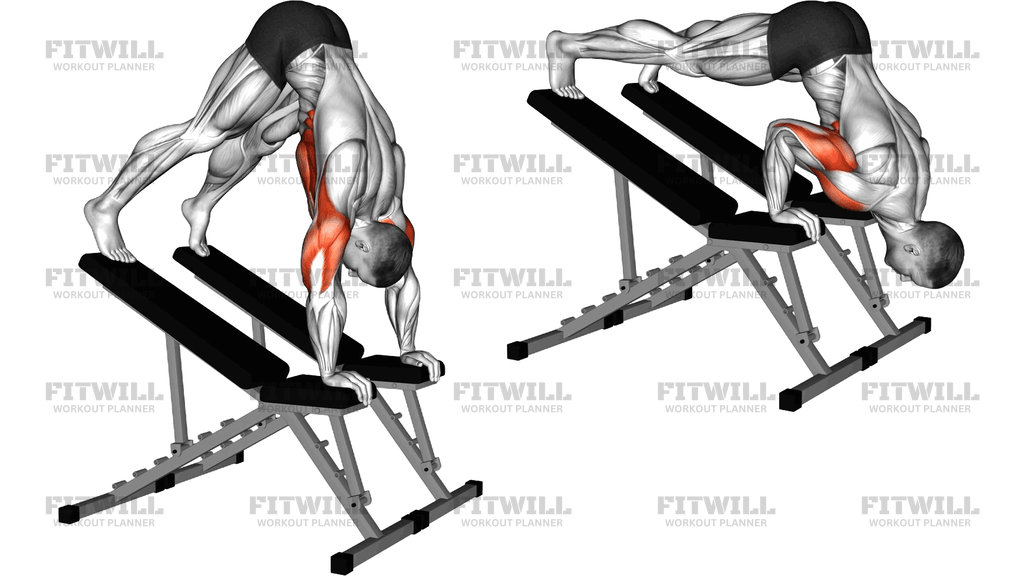
Decline Pike Press Between Benches is a bodyweight pressing exercise built around a steep pike position with the hands on one bench and the feet on another. The setup changes the line of push so the shoulders and triceps do most of the work while the core keeps the torso rigid and the hips stacked. It is a useful choice when you want a vertical pressing pattern without a barbell, dumbbells, or wall handstand work.
The two-bench setup matters because it creates both elevation and a clear space for the head to travel between the benches. With the feet raised, the press becomes more demanding than a floor pike press and rewards good shoulder control, wrist position, and consistent scapular motion. If the benches shift, wobble, or sit too close together, the movement quickly turns awkward and the range of motion suffers.
A clean repetition starts in a strong inverted-V shape: hands planted firmly, elbows soft, hips high, and the head aimed down between the benches. From there, lower under control by bending the elbows and letting the head travel toward the gap between the benches. The press should finish with the arms straight and the shoulders active, not with a sagging lower back or a rushed kick from the legs.
Because this exercise loads the shoulders through a deep pressing angle, the easiest way to make it productive is to keep the tempo honest. Lower smoothly, press with control, and stop the set before the neck, wrists, or shoulders start to compensate. Shorter ranges, a slightly softer pike, or a lighter bench height can make the movement more accessible while preserving the same pattern.
Use it as an upper-body bodyweight strength drill, a shoulder accessory, or a progression toward harder handstand-style pressing. The goal is not to force a huge range, but to keep the line of pressure consistent from rep to rep while the torso stays braced and the shoulders do the lifting.
[ Workout Log & Planner ]
Put your next workout in Fitwill
Keep your plan and training log ready when you are.


Instructions
- Set two stable benches parallel to each other with enough space between them for your head and shoulders to travel through the gap.
- Place your hands shoulder-width apart on the edge of one bench and put your feet on the opposite bench, then walk your feet back until your hips are high.
- Form a strong pike position with straight legs, a neutral neck, and your weight centered over your hands.
- Brace your abs and keep your ribs down so your lower back does not over-arch as you lower.
- Bend your elbows and lower your head and upper chest between the benches under control.
- Keep your elbows at a comfortable angle, usually slightly out from your torso rather than flared wide.
- Press firmly through both palms to straighten your arms and drive your shoulders back to the top position.
- Exhale as you press up, inhale as you lower, and repeat for the planned reps without losing the pike shape.
Tips & Tricks
- Choose benches that do not move when you shift your weight; instability makes this press much harder on the wrists and shoulders.
- Keep your head traveling between the benches instead of drifting forward, or the press turns into a poor shoulder angle.
- If your shoulders feel pinched, shorten the range and stop a little higher before the bottom position.
- A slight bend in the knees can make the lever easier without changing the pressing pattern if the full pike is too demanding.
- Keep pressure through the whole hand, especially the base of the index finger and thumb, so the wrists do not collapse inward.
- Do not let the hips sag into a plank; the raised-hip pike is what makes the exercise a shoulder press.
- Lower slowly for 2 to 3 seconds so the shoulders stay organized and you do not bounce off the bottom.
- Limit elbow flare if your shoulders feel better with a narrower press path, but keep the elbows from drifting completely behind you.
- Stop the set when the head path, bench contact, or shoulder position starts to change from rep to rep.
Frequently Asked Questions
What muscles does Decline Pike Press Between Benches work?
It is mainly a shoulder-dominant press that also trains the triceps, upper chest, and core.
Why use two benches instead of the floor?
The benches raise the hands and feet, create a cleaner path for the head, and make the pressing angle more demanding than a floor pike press.
Where should my head go during the rep?
Lower your head and upper chest into the space between the benches, not forward in front of your hands.
Should my legs stay straight the whole time?
Straight legs keep the pike position strict, but a slight knee bend is a useful regression if the full lever is too hard.
How low should I go?
Lower only as far as you can keep the shoulders controlled, the neck neutral, and the benches stable.
Can beginners do this exercise?
Yes, but beginners usually do better with a shorter range, bent knees, or a simpler pike press variation first.
What is the most common form mistake?
Letting the hips collapse or the head drift forward usually turns the movement into a messy push instead of a true pike press.
How can I make it harder over time?
Use a deeper pike, slower lowering tempo, or a larger range of motion while keeping the benches fixed and the rep path clean.