Side Lying Leg Raise
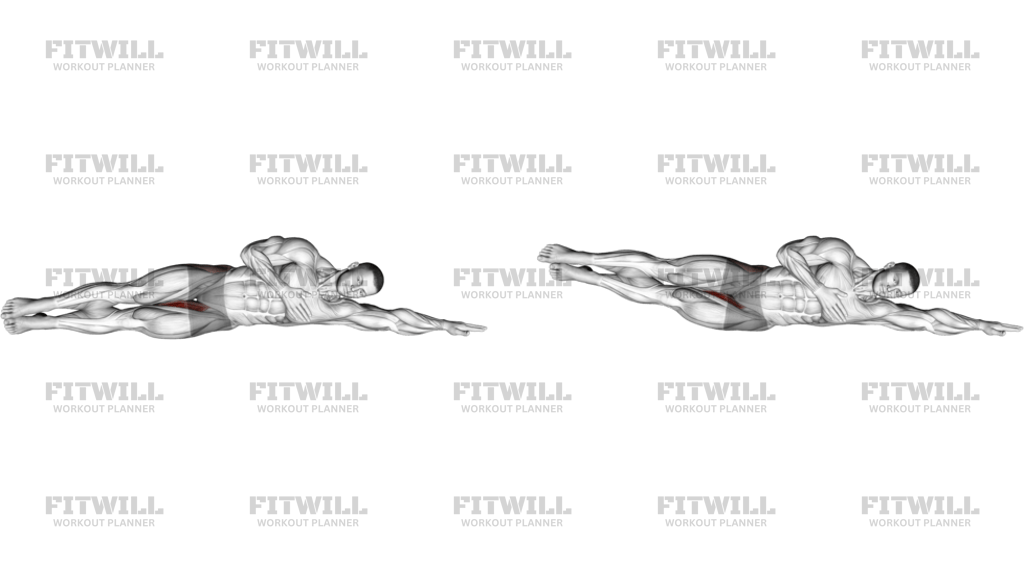
Side Lying Leg Raise is a bodyweight hip-abduction exercise that isolates the outer hip and upper glute while teaching you to keep the pelvis stacked and the trunk quiet. It is most useful when you want direct work for the glute medius and nearby hip stabilizers without loading the spine or needing equipment beyond a mat or floor space. The movement looks simple, but the setup matters: if the hips roll backward or the torso twists, the top leg will drift into momentum instead of controlled abduction.
In the image, the athlete lies on one side with the bottom arm supporting the head and the top arm reaching forward for balance. Both legs stay long and aligned, then the top leg lifts away from the lower leg in a smooth arc. That lift should come from the side of the hip, not from swinging the foot upward or arching the low back. A clean rep keeps the pelvis stacked, the rib cage down, and the foot traveling only as high as you can control without losing alignment.
This exercise is commonly used for glute activation, hip stability work, rehab-style accessory training, and higher-rep lower-body finishers. It is especially helpful for people who need better single-leg control, cleaner knee tracking, or more awareness of the lateral hip during squats, lunges, running, and change-of-direction work. Because it is bodyweight, the challenge usually comes from precision and tempo rather than load.
The best version of Side Lying Leg Raise uses a steady lift, a brief pause near the top, and a controlled return. Keep the neck relaxed, breathe evenly, and stop the set if the top hip starts to open or the lower back starts helping the leg rise. If the exercise feels too easy, slow the lowering phase, add a light ankle weight, or use a longer pause at the top before progressing to heavier resistance.
[ Workout Log & Planner ]
Put your next workout in Fitwill
Keep your plan and training log ready when you are.


Instructions
- Lie on one side on a mat with your body in a straight line, bottom arm under your head, and the top hand resting on the floor in front of your torso for balance.
- Stack your hips and shoulders, then keep both legs long with the top foot lined up over the lower foot.
- Brace your trunk lightly and keep your rib cage from flaring as you begin the rep.
- Lead with the top heel and lift the top leg upward in a smooth arc without letting the pelvis roll backward.
- Raise the leg only as high as you can while keeping the hips stacked and the waist long.
- Pause briefly at the top, feeling the side of the hip and upper glute work instead of the lower back.
- Lower the leg slowly to the starting position without letting it drop or bounce off the bottom leg.
- Keep breathing steady and repeat for the planned number of reps before switching sides.
Tips & Tricks
- Keep the top hip stacked directly over the bottom hip; rolling the pelvis backward turns the lift into a twist instead of a hip-abduction rep.
- Think about lifting with the heel, not the toes, so the side of the glute stays involved through the full range.
- Stop the leg before the low back starts arching or the torso starts rocking to chase extra height.
- A small lift with perfect control is better than a high kick that opens the front of the hip and loses tension.
- Turn the top toes slightly forward or just a little down if you want to keep the work on the outer hip instead of the front of the thigh.
- Slow the lowering phase to make the bodyweight version challenging before adding ankle weights or bands.
- Keep the neck long and the bottom shoulder relaxed so the upper body does not help drive the motion.
- If the floor feels hard on the bottom hip, place a folded mat or towel under the pelvis before starting the set.
Frequently Asked Questions
What does the Side Lying Leg Raise train most?
It primarily targets the outer hip muscles, especially the glute medius and other hip abductors, while the trunk works to keep the body stable.
How should my body be positioned on the floor?
Lie on your side with the bottom arm supporting your head, the top hand in front for balance, and both hips and shoulders stacked before you lift the top leg.
Should my top leg stay straight or bent?
Keep the top leg long and straight for the standard version shown here. Bending the knee changes the leverage and usually reduces the focus on the outer hip.
How high should I lift the leg?
Lift only until the pelvis stays still and the side of the hip keeps working. If the torso rolls or the low back arches, the leg is probably going too high.
What are the most common mistakes?
The biggest errors are rocking the hips, swinging the leg, turning the movement into a hip-flexor raise, and letting the lower back help at the top.
Can beginners do this exercise?
Yes. It is a good beginner hip exercise because the load is low and the main challenge is control, not strength from a machine or external weight.
How can I make Side Lying Leg Raise harder?
Slow the lowering phase, add a pause at the top, or use a light ankle weight or mini band once you can keep the pelvis stacked for the entire set.
What should I feel if I am doing it correctly?
You should feel tension on the side of the hip and upper glute of the lifting leg, with the torso staying quiet instead of braced like a full core exercise.