Kick Through Push-Up
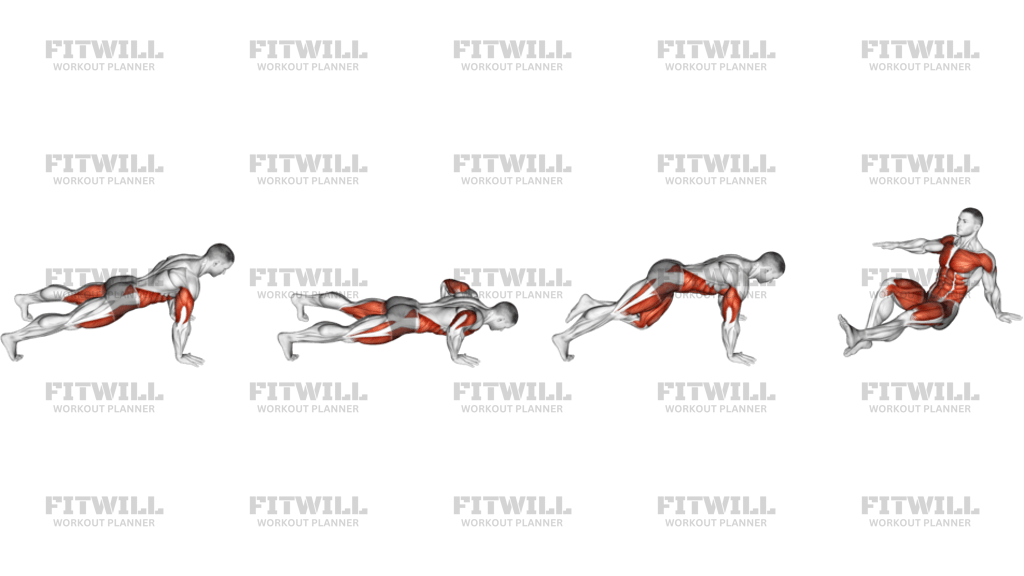
Kick Through Push-Up is a bodyweight conditioning drill that blends a push-up with a controlled rotational kick-through. In the plank phase, it trains pressing strength through the chest, shoulders, and triceps; in the kick-through phase, it adds oblique work, hip control, and shoulder stability as you rotate from a loaded plank into a side-supported sit. The movement is fast enough to raise the heart rate, but the value comes from keeping each rep organized rather than letting the rotation turn into a collapse.
The setup matters because the exercise asks your shoulders, wrists, and core to share load while the legs swing underneath you. Start in a strong high plank with the hands under or just slightly wider than the shoulders, fingers spread, and the feet set wide enough to give the kicking leg room to pass through. Keep the ribs down and the pelvis neutral before the first rep. If the plank is loose, the twist becomes sloppy immediately.
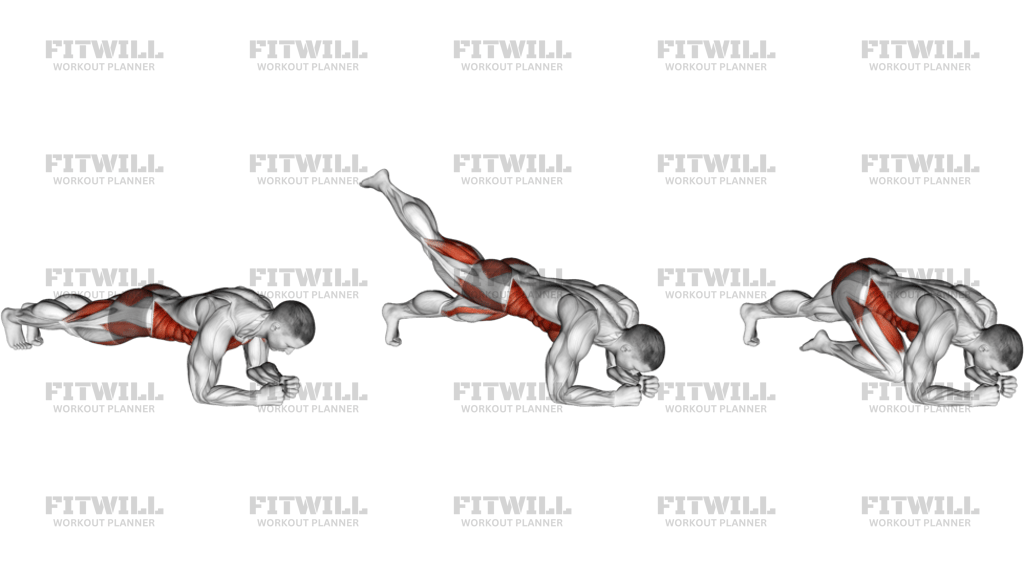
Each repetition should feel like one clean sequence: lower into the push-up, press back to plank, then sweep one leg under the body and rotate into the kick-through position. The supporting hand stays planted and active, the chest stays open, and the free arm can help balance without dumping weight into the shoulder. When the leg threads through, think of opening the hips and pivoting from the torso together, not flinging the lower body sideways. The return path should be just as controlled as the entry.
Kick Through Push-Up is useful in conditioning circuits, athletic core work, and warmups where you want a mix of upper-body pressing and rotational control. It is also a good test of whether your plank and shoulder positions hold up once fatigue starts to rise. If your wrists ache, your lower back sags, or the kick-through turns into a crash, shorten the range or slow the pace. Keep the motion crisp, the breathing steady, and the transition smooth from side to side.
Fitwill
Log Workouts, Track Progress & Build Strength.
Achieve more with Fitwill: explore over 9600 exercises with images and videos, access built-in and custom workouts, perfect for both gym and home sessions, and see real results.
Start your journey. Download today!




Instructions
- Start in a high plank with your hands under or just wider than your shoulders, fingers spread, feet set wide enough for the leg to travel through, and your body in one straight line from head to heels.
- Brace your abs and squeeze your glutes so your ribs stay down and your lower back does not sag before the first rep.
- Bend your elbows and lower your chest toward the floor under control, keeping the elbows angled back rather than flared hard to the sides.
- Press through your palms to return to a strong plank, exhaling as you finish the push-up portion.
- Shift your weight onto one hand and the opposite foot, then sweep the free leg underneath your torso toward the other side.
- Rotate onto the supporting hand and opposite foot as the leg kicks through, opening your chest and keeping the non-supporting hand light for balance.
- Sit through briefly with the hips low and the kick-through leg extended, then reverse the same path to bring the leg back under your body.
- Return to high plank, reset your brace, and repeat on the opposite side for the next rep or alternate sides each time.
- Stop the set if you can no longer control the shoulder position, the kick-through path, or the return to plank.
Tips & Tricks
- Set your hands slightly wider if the kick-through feels crowded or your wrists are forced into an awkward angle.
- Keep the supporting shoulder packed and active so the rotation does not sink into the joint.
- Use a shorter kick-through path if your hips feel pinched or if your torso starts to sway.
- Let the chest lower under control on the push-up instead of bouncing off the floor to create momentum.
- Think of the rep as push-up plus rotation, not a loose hip swing with a half-rep press.
- Exhale through the press and the turn so your trunk stays braced while the body rotates.
- Keep the free leg low and long as it threads through; yanking the knee high usually breaks the line of the movement.
- Slow the return to plank, because the way back is where many reps lose shoulder and core position.
- Choose a smooth floor or mat that lets the foot pivot; a sticky surface makes the transition feel jerky.
Frequently Asked Questions
What muscles does the Kick Through Push-Up work?
It mainly hits the chest, shoulders, and triceps during the push-up, then adds obliques, glutes, and shoulder stabilizers during the rotation.
Is the kick-through supposed to be fast?
The transition can be quick, but it should still be controlled. A clean rep is more important than a big, flashy leg sweep.
Do I need to do a full push-up every rep?
Not if the speed or fatigue turns it sloppy. A smaller, controlled push-up is better than losing the plank position before the kick-through.
Should my leg fully pass through to the other side?
It should travel far enough to rotate your hips and torso, but not so far that you crash into the floor or lose the supporting shoulder.
Can beginners do this exercise?
Yes, but it is easier if you shorten the kick-through, slow the pace, or use an elevated surface for the push-up portion.
Why do my wrists or shoulders feel overloaded?
Usually the hands are too narrow, the shoulders are collapsing, or the feet are too close together to give the leg room to pass through.
What is the most common form mistake?
Letting the lower back sag and turning the kick-through into a side collapse instead of a controlled rotation.
How should I breathe during the movement?
Inhale as you lower, then exhale as you press, rotate, and thread the leg through so your trunk stays braced.