Jumping Pistol Squat
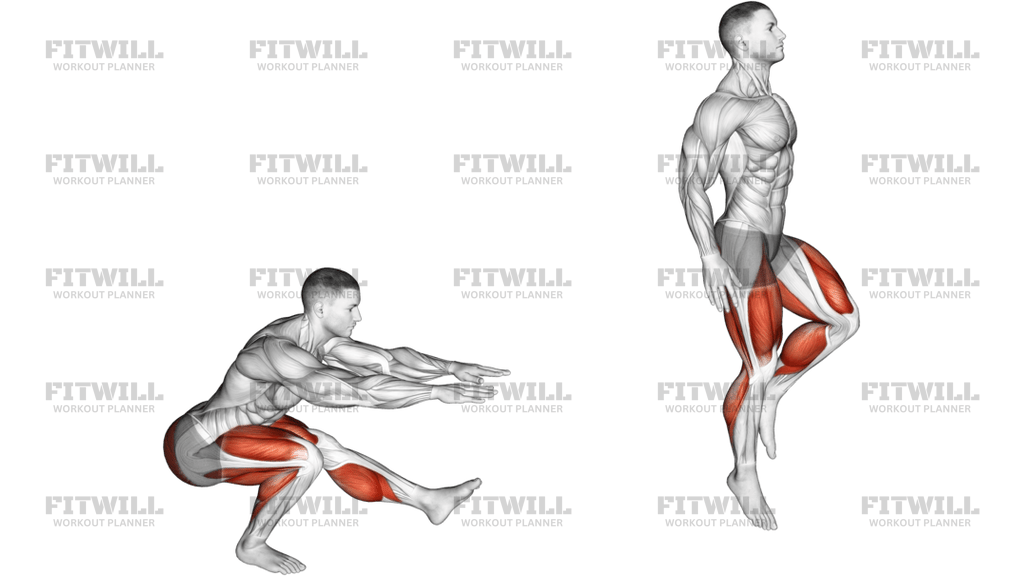
Jumping Pistol Squat is a bodyweight plyometric squat performed on one leg. You lower into a deep single-leg squat, keep the free leg extended in front for balance, then drive up explosively and reset with control. The exercise combines unilateral leg strength with speed, landing control, and foot and hip stability in one movement.
Because the body is supported on only one foot, the setup matters as much as the jump. The standing foot needs a solid tripod contact, the knee needs room to track over the toes, and the torso needs enough forward lean to keep the center of mass over the working leg. The arms reaching forward in the bottom position are not decorative; they help counterbalance the long lever of the extended leg and keep the rep organized.
The best reps feel crisp at the start, controlled in the bottom, and quiet on the landing. Lower under control, load the hip and quad, then extend the ankle, knee, and hip to rise. If the variation includes an actual hop, use only as much height as you can absorb without wobbling, collapsing the arch, or letting the knee cave inward. The free leg should stay long in front or tuck cleanly through the transition, depending on the athlete's range and balance.
This movement fits athletic lower-body work, plyometric blocks, and advanced single-leg training where power and coordination matter. It is not a beginner pattern for most people; an assisted pistol squat or box pistol is usually the better starting point. Keep the landing soft, the breathing steady, and the rep size honest so the working leg does the job instead of momentum.
Fitwill
Log Workouts, Track Progress & Build Strength.
Achieve more with Fitwill: explore over 9600 exercises with images and videos, access built-in and custom workouts, perfect for both gym and home sessions, and see real results.
Start your journey. Download today!




Instructions
- Stand on one foot with the other leg extended forward, arms reaching in front to counterbalance the squat.
- Plant the working foot firmly and keep the heel down as you sit the hips back and down into the pistol squat.
- Track the standing knee over the second and third toes instead of letting it cave inward.
- Keep the free leg long in front so it helps balance the rep instead of dropping behind you.
- Lower until you reach the deepest position you can control without losing the arch or folding the torso.
- Drive through the whole foot to rise explosively and, if prescribed, add a small hop at the top.
- Land softly on the same foot, bend the knee to absorb force, and freeze long enough to own the position.
- Reset your balance before the next rep and match the same setup on the other side if you are alternating legs.
Tips & Tricks
- If the landing gets loud, reduce the jump height before you reduce the depth.
- Use the arms as a counterbalance, but do not swing them so hard that they pull the torso upright.
- A slight forward torso lean is normal in the bottom position; a rounded back is not.
- Keep the standing heel rooted so the ankle, knee, and hip share the load instead of dumping everything into the toes.
- Think about pushing the floor away with the entire foot, not just straightening the knee.
- If balance is the limiter, keep the free leg more active in front and pause longer between reps.
- If ankle mobility is tight, use a shallower range rather than forcing the bottom position.
- Stop the set when the knee starts drifting inward or the landing becomes unstable.
Frequently Asked Questions
What muscles does Jumping Pistol Squat work?
It heavily trains the quads and glutes on the working leg, with the calves, hamstrings, and core helping stabilize the rep.
Is this just a regular pistol squat with a jump?
It is the explosive, plyometric version of a pistol squat, so the single-leg squat pattern is paired with a fast drive or hop.
Where should my free leg go during the rep?
Keep it extended forward for balance through the squat, then bring it through cleanly as you stand or hop.
How high should I jump?
Only high enough to stay controlled. A small, quiet hop is better than a big jump that ruins the landing.
Can beginners do Jumping Pistol Squat?
Most beginners should start with an assisted pistol squat or a box pistol squat before adding the jump.
What should I feel most in the bottom position?
You should feel the working leg loaded through the foot, ankle, knee, and hip, with the torso staying organized over the stance leg.
What is the biggest form mistake?
Letting the standing knee cave inward or landing too stiffly are the most common problems.
How can I make it easier?
Use a higher bottom position, hold onto a support, or remove the jump and practice the controlled pistol squat first.