Resistance Band Overhead Squat
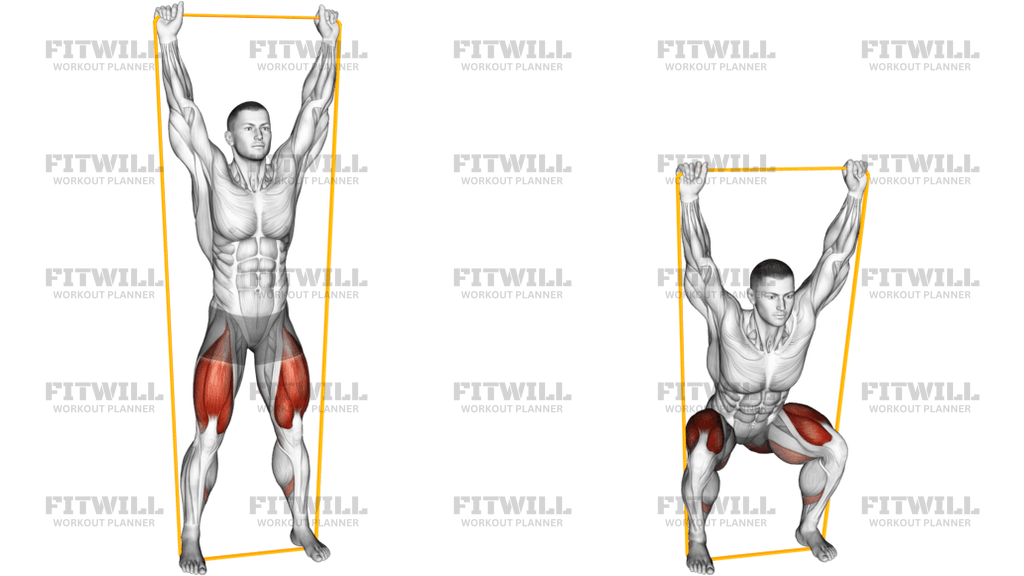
Resistance Band Overhead Squat is a band-loaded squat variation that challenges the thighs, glutes, core, upper back, and shoulder stability at the same time. The image shows the band anchored under the feet and held overhead, which makes the exercise less about brute force and more about keeping a stacked, upright position while you descend and rise.
That overhead hold changes the squat a lot. Your arms have to stay extended, the rib cage has to stay controlled, and the torso has to resist folding forward as the hips drop between the heels. The quads are the main driver, but the midline, glutes, adductors, and stabilizing muscles work hard to keep the knees tracking and the chest from collapsing.
Setup matters because small errors are amplified when the band is overhead. If the stance is too narrow, the knees may cave in and the hips will feel cramped. If the stance is too wide, the bottom position can turn into a side-to-side shift instead of a clean squat. Stand on the band with both feet flat, grip the handles or band ends, and lock the arms overhead before you start the first rep.
Each rep should feel smooth and deliberate: descend by sending the hips down between the heels, keep the elbows straight, and let the band stay tight overhead as you reach the bottom. Drive back up through the midfoot and heels while keeping the ribs down and the head neutral. The best reps finish with the knees and hips extending together instead of the chest shooting up first.
Use this movement for technique work, warmups, conditioning circuits, or accessory strength when you want a squat pattern that also trains shoulder control and trunk stiffness. It is usually best with light to moderate band tension so the overhead position stays clean. Stop the set if the band drifts forward, the lower back arches, or the heels begin to lift.
[ Workout Log & Planner ]
Put your next workout in Fitwill
Keep your plan and training log ready when you are.


Instructions
- Stand on the middle of the resistance band with both feet about shoulder-width apart and toes turned slightly out.
- Grip the band ends or handles and press your arms straight overhead until your elbows are locked and the band is taut.
- Set your ribs down, tighten your midsection, and keep your chest stacked over your hips before you descend.
- Sit your hips down between your heels while keeping the band overhead and your arms in line with your ears.
- Let your knees travel in the same direction as your toes instead of collapsing inward.
- Lower until your thighs reach your chosen squat depth without losing heel contact or overhead position.
- Drive up through your midfoot and heels to return to standing while keeping the torso tall and the band steady.
- Exhale as you stand, then reset your brace before the next repetition.
- Finish the set by lowering the band under control and stepping off it safely.
Tips & Tricks
- Keep the band directly over your shoulders; if it drifts forward, the squat usually turns into a back-arched compensation.
- Choose a band tension that lets you lock the elbows without shrugging hard or bending the wrists back.
- A slightly wider stance often helps the hips stay open while the knees track cleanly over the toes.
- Think about sitting between the heels, not reaching the hips straight back like a hinge.
- If your heels pop up, shorten the depth or widen the stance before adding more resistance.
- Keep the ribs from flaring as you stand; the squat should finish with glutes and quads, not a lower-back lean.
- A slow descent makes this exercise much more useful than bouncing in and out of the bottom.
- If the shoulders fatigue first, reduce band tension so the legs stay the limiter.
Frequently Asked Questions
What does the Resistance Band Overhead Squat work most?
The quads are the main driver, with strong help from the glutes, core, adductors, and upper back to keep the overhead position stable.
How should I hold the band overhead?
Stand on the band, hold the ends at about shoulder width, and press the arms straight up so the band stays tight over the shoulders.
How wide should my stance be?
Start around shoulder width with the toes slightly turned out. That usually gives enough room for the hips to drop without forcing the knees inward.
Why is this harder than a regular squat?
The overhead band position adds a shoulder and trunk stability demand, so you have to keep the torso stacked while the legs do the squatting.
Should I go as deep as possible?
Only go as deep as you can while keeping the heels down, the band overhead, and the knees tracking over the toes.
What is the most common form mistake?
Letting the band drift forward and arching the lower back to fake overhead mobility is the most common breakdown.
Is this exercise appropriate for beginners?
Yes, if the band tension is light and the squat depth is kept within a clean, pain-free range.
What should I do if my heels lift at the bottom?
Reduce the depth, widen the stance slightly, or use a lighter band so you can keep full foot contact.