Single Leg Board Jump
Single Leg Board Jump is a bodyweight plyometric drill built around one-foot takeoff, quick airborne control, and a quiet landing on the same leg. It is best thought of as a power-and-stability exercise rather than a conditioning move. The goal is to create a crisp, athletic jump pattern that teaches the ankle, knee, hip, and trunk to work together without losing balance.
This movement is useful for athletes and anyone training for elastic leg power, single-leg balance, and landing control. The standing leg does most of the work, but the core and hip stabilizers are what keep the body from collapsing or twisting as you leave the ground and return to it. Because the exercise is performed on one side at a time, it exposes side-to-side differences very quickly.
The setup matters more than the jump height. Stand on one foot next to a low board, line, or similar marker on flat ground, then lower into a small quarter squat with the chest tall and the free leg relaxed behind you. Keep the standing foot planted firmly so you can load the glutes, quads, and calf before you explode upward and across the board.
On the way up, drive through the whole foot and use the arms to help create lift without swinging wildly across the body. Bring the knee through naturally, clear the board cleanly, and land on the same foot with the knee bent and the hips sitting back enough to absorb force. A good rep looks springy but controlled, with no hard slap on the floor and no wobbling that turns the landing into a hop in place.
Single Leg Board Jump fits best in a warm-up, speed block, or lower-body power session when you want quality over fatigue. Keep the obstacle low and the total rep count modest so each landing stays sharp. If the knee caves inward, the torso tips, or the landing gets loud, the drill has already gotten too difficult for the current set.
[ Workout Log & Planner ]
Put your next workout in Fitwill
Keep your plan and training log ready when you are.


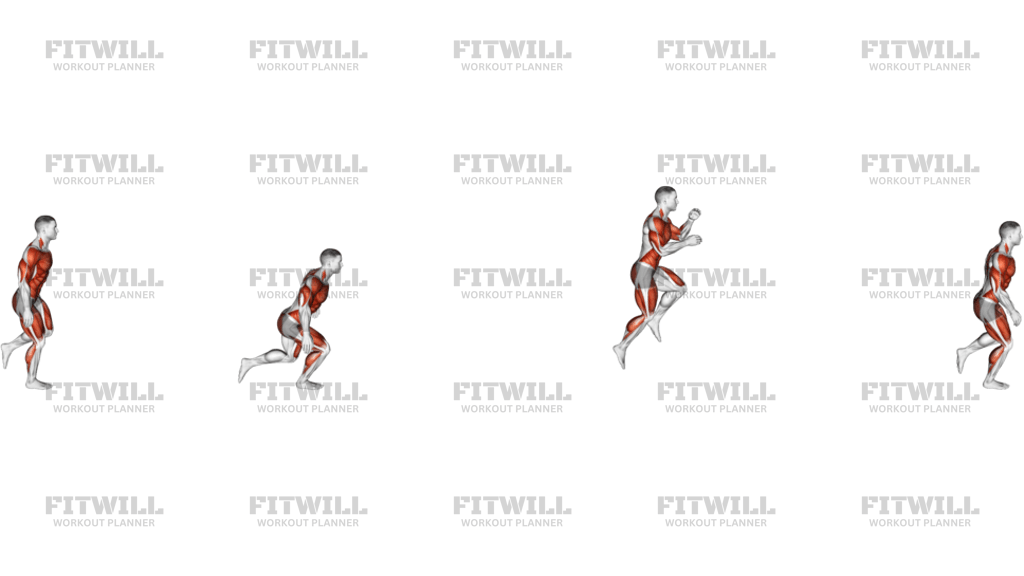
Instructions
- Place a low board, line, or small marker on flat ground and stand on one foot a short step to one side of it.
- Keep the standing knee slightly bent, the chest tall, and the free leg lifted or held lightly behind you for balance.
- Lower into a small quarter squat on the working leg so the glute, quad, and calf are loaded before takeoff.
- Swing both arms and drive through the whole foot to jump over the board or line.
- Keep the hips square and the knee tracking over the toes as you travel through the air.
- Land on the same foot with a soft knee and the hips back enough to absorb the impact.
- Freeze the landing for a moment until the ankle, knee, and balance settle.
- Reset the same way for the next rep or step down and switch sides when the set is complete.
Tips & Tricks
- Use a very low board or line first; if you have to reach for the landing, the obstacle is too high.
- Land quietly on the midfoot and let the heel kiss down after the impact instead of slapping the floor.
- Keep the knee stacked over the second toe so the leg does not collapse inward on landing.
- Think of the jump as a forward-and-up drive, not a broad sideways leap across the room.
- If balance is the weak point, shorten the jump and hold the landing before the next rep.
- Use the arms to help create rhythm, but do not let them rotate the torso across the standing leg.
- Stop the set when the ankle starts wobbling or the landing becomes loud and stiff.
- Keep the free foot off the ground between reps so each repetition stays truly single-leg.
Frequently Asked Questions
What muscle does Single Leg Board Jump target most?
The standing leg does most of the work, especially the glutes, quads, calves, and the smaller stabilizers around the ankle and hip.
Do I need an actual board for Single Leg Board Jump?
Not necessarily. A low board, floor line, tape mark, or thin step can work as long as the surface is stable and the jump clears it cleanly.
Should I land on the same foot or switch feet?
Land on the same foot for the standard Single Leg Board Jump. Switching feet changes the drill into a different plyometric pattern.
How high should the board or obstacle be?
Keep it low enough that you can jump over it and still land quietly with the knee bent. If the height forces a hard landing, lower it.
Can beginners do Single Leg Board Jump?
Yes, but only with a very low marker and a small jump. Beginners should be able to balance on one leg and stick the landing before adding speed.
Why does my knee cave inward when I land?
Usually the jump is too big or the hip is not controlling the landing. Make the board lower, shorten the jump, and focus on driving the knee over the toes.
Where should I put this exercise in a workout?
Use it early in a session, after a warm-up, when the legs are fresh and you can focus on crisp takeoffs and controlled landings.
What is the most common mistake in Single Leg Board Jump?
The most common mistake is chasing distance and letting the landing get loud, twisted, or unstable. Clean mechanics matter more than jumping farther.