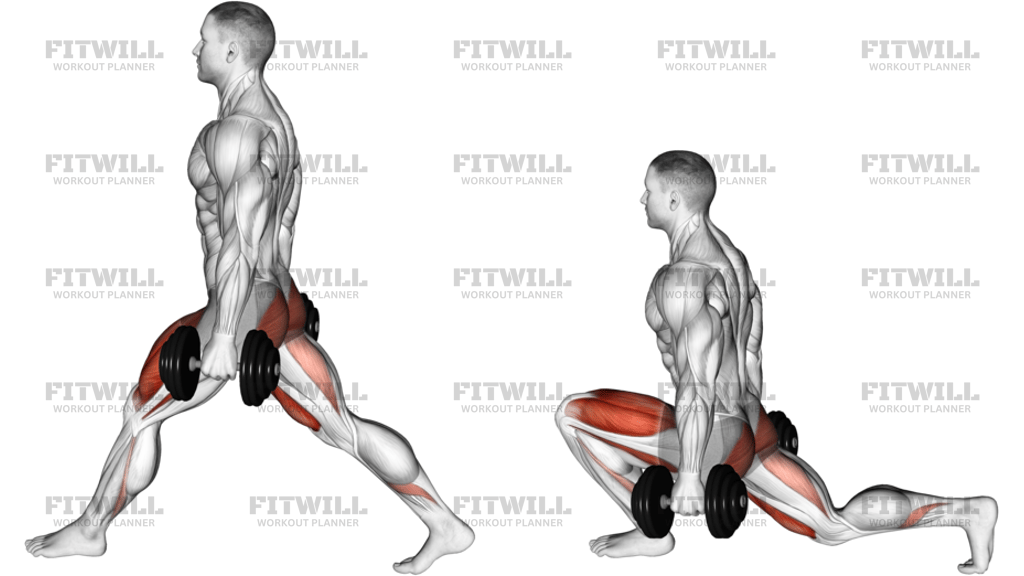
Dumbbell Walking Lunge
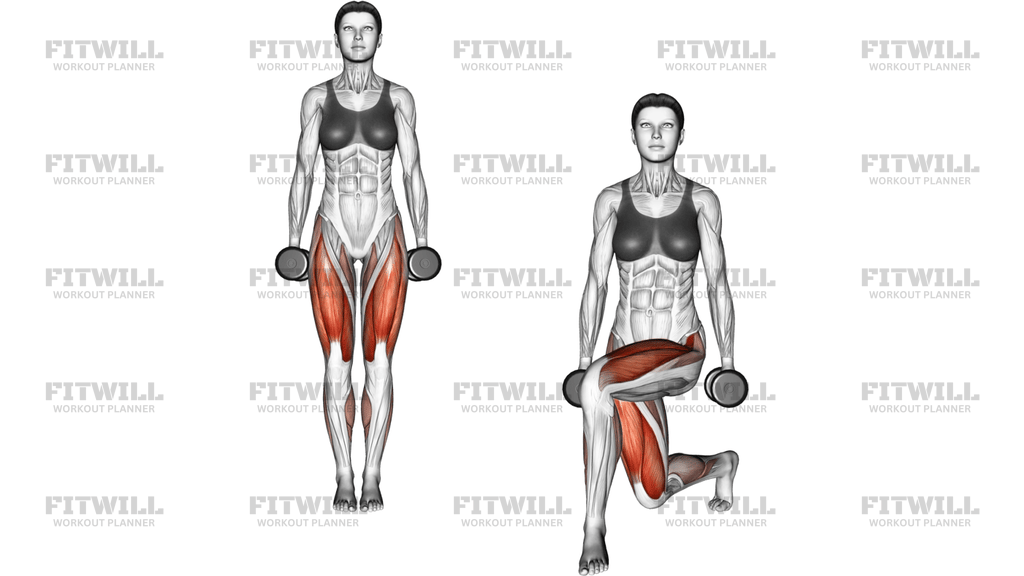
Dumbbell Walking Lunge is a lower-body strength exercise built around alternating forward steps while holding a dumbbell in each hand. It loads the thighs and glutes through a deep split stance, so every rep asks you to control balance, stride length, knee tracking, and trunk position at the same time.
The movement is especially useful when you want a unilateral leg pattern that carries over to running, climbing stairs, field sports, and general lower-body strength. In this version, the dumbbells sit at your sides rather than on the shoulders, which makes the exercise feel more natural to walk with while still challenging the hips, thighs, and core to stay organized.
The setup matters because a walking lunge can fall apart quickly if the first step is too short or too narrow. Start tall with your ribs stacked over your pelvis, eyes forward, and your dumbbells hanging quietly beside your thighs. Each step should land far enough forward that you can lower under control without the front heel lifting or the back leg collapsing into the floor.
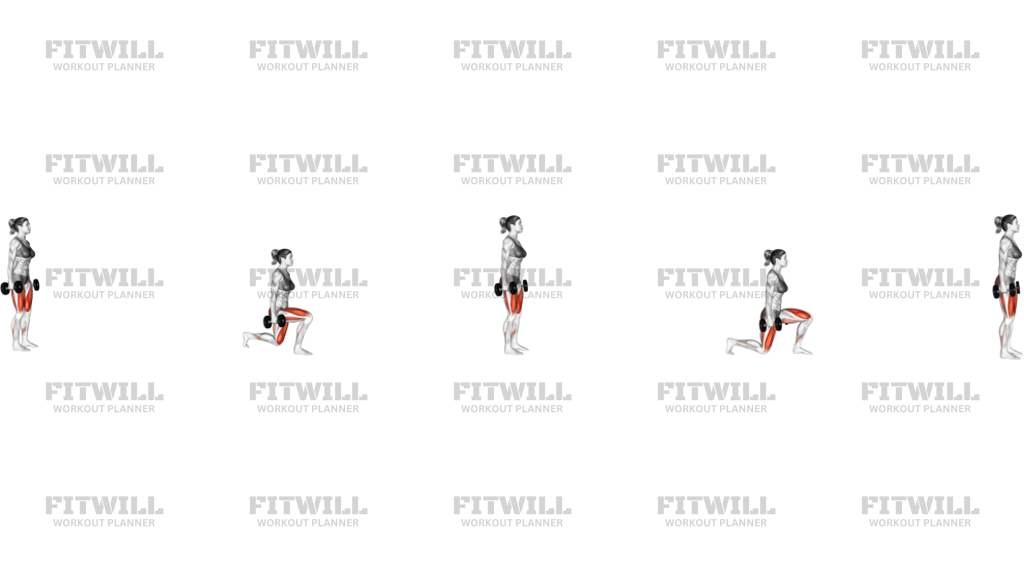
On the way down, the front knee and back knee bend together as the torso stays mostly upright and the front shin stays under control. The back knee moves toward the floor, the front foot stays planted, and the hips drop straight between your legs instead of drifting side to side. Drive back up through the front heel and midfoot, then step through smoothly into the next lunge so the set looks like one steady walk rather than a series of rushed stumbles.
Dumbbell Walking Lunge is a strong choice for leg day finishers, accessory work, or athletic conditioning because it combines strength with coordination. It rewards clean stride mechanics more than brute force, so the best sets are the ones where each step looks almost identical. If balance, knee comfort, or trunk control starts to fade, shorten the stride, lighten the dumbbells, or switch to a slower, more deliberate pace before the pattern breaks down.
[ Workout Log & Planner ]
Put your next workout in Fitwill
Keep your plan and training log ready when you are.


Instructions
- Stand tall with a dumbbell in each hand, arms straight at your sides, feet about hip-width apart, and your chest stacked over your hips.
- Pick a clear path ahead of you so you can step forward without turning or crossing your feet.
- Brace your midsection and keep your shoulders down as you prepare to take the first step.
- Step one leg forward far enough that your front heel stays planted when you lower.
- Lower until both knees bend and the back knee hovers just above the floor.
- Keep your front knee tracking over the middle toes and your torso mostly upright as you descend.
- Drive through the front heel and midfoot to stand up, bringing the back leg through into the next step.
- Continue walking forward with alternating legs, keeping the dumbbells quiet and your steps smooth.
- Breathe in as you step down and exhale as you stand up through each rep.
- Finish the set by standing tall, then lower the dumbbells to the floor with a controlled hip hinge if needed.
Tips & Tricks
- Take a longer step if your front heel pops up; a short stride usually turns the exercise into a knee-dominant shuffle.
- Keep the dumbbells beside your thighs instead of letting them swing in front of your knees, especially on the way up.
- Land each foot on two tracks, not a tightrope, so your hips do not wobble side to side.
- Let the back knee travel down toward the floor, but do not slam it; a soft touch keeps the rep smoother.
- Keep your ribs stacked over your pelvis so the torso does not fold forward as fatigue builds.
- If the front knee dives inward, slow the step and think about pushing the knee gently toward the second toe.
- Use a flatter floor and a steady pace when the dumbbells start to pull you off balance.
- A slightly slower walking rhythm usually works better than trying to cover ground quickly.
- If your lower back takes over, shorten the stride and reduce the load before continuing.
- Stop the set when the last step becomes noisy or uneven; this exercise should look controlled from start to finish.
Frequently Asked Questions
What muscle does Dumbbell Walking Lunge target most?
The glutes are the main driver, with the thighs doing a lot of the work as you step, lower, and stand back up.
Can beginners perform this exercise?
Yes. Beginners should start with light dumbbells or even bodyweight so they can learn the stride length, balance, and knee tracking first.
How far forward should I step in Dumbbell Walking Lunge?
Step far enough that your front heel stays down and both knees can bend comfortably without the torso collapsing forward.
Should my front knee go past my toes?
A little forward travel is normal, but the knee should stay aligned with the middle toes instead of caving inward or shooting far ahead because the step was too short.
What if the dumbbells make me lose balance?
Slow the pace, reduce the load, and keep the dumbbells still at your sides instead of letting them swing across your body.
Is Dumbbell Walking Lunge different from a stationary lunge?
Yes. Walking lunge adds continuous forward movement, so it challenges coordination and hip stability more than a split squat or stationary lunge.
What should I do if my back knee hits the floor hard?
Shorten the depth slightly and control the lowering phase so the back knee floats close to the floor instead of dropping onto it.
Can I use Dumbbell Walking Lunge as a finisher?
Yes. It works well near the end of a leg session if you keep the load moderate and the steps crisp rather than turning it into a sprint.