Bodyweight Standing Military Press
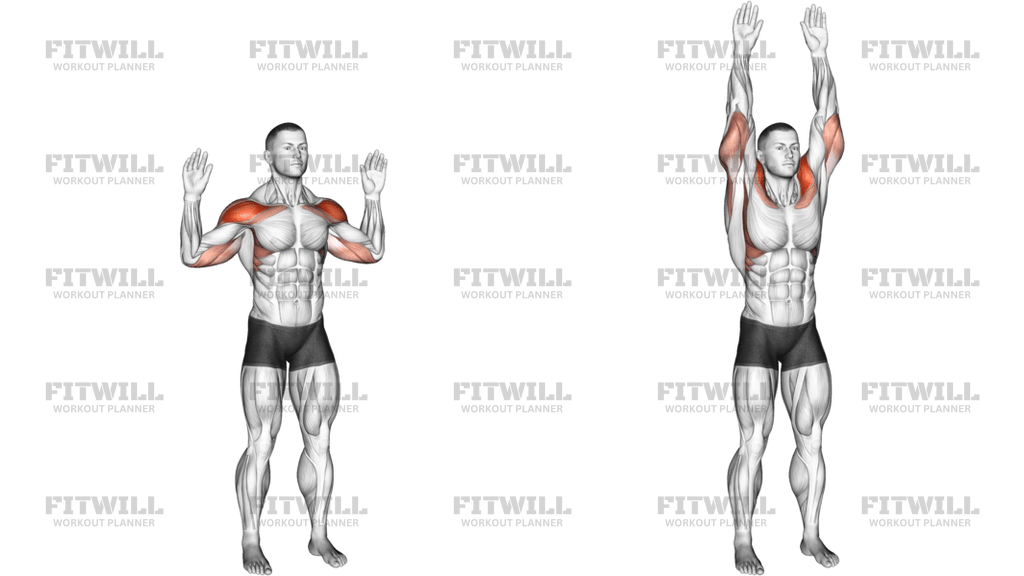
Bodyweight Standing Military Press is an unloaded standing overhead press pattern used to train shoulder control, trunk position, and coordinated arm reach. From a tall stance, you start with the elbows bent near shoulder height and the forearms vertical, then press both hands straight up until the arms finish overhead beside the ears. Because there is no external load, the exercise is useful as a warm-up drill, a low-fatigue accessory, or a regression for people who need cleaner overhead mechanics before adding weight.
The main benefit of the movement is not brute strength, but the ability to keep the body stacked while the shoulders move through a full press path. The delts do most of the work, while the triceps, serratus anterior, upper back, and core help keep the motion smooth and symmetrical. A good rep feels organized from the floor to the fingertips: the ribs stay down, the neck stays long, and the finish position is tall rather than arched.
Setup matters because standing overhead work exposes compensations quickly. If the feet are unstable, the ribs flare, or the chin pushes forward, the press turns into a lower-back or neck exercise instead of a shoulder drill. Keep the pelvis neutral, brace lightly before each rep, and let the arms travel in a straight line so the elbows stack under the wrists at the start and the wrists stack over the shoulders at the top.
Use Bodyweight Standing Military Press when you want repetition quality, shoulder mobility under control, and a simple way to practice the overhead pattern without equipment. It fits well before pressing sessions, in activation circuits, or as a technical finisher when load is not the priority. Keep every repetition pain-free, lower with control, and stop the set as soon as the torso starts to lean back or the shoulders lose their clean path.
[ Workout Log & Planner ]
Put your next workout in Fitwill
Keep your plan and training log ready when you are.


Instructions
- Stand tall with your feet about hip-width apart, knees soft, glutes lightly engaged, and ribs stacked over the pelvis.
- Raise your upper arms to shoulder height with your elbows bent about 90 degrees, forearms vertical, and hands beside your face in a goalpost position.
- Set your neck long, keep your chin slightly tucked, and brace your midsection before you begin the press.
- Press both hands straight upward until your elbows straighten and your arms finish beside your ears.
- Keep the path smooth and avoid leaning back as the hands travel overhead.
- Pause for a brief moment at the top without shrugging hard or losing the rib-cage position.
- Lower the hands along the same path back to the goalpost position with control.
- Reset your posture, breathe, and repeat for the planned number of reps.
Tips & Tricks
- Think of reaching the hands toward the ceiling, not arching the chest upward to fake extra range.
- If your lower back starts to take over, shorten the overhead range and keep the ribs pinned down.
- Keep the forearms vertical at the start so the wrists sit directly above the elbows before you press.
- Squeeze the glutes lightly to stop the pelvis from tipping forward as the arms rise.
- Let the shoulder blades rotate upward naturally instead of forcing them down and back.
- Lower the arms slowly; the return phase is where many people lose shoulder position and dump into the neck.
- Stop the rep if the elbows drift far in front of the body or the wrists wobble overhead.
- Use a pain-free range only; a clean partial press is better than forcing a painful lockout.
Frequently Asked Questions
What muscles does Bodyweight Standing Military Press work?
It mainly trains the deltoids, with help from the triceps, serratus anterior, upper back, and core that keep the press stacked.
How should the start position look?
Start with your elbows around shoulder height, forearms vertical, and hands beside your face so the press can travel straight overhead.
Should my ribs flare when I press overhead?
No. Keep the ribs down and the pelvis neutral so the movement comes from the shoulders instead of a lower-back arch.
Why do I feel this in my neck or upper traps?
That usually means you are shrugging or reaching forward with the head. Keep the neck long and finish with the arms beside the ears, not the shoulders jammed up.
Can beginners use this movement?
Yes. The bodyweight version is a good introduction to overhead mechanics because you can practice the pattern without external load.
What should I do if overhead range feels tight?
Use a smaller pain-free range, slow the lowering phase, or pair it with shoulder mobility work before you press.
Is this the same as a dumbbell shoulder press?
No. The pattern is similar, but this version is a load-free control drill rather than a strength exercise with external resistance.
When should I program this exercise?
It works well in warm-ups, activation circuits, accessory blocks, or any session where clean overhead mechanics matter more than heavy loading.