Medicine Ball Around Head Rotation
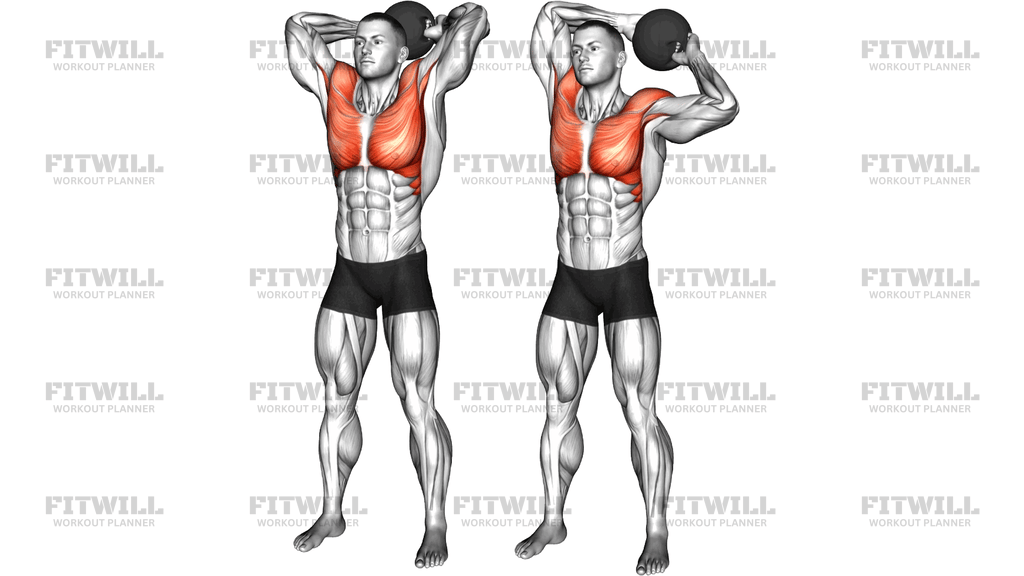
Medicine Ball Around Head Rotation is a standing halo-style shoulder drill that moves a medicine ball in a controlled circle around the head. The exercise asks the shoulders, upper back, arms, and trunk to stay organized while the ball travels from one side of the head to the other, so it is useful when you want mobility, stability, and light conditioning in the same movement.
The setup matters because the halo path changes as soon as the ribs flare, the chin lifts, or the torso starts chasing the ball. A clean repetition begins with the feet planted, the core lightly braced, and the ball held close enough to the head that the circle stays smooth. That compact path lets the shoulders do the work instead of turning the drill into a sway or a back extension.
As the ball travels around the crown of the head, keep the elbows bent and the forearms active so the load stays controlled near the head and upper shoulders. The movement should feel deliberate on both sides of the circle, with no jerking when the ball passes behind the neck or in front of the face. If the shoulders feel pinched, shorten the arc and slow the tempo before adding load.
This exercise is commonly used in warmups, accessory blocks, athletic prep, or shoulder-focused circuits because it reinforces coordinated overhead control without needing a heavy weight. It can also be a useful regression for people who are not ready for loaded overhead work, provided the ball stays light and the neck remains relaxed. The goal is clean positioning and smooth travel, not speed.
Use a medicine ball that lets you keep the circle tight and symmetrical for every rep. If the body leans, the head juts forward, or the ball drifts far from the head, the set is too heavy or the range is too large. Done well, this is a controlled shoulder and trunk coordination drill, not a max-strength lift.
[ Workout Log & Planner ]
Put your next workout in Fitwill
Keep your plan and training log ready when you are.


Instructions
- Stand tall with your feet about hip-width apart and hold the medicine ball in front of your chest.
- Lift the ball toward one side of your head, keeping your elbows bent and your ribs stacked over your pelvis.
- Guide the ball behind the head in a smooth arc, letting the shoulders rotate while the torso stays mostly still.
- Continue the circle over the top of the head and bring the ball around to the other side without letting it drift far away.
- Keep your neck long and your chin neutral as the ball passes behind and beside the head.
- Finish the halo by returning the ball to the front of your chest with control.
- Exhale as you move the ball through the most challenging part of the circle and inhale as you return to the start.
- Repeat for the planned number of reps, then lower the ball safely to finish.
Tips & Tricks
- Keep the ball close to your head; a smaller halo is usually smoother and safer than a wide swing.
- If your lower back arches as the ball goes behind you, lower the load and brace harder through the ribs.
- Let the elbows bend naturally instead of locking the arms straight, which makes the circle harder to control.
- Move slowly enough that you can feel both sides of the arc, especially when the ball passes behind the neck.
- Keep your chin level so you do not crane forward to follow the ball.
- Use a light medicine ball that you can steer, not one that forces you to lean or shrug.
- If one shoulder feels tighter, reduce the height of the circle before you try to go heavier.
- Stop the set when the ball starts drifting or the torso starts twisting to compensate.
Frequently Asked Questions
What does Medicine Ball Around Head Rotation train?
It mainly trains shoulder control, upper-back coordination, and trunk stability while the ball moves around the head.
Can beginners perform this exercise?
Yes. Beginners should use a very light medicine ball and keep the halo tight and slow.
Should the ball stay close to the head the whole time?
Yes. The ball should travel in a compact circle around the head, not swing far away from it.
What is the most common mistake?
People usually arch the lower back or let the torso sway instead of keeping the halo controlled by the shoulders.
How heavy should the medicine ball be?
Light enough that you can keep the circle smooth, symmetrical, and close to the head for every rep.
Do I need to keep my elbows locked?
No. A bent-elbow position usually makes it easier to control the ball and keep the path clean.
Where does this fit in a workout?
It works well in a warmup, shoulder-prep block, or accessory circuit before heavier overhead work.
What should I do if the ball passes behind my neck and feels awkward?
Shorten the circle and slow the tempo until you can keep the halo smooth without shrugging or craning your neck.