Lying Leg Raise Modified
Lying Leg Raise Modified is a bent-knee floor variation of the leg raise that shifts the work toward the lower abs and hip flexors while making it easier to keep the low back from arching. Because the knees stay bent, the lever is shorter than in a straight-leg raise, so the exercise is easier to control and better suited to people who need a cleaner regression before progressing to longer-lever leg raises.
The value of this exercise comes from pelvic control. When you lie flat and raise the legs with bent knees, the goal is not to swing the thighs up and down. The goal is to keep the ribcage down, brace the midsection, and let the pelvis curl slightly as the knees come in. That small posterior pelvic tilt is what turns the movement into an abdominal exercise instead of a hip-swinging drill.
Set up on the floor or a mat with your arms by your sides for balance. Bend the knees to shorten the lever, then start with the legs in a position you can hold without your lower back lifting. From there, lift the knees and thighs with control, pause when the abs are fully engaged, and lower slowly until you can reset without losing tension or letting the lumbar spine take over.
Use this movement as a core accessory, a warm-up for more advanced leg-raise work, or a regression when straight-leg raises are too demanding on the lower back or hip flexors. It is especially useful when you want abdominal tension without heavy spinal loading, but it still needs clean mechanics. If the legs swing, the neck tenses, or the back arches, shorten the range and slow the tempo until the rep is crisp again.
Fitwill
Log Workouts, Track Progress & Build Strength.
Achieve more with Fitwill: explore over 9600 exercises with images and videos, access built-in and custom workouts, perfect for both gym and home sessions, and see real results.
Start your journey. Download today!




Instructions
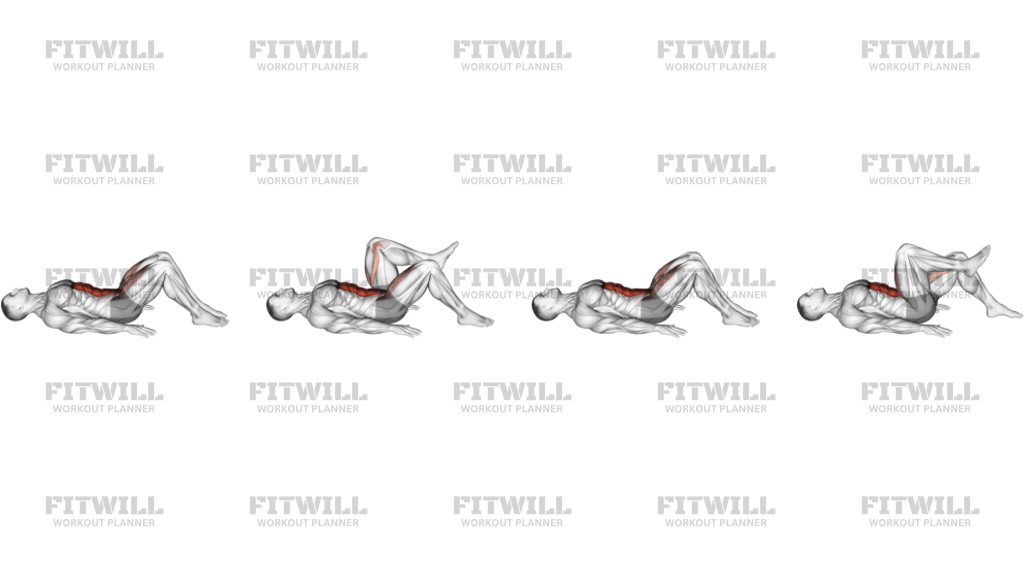
- Lie on your back on the floor or a mat with your arms by your sides for balance.
- Bend your knees so the shins stay roughly parallel to the floor and keep the feet relaxed.
- Press your lower back gently into the floor before you start the first rep.
- Exhale and lift your knees toward your chest without swinging your legs.
- At the top, let the pelvis curl slightly so the abs take over instead of the hip flexors.
- Pause for a moment while keeping the ribs down and the neck relaxed.
- Lower your legs slowly until the low back is about to lose contact, then stop the descent.
- Reset the brace and repeat for the planned number of reps.
Tips & Tricks
- Keep the knees bent at about 90 degrees if straight legs make your lower back arch.
- Think about curling the tailbone up slightly, not just lifting the thighs.
- If your hip flexors dominate, shorten the range and focus on the last few inches of the curl.
- Do not let the feet drift overhead or behind you; that usually turns the rep into momentum.
- Lower slowly enough that you can feel the abs resist the descent instead of dropping the legs.
- Keep your chin neutral and look at the ceiling so the neck does not help the lift.
- Exhale as the knees come in and avoid holding your breath at the top.
- Stop the set when the low back starts peeling off the floor or the legs begin to swing.
Frequently Asked Questions
What does Lying Leg Raise Modified work most?
It mainly trains the lower abdominals and hip flexors, with the bent-knee position making the ab work easier to control.
Why are the knees bent instead of straight?
Bent knees shorten the lever, so the exercise is easier on the low back and better for learning pelvic control before progressing to straighter leg raises.
Should my lower back stay on the floor the whole time?
Yes, the low back should stay pressed down as much as possible. If it arches off the floor, reduce the range or bend the knees more.
Is this the same as a straight-leg raise?
No. This modified version uses bent knees, which reduces difficulty and usually makes it easier to avoid swinging or overextending the spine.
How do I know if I am using the abs or just the hip flexors?
If the pelvis curls slightly and the ribs stay down, the abs are doing the work. If the thighs just move and the low back arches, the hip flexors are taking over.
Can beginners do this exercise safely?
Yes, this is a good beginner regression as long as the movement stays slow and the lower back does not pop off the floor.
What is the most common mistake with the floor setup?
People often let the ribcage flare and the neck tense up. Keep the head relaxed and the torso heavy against the mat.
How can I make the movement harder later?
Progress to a straighter-leg variation, slow the lowering phase, or add a pause at the top while keeping the same floor setup.