Kettlebell Half Kneeling One-Arm Bottoms-Up Press
Kettlebell Half Kneeling One-Arm Bottoms-Up Press is a shoulder stability exercise built around a very unforgiving kettlebell position: the bell stays upside down while you press from shoulder height to full lockout. That unstable load makes every rep honest. If your wrist collapses, your elbow drifts, or your torso leans, the kettlebell tells you immediately.
The half-kneeling stance adds another layer of control because it removes help from the lower body and forces you to organize the pelvis and ribs before you press. One knee stays on the floor, the opposite foot is planted in front, and the torso should stay tall without twisting. That makes Kettlebell Half Kneeling One-Arm Bottoms-Up Press useful for shoulder strength, upper-back control, and trunk stiffness all at once.
The movement is especially good for learning to stack the wrist, elbow, and shoulder under load. A clean rep starts with the forearm vertical, the bell balanced above the hand, and the elbow close enough to the body to keep the press smooth. From there, the kettlebell travels in a straight path overhead until the arm finishes beside the ear without shrugging or arching the low back.
Because the bell is upside down, load selection matters more than ego. A lighter kettlebell used with precision is far more productive than a heavier one that wobbles, tips forward, or forces the torso to compensate. Kettlebell Half Kneeling One-Arm Bottoms-Up Press is often used as accessory work, a warm-up for overhead lifting, or a control drill when you want shoulder strength without sloppy reps.
For most lifters, the goal is not to chase fatigue but to keep every repetition crisp from the rack to the lockout and back down. If the bell starts to drift, the wrist bends back, or the kneeling side loses tension, end the set and reset. This is a press where balance, breathing, and body position matter as much as force.
Fitwill
Log Workouts, Track Progress & Build Strength.
Achieve more with Fitwill: explore over 9600 exercises with images and videos, access built-in and custom workouts, perfect for both gym and home sessions, and see real results.
Start your journey. Download today!




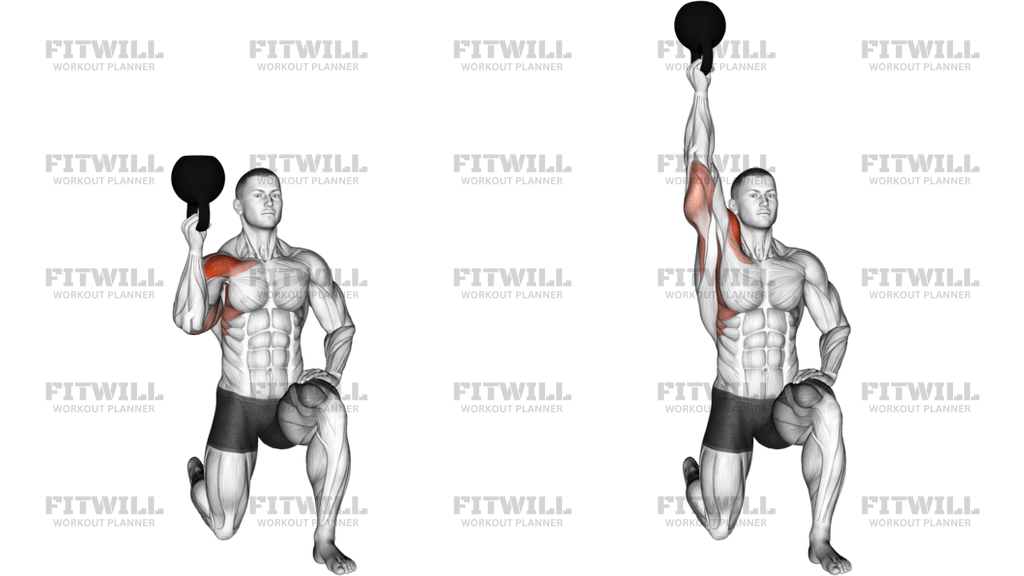
Instructions
- Kneel on one knee with the opposite foot flat in front, and hold a kettlebell at shoulder height in the same hand as the front-rack side.
- Keep the bell upside down above your palm, with your wrist straight, elbow under the kettlebell, and forearm vertical.
- Square your hips and ribs to the front, then lightly squeeze the glute on the kneeling side so the torso stays tall.
- Take a breath and brace before each rep so the trunk does not lean toward or away from the pressing arm.
- Press the kettlebell straight up from the shoulder, guiding it in a clean line rather than letting it swing forward.
- Finish with the arm locked out overhead, biceps near the ear, and the kettlebell stacked over the shoulder and hip.
- Lower the bell under control back to the rack position, keeping the bell balanced and the wrist from folding back.
- Reset your breath and posture before the next repetition, then switch sides after completing the set.
Tips & Tricks
- Choose a kettlebell you can keep perfectly upside down for the full set; once the bell starts tipping, the set is too heavy.
- Keep the knuckles pointed up at the ceiling in the rack and overhead positions so the wrist does not bend back under the bell.
- If the pressing shoulder shrugs toward the ear, lower the load and finish with the shoulder blade stable instead of jammed upward.
- Squeeze the kneeling-side glute hard enough to keep the pelvis from dumping forward as you press.
- A slow lowering phase exposes wobble more than the press does, so control the descent instead of dropping it back to the shoulder.
- Do not let the front ribs flare to fake extra range; the rep should come from the shoulder, not a backbend.
- Keep the elbow slightly in front of the torso on the way up so the kettlebell stays stacked instead of drifting wide.
- Use shorter sets if your forearm starts to burn and the bell begins to wobble, because grip fatigue is usually the first limiter.
Frequently Asked Questions
What muscles does Kettlebell Half Kneeling One-Arm Bottoms-Up Press work?
It mainly challenges the shoulders, especially the pressing side, while the upper back, forearm, triceps, and core work hard to keep the kettlebell stable.
Why use the bottoms-up position instead of a regular kettlebell press?
The upside-down kettlebell makes grip and shoulder stability more demanding, so you get more control work from a lighter load.
Should my elbow stay close to my body in Kettlebell Half Kneeling One-Arm Bottoms-Up Press?
Yes. Keep it tucked enough to stay under the bell in the rack, then press in a straight line without flaring it wide.
Is Kettlebell Half Kneeling One-Arm Bottoms-Up Press beginner friendly?
It can be, but only with a very light kettlebell and careful coaching. Beginners should first learn to hold the bell stable in the rack before pressing overhead.
What should I feel if the press is set up correctly?
You should feel the shoulder, forearm, and upper back working to keep the bell balanced, with the core helping you stay tall instead of leaning.
What if the kettlebell keeps tipping forward?
Use less weight and slow the press down. If the bell cannot stay stacked above your palm in the rack, the load is too heavy for this variation.
Can I do Kettlebell Half Kneeling One-Arm Bottoms-Up Press standing instead?
Yes, but standing removes some of the trunk-control demand. Half kneeling is better if you want to limit body sway and make the press more strict.
Why use half kneeling for this press?
Half kneeling helps you keep the pelvis and ribs stacked, which makes it easier to press overhead without leaning or twisting.
How heavy should Kettlebell Half Kneeling One-Arm Bottoms-Up Press be?
Light enough that the kettlebell stays steady through the whole rep. For this movement, control is the metric that matters more than load.