Bodyweight Front Plank To Downward Dog
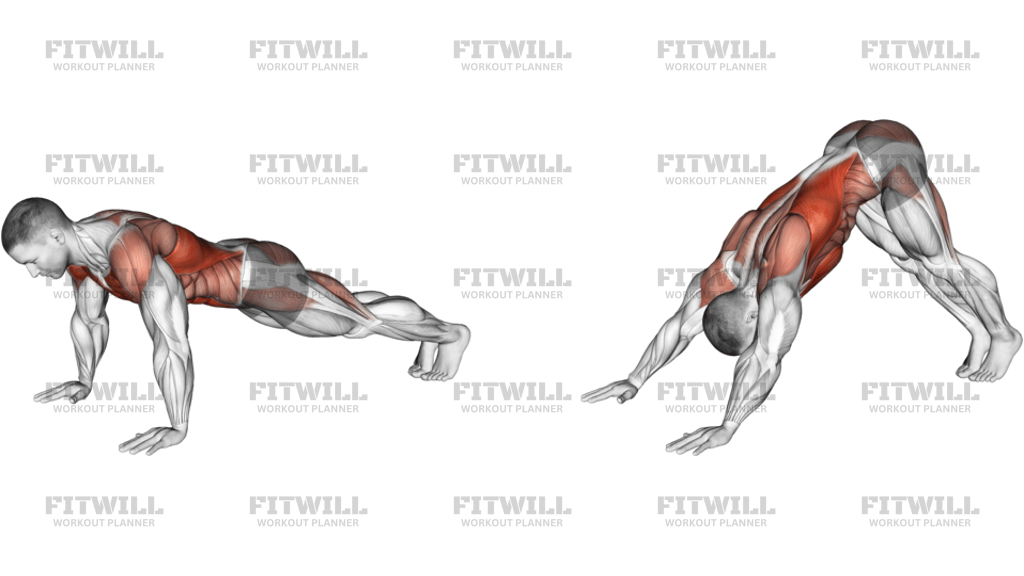
Bodyweight Front Plank To Downward Dog is a floor-based bodyweight movement that links a strong front plank with a hip-driven pike position. It trains shoulder stability, trunk control, and posterior-chain mobility in one continuous rep, so the value comes from keeping the torso organized while the hips travel back and up. The exercise is especially useful when you want core work that also opens the shoulders, lats, hamstrings, and calves.
The front plank portion teaches you to hold a rigid line from shoulders through heels while the hands press firmly into the floor. In the downward-dog portion, the body shifts into an inverted V, which changes the demand from anti-extension strength to a controlled stretch and shoulder flexion pattern. That transition makes the movement more demanding than a static plank because the trunk has to stay steady while the leverage changes.
Set your hands under the shoulders and walk the feet back until the body forms a straight line in the plank. Keep the fingers spread, the shoulders active, and the glutes engaged before you begin the first rep. If your hamstrings are tight, the knees can bend slightly in the downward-dog position so the spine stays long instead of collapsing into a rounded fold.
From the plank, press the floor away and drive the hips up and back until the head moves between the arms and the heels reach toward the floor. The path should feel like a smooth hinge through the shoulders and hips rather than a sudden crunch at the waist. Return to the plank with control, re-stacking the shoulders over the wrists and restoring a straight body line before the next repetition.
Bodyweight Front Plank To Downward Dog fits well in warm-ups, core circuits, and accessory blocks because it gives you both bracing practice and dynamic mobility without loading the spine. It is also a practical choice for beginners who need a simpler floor movement that still teaches body tension, but the rep quality matters more than speed or volume. If the low back sags in plank or the shoulders collapse in the pike, shorten the range and slow the tempo until both positions feel clean.
[ Workout Log & Planner ]
Put your next workout in Fitwill
Keep your plan and training log ready when you are.


Instructions
- Place your hands on the floor under your shoulders and walk your feet back until your body is in a straight front plank.
- Spread your fingers, press through your palms, and keep your feet about hip-width apart for balance.
- Tuck your ribs slightly, squeeze your glutes, and keep your neck long with your gaze a little ahead of your hands.
- Hold the plank long enough to feel the shoulders, abs, and glutes working before you start the first rep.
- Exhale and push the floor away as you send your hips up and back into a downward-dog shape.
- Let your head travel between your arms and reach your heels toward the floor without forcing them down.
- If your hamstrings are tight, keep a soft bend in the knees so your spine stays long instead of rounding.
- Inhale as you shift forward and lower your hips back into a strong plank with the shoulders over the wrists.
- Repeat for the planned number of reps, then lower your knees or step your feet forward to come out of the position safely.
Tips & Tricks
- Think about pushing the floor away in both positions; the shoulders should stay active instead of sinking toward the ears.
- Keep the plank shape honest on the way up and down. If the low back arches in plank, shorten the lever by widening the feet or bending the knees slightly.
- In the downward-dog phase, aim for a long spine first and a low heel second. A rounded back usually means the hips need to stay a little higher.
- Let the movement happen from the shoulders and hips, not by collapsing the torso at the waist.
- Use a small knee bend if your hamstrings pull you out of position or if your heels lift aggressively.
- Press evenly through the whole hand, especially the index finger and thumb side, to reduce wrist wobble.
- Move slowly enough to feel the transition from plank to pike and back again; rushing usually turns the exercise into a shoulder shrug.
- If the exercise is part of a warm-up, keep the reps smooth and easy. If it is part of core work, pause for a second in both the plank and the downward-dog position.
Frequently Asked Questions
What does Bodyweight Front Plank To Downward Dog work the most?
It mainly challenges the shoulders, abs, and upper back while also stretching the hamstrings, calves, and lats as you move into the downward-dog position.
Is Bodyweight Front Plank To Downward Dog more of a strength or mobility exercise?
It is both. The plank builds trunk and shoulder stability, while the downward-dog portion adds active mobility through the shoulders and posterior chain.
Can beginners do Bodyweight Front Plank To Downward Dog?
Yes. Beginners usually do best with slower reps, a small knee bend in the downward-dog position, and fewer total reps so the plank stays strong.
Should my heels touch the floor in the downward-dog part?
Not necessarily. Reaching the heels down is fine, but the priority is a long spine and active shoulders, not forcing the heels flat.
Why do my hips feel jammed when I move from plank to downward dog?
That usually means the shoulders or hamstrings are limiting the range. Shorten the motion, bend the knees a little, and focus on a smooth transition instead of a big pike.
What is the biggest form mistake in Bodyweight Front Plank To Downward Dog?
Letting the low back sag in the plank or collapsing through the shoulders in the pike. Both usually mean the body is moving faster than the core can control.
How many reps of Bodyweight Front Plank To Downward Dog should I do?
A controlled set of 6 to 12 reps is a common starting point. If the movement is being used for warm-up mobility, even fewer reps can be enough.
Can I modify Bodyweight Front Plank To Downward Dog if my wrists bother me?
Yes. You can place your hands on dumbbells or push-up handles for a more neutral wrist angle, or do the movement on an incline surface.