Boxing Jab With Boxing Bag
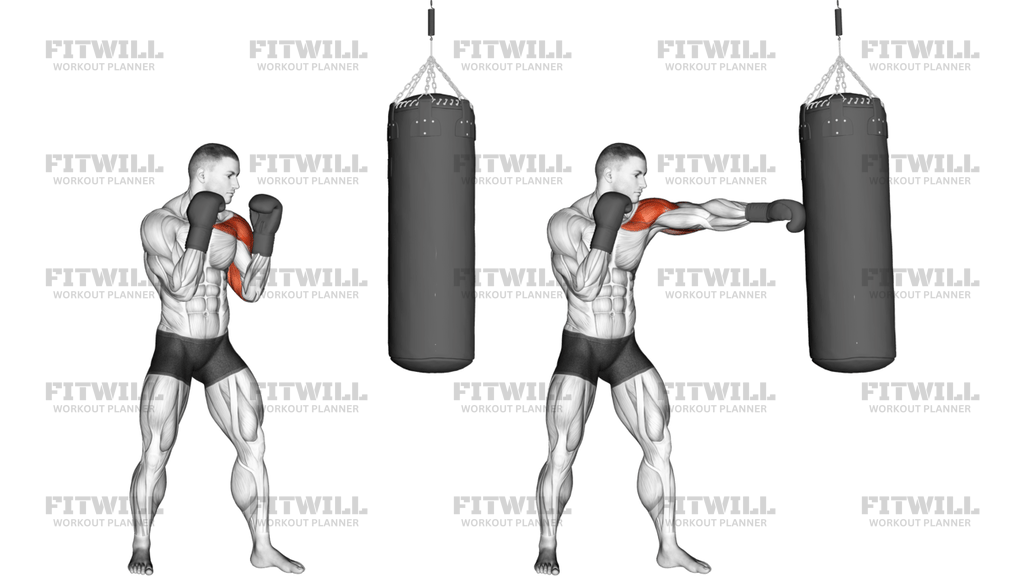
Boxing Jab With Boxing Bag is a straight lead-hand punch into a hanging heavy bag. It is a simple-looking drill, but the quality of each rep depends on how well you organize your stance, guard, and breathing before the fist leaves your face. When the setup is right, the jab becomes a sharp, repeatable strike that trains speed, coordination, shoulder endurance, and control rather than a wild arm swing.
The movement mainly challenges the lead shoulder, triceps, chest, upper back, and core to work together while the rest of the body stays compact. Your rear hand, rib cage, and trunk help keep the punch aligned, and your front-side shoulder has to stay active so the jab can travel fast and return just as quickly. If you let the punch drift off line or overreach, the bag will swing more and the rep will stop feeling like a crisp boxing jab.
Distance matters. Stand far enough from the bag that the lead arm can extend without locking hard at the elbow, and close enough that you do not have to lean your torso forward to make contact. Keep a light boxing stance, knees soft, chin tucked, and the rear hand near the cheek while the lead shoulder stays slightly raised. The jab should shoot straight from the guard to the bag and come back on the same line, with the wrist stacked and the knuckles landing flat.
This exercise is useful in warmups, conditioning rounds, technique work, and accessory circuits because it teaches you to strike without losing posture. Beginners can use it to learn how to punch from a stable base, while more experienced trainees can use it to sharpen timing, rhythm, and snap. The bag should move, but it should not be blasted so hard that you start chasing it around the floor.
Treat every repetition as a clean contact-and-return cycle. A good jab lands, briefly transfers force, then snaps back to guard before the next punch starts. That rhythm is what makes Boxing Jab With Boxing Bag valuable for both skill practice and upper-body conditioning. Keep your shoulders relaxed between punches, protect your hands with wraps or gloves, and stop the set if the wrist bends, the rear hand drops, or the bag starts swinging from uncontrolled power.
[ Workout Log & Planner ]
Put your next workout in Fitwill
Keep your plan and training log ready when you are.


Instructions
- Stand in a boxing stance beside the hanging bag, with your lead foot slightly forward, feet about shoulder-width apart, knees soft, and your fists raised to cheek level.
- Set your distance so the lead arm can reach the bag without fully locking the elbow or forcing your torso to lean forward.
- Keep your rear hand tight to the side of your face, your chin tucked, and your shoulders relaxed but ready.
- Brace lightly through your midsection and drive the lead fist straight toward the center of the bag.
- Land the jab with the first two knuckles lined up, the wrist straight, and the lead shoulder rising to help protect your chin.
- Exhale sharply as the glove touches the bag, then keep the punch short and crisp instead of pushing through the target.
- Snap the lead hand straight back to guard on the same line you punched, keeping the elbow close to your ribs on the return.
- Reset your stance, recheck your distance, and repeat for the planned number of reps before stepping out of range.
Tips & Tricks
- If the bag is too close, you will overbend the elbow; if it is too far, you will lean and lose balance. Adjust your stance until the jab lands with a straight arm path and no torso reach.
- Let the punch start from a small push through the floor and a slight shoulder turn, not from a big swing of the arm.
- Keep the rear hand glued to your cheek for every rep so the return to guard becomes automatic.
- Think of the jab as a quick touch-and-retract strike. If the bag starts rocking heavily, your punch is probably pushing instead of snapping.
- Keep the wrist stacked over the knuckles at impact so the force travels into the bag instead of folding the hand back.
- Let the lead shoulder rise at the end of the jab to cover the jaw, but do not shrug so hard that the neck tenses up.
- Use wraps and gloves if you are striking the bag with any speed or volume, especially when your technique is still developing.
- Shorter, cleaner jabs usually make better conditioning rounds than hard lunges that break your stance and leave you off balance.
Frequently Asked Questions
What muscles does Boxing Jab With Boxing Bag work?
It mainly trains the lead shoulder, triceps, chest, upper back, and core as they stabilize the punch and bring the hand back to guard.
How far should I stand from the bag for Boxing Jab With Boxing Bag?
Stand close enough that the lead arm can extend straight without locking hard at the elbow, but not so close that you have to lean your chest toward the bag.
Should my rear hand move when I throw the jab?
No. Keep the rear hand parked at your cheek or temple so the non-punching side stays protected and balanced.
Do I need to rotate my hips a lot on the jab?
Only a small amount. The jab stays mostly straight and compact, with just enough weight shift to make the punch snap without turning it into a cross.
Can beginners do Boxing Jab With Boxing Bag?
Yes. Start with slow, light jabs and focus on stance, distance, and a fast return to guard before adding speed or power.
Why does the bag swing so much when I jab?
Usually the punch is pushing through the target or the stance is too narrow. A crisper contact and faster retraction will keep the bag movement smaller.
What is the biggest form mistake in Boxing Jab With Boxing Bag?
Overreaching. If you have to lean or lock out the elbow to touch the bag, your distance is off and the punch will lose speed and control.
Is Boxing Jab With Boxing Bag more for power or conditioning?
It can be used for both, but most people get the best results by treating it as a technique and conditioning drill with clean, repeatable speed.