Front Kick Kickboxing With Partner
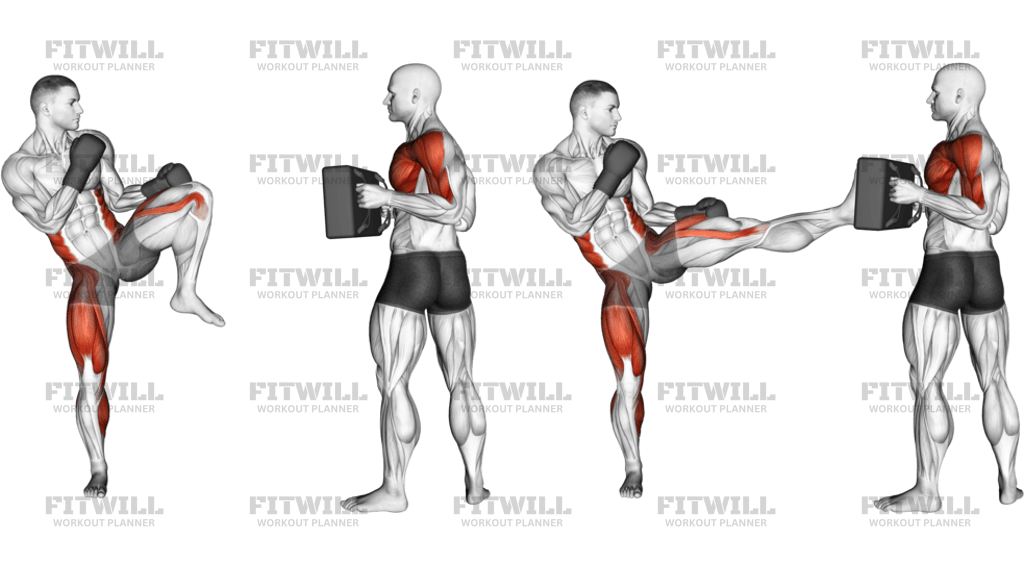
Front Kick Kickboxing With Partner is a standing striking drill that teaches you to lift the knee, extend the leg, make clean contact, and snap the foot back under control. It is useful for developing kicking mechanics, distance judgment, coordination, and conditioning without needing heavy equipment. The partner element matters because the target gives instant feedback on where the kick lands and whether you are reaching, leaning, or staying balanced.
Although the movement is simple on paper, it asks a lot from the kicking leg and the support leg at the same time. The working side uses the hip flexors and quadriceps to chamber and extend the kick, while the standing leg, calves, glutes, and core keep you upright and organized. If the stance is sloppy or the torso drifts too far back, the kick becomes slower, less accurate, and harder to control on the return.
A good Front Kick Kickboxing With Partner rep starts from a fighting stance with the feet staggered, the knees soft, and the hands up. From there, the knee comes up first, the toes pull back, and the lower leg drives forward toward the partner's target. The goal is not to throw the foot and hope it lands; the goal is to lift, strike, and recoil in one clean sequence so the body stays stacked over the base.
Because this is a partner drill, the setup should match the goal of the round. A higher target emphasizes speed and accuracy, while a lower target makes it easier to keep the pelvis tucked and the spine tall. A cooperative partner can help you practice repeated kicks, alternating sides or working the same leg for technical practice, conditioning, or warmup work. In every case, the rep quality should stay crisp enough that you can reset your stance before the next kick.
Front Kick Kickboxing With Partner is also useful as a low-equipment way to build rhythm and timing in martial arts training. It works best when you keep the kick direct, the recovery fast, and the breathing steady. Exhale as the leg extends, re-center as the foot returns, and stop the set if you start leaning, swinging, or losing balance. Clean contact and clean recoil matter more than forcing extra power into every rep.
Fitwill
Log Workouts, Track Progress & Build Strength.
Achieve more with Fitwill: explore over 9600 exercises with images and videos, access built-in and custom workouts, perfect for both gym and home sessions, and see real results.
Start your journey. Download today!




Instructions
- Stand in a fighting stance facing your partner or target, with one foot slightly ahead, knees soft, and your hands up by your cheeks.
- Balance your weight evenly on the balls of both feet so you can lift the kicking leg without tipping your torso backward.
- Lift the knee of the kicking leg straight up first, keeping the toes pulled back and the shin folded underneath you.
- Brace your midsection and keep your chest tall as you drive the knee forward toward the target.
- Extend the lower leg into the front kick and make contact with the ball of the foot or heel, depending on the drill and target.
- Keep the standing foot rooted and avoid over-rotating the hips as you strike.
- Snap the kicking leg back to the chamber position as soon as you hit the target.
- Set the kicking foot back down under your hips, re-establish your stance, and reset your guard before the next rep.
- Breathe out on the kick, inhale as you return to stance, and finish each rep in control before starting the next one.
Tips & Tricks
- A clean chamber is more important than a hard kick; lift the knee before you extend the leg.
- Keep the toes pulled back so the striking surface stays firm and the ankle does not collapse on contact.
- If your torso leans away from the target, lower the target height until you can kick without arching your back.
- Let the standing leg stay slightly bent so you can absorb the recoil instead of locking out the knee.
- Use the partner's target to judge distance; if you are reaching for it, you are too far away.
- Snap the foot back quickly after contact instead of leaving the leg extended and off balance.
- Keep your hands high through the whole rep so the kick does not pull your guard apart.
- Alternate sides only after you can reset the stance cleanly; sloppy foot placement turns the drill into a balance loss exercise.
Frequently Asked Questions
What does Front Kick Kickboxing With Partner work?
It mainly trains the hip flexors, quadriceps, glutes, calves, and core, with the standing leg doing a lot of balance and stabilization work.
Should I strike with the toes or the heel in Front Kick Kickboxing With Partner?
Most drills use the ball of the foot or the heel, with the toes pulled back so the ankle stays protected. Follow the target and style your coach wants.
How high should my partner hold the target?
Start at a height you can reach without leaning back or lifting the supporting heel. If the kick gets sloppy, lower the target and clean up the chamber first.
Can beginners do Front Kick Kickboxing With Partner?
Yes. Beginners should work slowly, keep the kicks short, and use a cooperative target so they can learn the chamber and recoil before adding speed.
Why does my lower back arch when I kick?
You are probably leaning back to reach the target or trying to kick higher than your hip mobility allows. Shorten the range and keep your ribs stacked over your pelvis.
Do I alternate legs or train one side at a time?
Either works. Alternate legs for conditioning and rhythm, or stay on one side longer if you are practicing accuracy and snap on that kick.
What is the biggest mistake in Front Kick Kickboxing With Partner?
Swinging the leg without a clean knee lift is the most common error. The kick should be chamber, strike, and recoil, not a loose leg swing.
Can I use this exercise for conditioning?
Yes. Short rounds with crisp kicks and fast resets are a good conditioning tool, as long as the partner target and your stance stay controlled.