Front Knee Kick Kickboxing With Partner
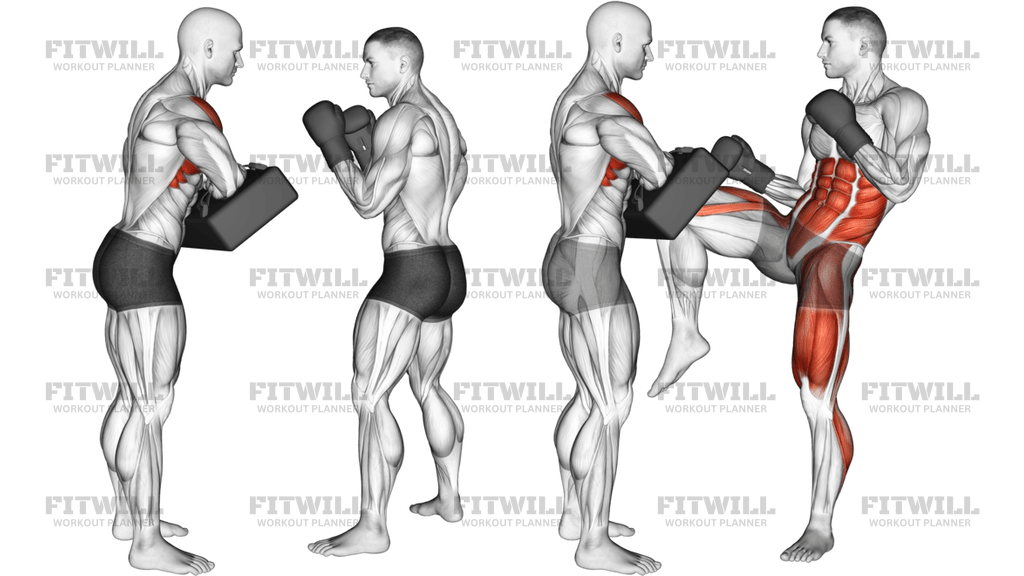
Front Knee Kick Kickboxing With Partner is a partner drill for learning how to drive a compact knee strike into a pad while staying balanced and organized. It is less about raw power than about timing, posture, and a clean line of force from the floor through the hips into the target. The pad gives immediate feedback, so you can see whether the knee is landing straight and whether the upper body stays tall instead of folding forward.
This movement builds more than just leg drive. The standing leg, hips, core, and guard all have to work together to keep you stable while the knee travels up and forward. Because the strike is delivered against a partner-held target, it also trains coordination, distance control, and the ability to repeat the same shape under light fatigue without losing your balance or drifting off line.
Setup matters a lot here. The partner should present the pad at about midsection height and brace it firmly, while you stand in a fight stance with enough space to lift the knee cleanly. Keep your shoulders relaxed, hands high, and weight centered before each rep. If you start too square, lean too far back, or crowd the pad, the strike turns sloppy and the knee loses its direct path.
To perform the rep, chamber the knee first, then drive it straight into the pad with a short hip snap rather than a wild swing. The supporting foot should stay planted and active as you strike, and the torso should stay tall enough to keep the balance on the standing leg. Exhale sharply on contact, then return the foot to the floor under control and reestablish your stance before the next repetition.
Front Knee Kick Kickboxing With Partner fits well in striking practice, conditioning circuits, or warmups where you want a controlled explosive drill without needing heavy equipment. It can be scaled for beginners by using a softer target, slower tempo, and smaller range. For more experienced athletes, the same drill can be made more demanding by improving timing, sharpness, and repeatability rather than simply forcing bigger movement.
Fitwill
Log Workouts, Track Progress & Build Strength.
Achieve more with Fitwill: explore over 9600 exercises with images and videos, access built-in and custom workouts, perfect for both gym and home sessions, and see real results.
Start your journey. Download today!




Instructions
- Stand in a fighting stance facing your partner, with your hands up and your weight centered before the pad comes into range.
- Have your partner hold the strike pad firmly at midsection height, slightly in front of their torso, so the target is stable and easy to read.
- Set your rear heel light and your front foot grounded so you can lift the knee without tipping your chest forward.
- Draw the striking knee up toward the pad by folding at the hip and knee, keeping the toes relaxed and the shin angled forward.
- Drive the knee straight into the center of the pad with a short hip thrust, as if striking through the target rather than stopping on it.
- Keep your opposite hand guarding your face and your ribs tight so your upper body does not collapse as the knee lands.
- Exhale sharply at contact, then pull the knee back and place the foot down under control to reset your stance.
- Re-center your balance before the next rep, or switch sides if the drill calls for alternating knees.
Tips & Tricks
- A firm pad hold matters more than extra force; if the target moves too much, the knee strike will turn into a chase instead of a clean line.
- Keep your chest tall at contact. Folding forward usually turns the strike into a bent-over shove and takes power away from the hip.
- Think of lifting the knee first and striking second. If you swing the leg from the floor, the movement gets noisy and loses balance.
- The planted foot should stay active. Let the ball of the foot and hip on the standing side help stabilize the strike instead of twisting hard at the knee.
- Use a short, sharp exhale on impact rather than holding your breath through the rep.
- The pad should meet the knee, not the other way around. If you are overreaching, step in slightly before striking.
- Keep the guard high. Dropping both hands makes the drill look powerful but leaves the head and ribs exposed.
- If the hip flexors or standing ankle start to wobble, reduce speed and strike with a smaller chamber until the line stays clean.
Frequently Asked Questions
What muscles does Front Knee Kick Kickboxing With Partner work?
It mainly trains the hip flexors, glutes, core, and the standing leg that supports the strike. The upper body also works to keep your guard and posture stable.
How should my partner hold the pad for Front Knee Kick Kickboxing With Partner?
The pad should be braced firmly at about stomach or lower-rib height, slightly in front of the torso. A stable target makes it easier to learn a straight knee path and better timing.
Is Front Knee Kick Kickboxing With Partner a knee strike or a front kick?
In this drill, it is a knee strike. You chamber the knee and drive it into the pad, rather than extending the lower leg like a front kick.
What is the most common mistake in Front Knee Kick Kickboxing With Partner?
Leaning forward and swinging the leg instead of lifting the knee under control. That usually makes the strike lose power and throws off balance.
Can beginners do Front Knee Kick Kickboxing With Partner?
Yes. Beginners should use a soft pad, slow tempo, and short range so they can learn the chamber, contact point, and reset without rushing.
Where should I feel the strike when Front Knee Kick Kickboxing With Partner is done well?
You should feel the working side of the hip and the core as the knee drives in, plus the standing leg stabilizing you. The contact should feel direct and compact, not like a wild swing.
What stance works best for Front Knee Kick Kickboxing With Partner?
A comfortable fighting stance with the hips slightly staggered works best. It gives you enough room to lift the knee without over-rotating or losing balance.
What should I do if I feel off balance during Front Knee Kick Kickboxing With Partner?
Shorten the strike, slow the rep down, and make sure the pad is not too high or too far away. If needed, reset your stance between every knee instead of chaining reps.