PVC Good Morning
PVC Good Morning is a light hip-hinge drill that teaches you how to push the hips back while keeping the torso braced and the spine neutral. It is useful for warming up the posterior chain, rehearsing good hinge mechanics before loaded deadlifts or good mornings, and building awareness of where the load should sit across the upper back.
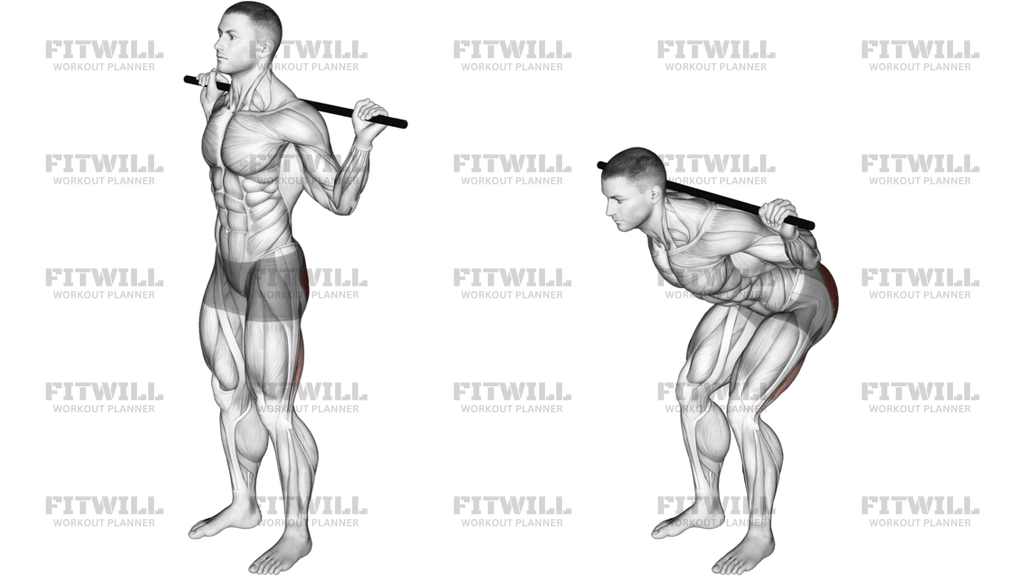
The exercise is best treated as a technical pattern, not a strength test. With a PVC pipe or similar light dowel resting across the upper traps, the goal is to feel the hips travel back, the hamstrings lengthen, and the torso stay organized as the trunk inclines forward. That makes it a practical drill for beginners learning the hinge and for experienced lifters who want cleaner setup before heavier work.
The setup matters more than the range. Stand with feet about hip-width apart, keep a small bend in the knees, and hold the pipe so it stays anchored on the upper back without rolling up toward the neck. From there, brace the midsection, keep the chest long, and hinge until the hamstrings limit the movement rather than the lower back.
On each rep, the body should fold at the hips and then return by driving the hips forward, not by turning the movement into a squat or by overextending at the top. The best reps feel smooth, deliberate, and repeatable. If the torso rounds, the pipe slips, or the knees keep drifting forward, shorten the range and reset the position.
PVC Good Morning fits well in warm-ups, activation circuits, rehab-adjacent technique work, and accessory blocks where you want to rehearse hip extension without heavy spinal loading. It can also be paired with squats, Romanian deadlifts, or split-stance hinge drills to reinforce the same movement pattern from different angles. Keep the resistance light, the motion controlled, and the posture consistent from the first rep to the last.
[ Workout Log & Planner ]
Put your next workout in Fitwill
Keep your plan and training log ready when you are.


Instructions
- Place a PVC pipe or light dowel across your upper back, just below the base of your neck, and hold it with both hands so it stays pinned to your traps.
- Stand with your feet about hip-width apart, toes forward or slightly out, and keep your weight balanced through the midfoot and heels.
- Unlock your knees with a small bend and stack your ribs over your pelvis before you start the hinge.
- Brace your midsection and keep your chest long so the pipe stays in contact with your upper back.
- Push your hips straight back and let your torso tip forward until you feel a strong stretch in the hamstrings.
- Keep the shins nearly vertical and avoid letting the knees drift far forward as you hinge.
- Lower only as far as you can maintain a neutral spine and steady contact between the pipe and your upper back.
- Drive your hips forward to stand tall, squeeze your glutes at the top, and avoid leaning back into the finish.
- Reset your stance and repeat for the planned reps with the same hinge path and tempo.
Tips & Tricks
- If the pipe slides toward your neck, lower it onto the upper traps and soften your grip so it stays anchored.
- Think 'hips back' instead of 'chest down'; the torso should tip because the hips are traveling behind you.
- Keep only a small knee bend. Turning the drill into a squat makes the hinge harder to learn and usually shortens the hamstring stretch.
- Stop the descent when your lower back starts to round or when the pipe no longer stays glued to your upper back.
- A side-view mirror or phone video helps you check whether your torso and shins are staying in a clean hinge pattern.
- Move slowly through the lowering phase so you can feel the hamstrings load before you reverse the rep.
- At the top, finish with the glutes, not by throwing the ribs up and overextending the lower back.
- Keep the resistance light enough that every rep looks the same; this drill works best when it feels precise, not heavy.
Frequently Asked Questions
What muscles does PVC Good Morning work?
It mainly teaches the hamstrings, glutes, and spinal erectors to work together through a hip hinge. The abs and upper back also help keep the pipe stable and the torso braced.
Where should the PVC pipe sit during PVC Good Morning?
The pipe should rest across the upper traps and rear shoulders, not up on the neck. If it shifts around, reset your hand position and keep the elbows softly angled down.
Is PVC Good Morning good for beginners?
Yes. It is a useful beginner drill because the light implement makes it easier to learn where the hips, ribs, and spine should be during a hinge.
How low should I hinge on PVC Good Morning?
Go only as far as you can keep a neutral spine and steady contact between the pipe and your back. For many people that is somewhere between a shallow bow and a torso nearly parallel to the floor.
How is PVC Good Morning different from a Romanian deadlift?
PVC Good Morning puts the implement across the upper back, so it teaches hip movement with the load fixed behind you. A Romanian deadlift holds the weight in front of the body, which changes the balance demand and the way the hinge feels.
Why do my knees bend too much during PVC Good Morning?
That usually means you are dropping into a squat instead of sending the hips back. Keep the knees unlocked, then think about sliding the hips behind your heels before the torso tips forward.
What should I feel most in PVC Good Morning?
You should feel the hamstrings lengthen on the way down and the glutes help drive you back to standing. If you mostly feel it in the low back, shorten the range and tighten the brace before each rep.
Can I use PVC Good Morning as a warm-up before heavier lifting?
Yes, that is one of its best uses. A few controlled reps can groove the hip hinge before squats, deadlifts, or loaded good mornings.