Dumbbell Front Plank Arm Leg Raise
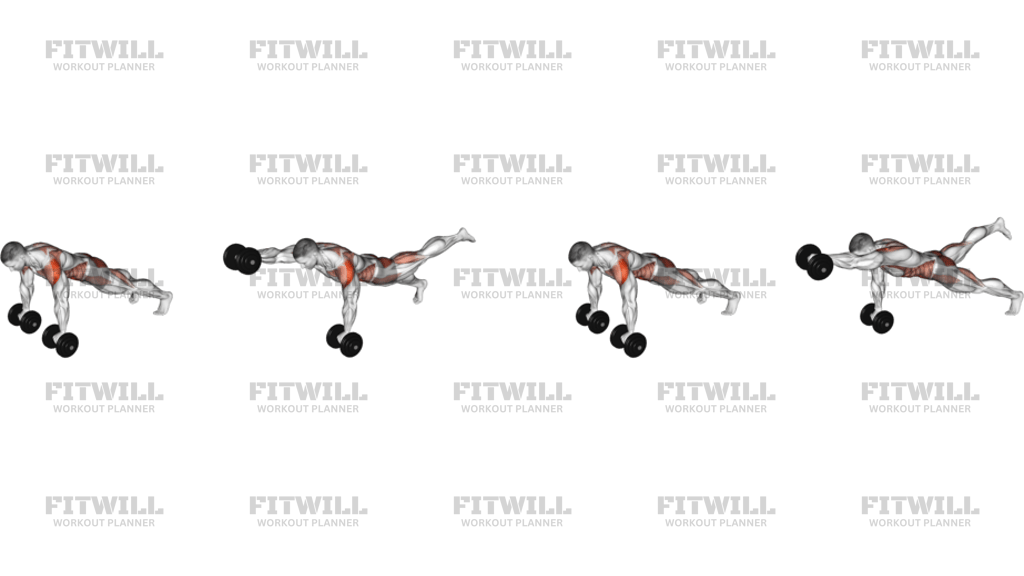
Dumbbell Front Plank Arm Leg Raise is a floor-based stability drill built around a high plank with the hands supported on dumbbells. The exercise asks you to keep the torso quiet while you lift one arm and the opposite leg, so the goal is less about moving weight and more about resisting rotation, arching, and side-to-side sway. That makes it a useful accessory movement for core control, shoulder stability, hip extension control, and overall trunk coordination.
The dumbbells are there to raise the hands slightly and give the wrists a more neutral angle, but they also make the plank feel less forgiving because each support point must stay steady. As soon as one arm leaves the floor, the shoulders and waist have to organize the body so the pelvis does not twist open or drop. The working side should feel controlled and deliberate, not like a balance drill you are trying to rush through.
A good setup starts with the dumbbells placed shoulder-width apart on a non-slip floor. Stack the shoulders directly above the handles, extend the legs long behind you, and press the feet into the floor with the glutes lightly active. Before the first rep, find a long line from the back of the head to the heels and keep the ribs from flaring as you move.
Each repetition should look small and clean. Lift one arm only as high as you can without shifting the hips, and raise the opposite leg only until it stays in line with the torso rather than arching the lower back. The best reps have a brief pause at the top, a controlled return to the floor, and a smooth switch to the other side without losing pressure through the hands and toes.
This exercise fits well in warmups, core circuits, shoulder-stability work, or as accessory training after heavier pressing or rowing. It is especially useful when you want plank work that challenges the anti-rotation pattern without needing large external loads. If the dumbbells wobble, the low back pinches, or the hips keep spinning open, the set is too hard or the range is too large. Keep the movement strict and stop the set once the plank shape starts to collapse.
[ Workout Log & Planner ]
Put your next workout in Fitwill
Keep your plan and training log ready when you are.


Instructions
- Place two dumbbells on the floor shoulder-width apart and come into a high plank with one hand on each handle, shoulders stacked over the wrists.
- Step both feet back into a long plank, squeeze the glutes, and spread the feet just wide enough to keep the pelvis steady.
- Set the neck in line with the spine, tuck the ribs down, and lock in a quiet plank before you start moving.
- Lift one arm forward only a few inches while the opposite leg rises behind you to about hip height.
- Keep the hips square to the floor and stop the lift before the lower back starts to arch or the torso rotates.
- Pause briefly at the top of the reach so the body stays still instead of swinging through the rep.
- Lower both limbs with control until the hand returns to the dumbbell handle and the toe lands softly on the floor.
- Repeat on the other side, alternating sides for the planned number of reps while breathing steadily through the plank.
Tips & Tricks
- Choose dumbbells with flat, stable heads so the handles do not roll when you load them in the plank.
- A wider foot stance makes the drill easier; bring the feet closer together only after you can keep the hips level.
- Keep the lifted arm in line with the ear rather than sweeping it out to the side, which usually twists the torso.
- Raise the opposite leg only until the glute is working; if the low back takes over, the leg is going too high.
- Think about pressing the supporting hand and toe into the floor to stop the body from rocking.
- A small, controlled reach is more useful here than a big lift that makes the ribs flare.
- If your shoulders sink toward the dumbbells, shorten the set or use a higher handle position before the wrists fatigue.
- Move slowly enough that you can feel the plank shape stay unchanged from the start of the rep to the finish.
Frequently Asked Questions
What does Dumbbell Front Plank Arm Leg Raise train?
It mainly trains the deep core, shoulder stabilizers, glutes, and the muscles that keep the pelvis from rotating during a plank.
Can beginners perform this exercise?
Yes, but beginners should keep the feet wider, lift the arm and leg only a little, and stop before the lower back starts to sag.
Why are the hands on dumbbells instead of the floor?
The dumbbells create a more neutral wrist angle and add a slightly unstable support point, which makes the plank demand more control from the shoulders and core.
How high should I raise the arm and leg?
Only high enough to keep the torso square and the ribs down. A small, strict lift is better than a bigger reach that twists the hips.
What muscles should feel tired first?
You should feel the deep core, glutes, shoulders, and the support side of the trunk working before anything feels like a cardio sprint.
What is the biggest mistake in Dumbbell Front Plank Arm Leg Raise?
The biggest mistake is rotating the hips open or letting the low back arch when the arm and leg leave the floor.
Can I use this as a warm-up exercise?
Yes. It works well as a short activation drill before pressing, rows, or any session that needs better trunk control.
How do I make this harder without adding weight?
Bring the feet closer together, hold the top position a little longer, or slow the lowering phase while keeping the plank perfectly still.