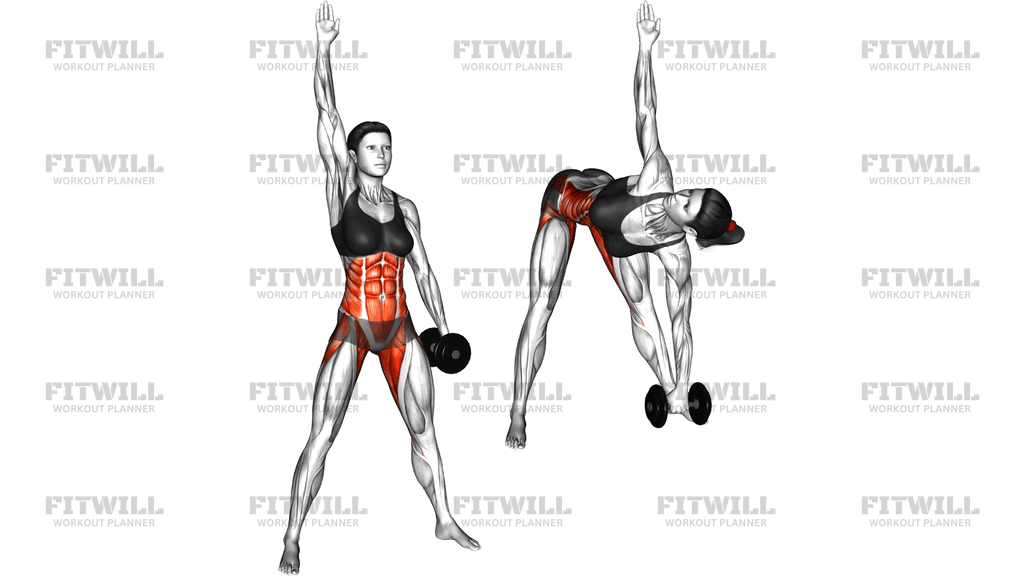
Dumbbell Standing High Windmill
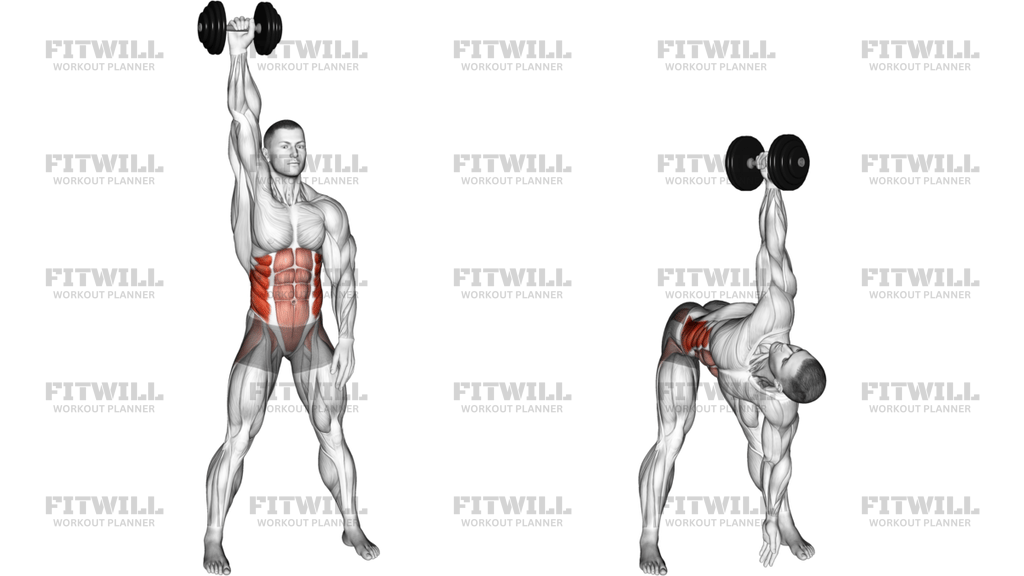
Dumbbell Standing High Windmill is a standing overhead mobility-and-strength exercise built around one locked-out dumbbell, a wide stance, and a controlled hip hinge. It trains the obliques, shoulder stabilizers, glutes, adductors, and thoracic rotation at the same time, so the movement feels more like coordinated body control than a simple side bend. The overhead arm stays stacked while the torso folds and rotates underneath it.
The overhead position matters. When the arm is straight and the shoulder is packed, the dumbbell gives you a clear line to follow as you hinge. If the weight drifts forward or the elbow softens, the torso tends to twist and the range becomes sloppy. The goal is to keep the loaded arm vertical, let the hips shift back and slightly toward the free-hand side, and keep the chest open as you reach the other hand down the leg.
At the bottom, the working side hamstrings and adductors should feel lengthened, the obliques should resist collapse, and the shoulder should still feel active rather than hanging loose. A good windmill is not a race to the floor. It is a controlled descent to the deepest position you can own without losing balance, losing the overhead line, or rounding through the lower back.
Use this exercise when you want more than basic core bracing. It fits well in warm-ups, prep work before overhead lifting, accessory blocks for trunk strength, and mobility-focused sessions for athletes who need rotation and hip control. It is also useful as a lighter strength drill for people learning how to move their hips and rib cage independently while keeping one arm fixed overhead.
Keep the load conservative and the stance intentional. The exercise becomes harder very quickly once the dumbbell is too heavy to stabilize or the feet are too narrow to let the hips travel. If the shoulder cannot stay stacked or the free hand cannot reach the shin without the trunk collapsing, shorten the range and clean up the pattern before adding weight.
[ Workout Log & Planner ]
Put your next workout in Fitwill
Keep your plan and training log ready when you are.


Instructions
- Stand with your feet wider than hip-width and turn them slightly out so you have room to hinge. Press one dumbbell overhead and lock the elbow so the wrist, elbow, shoulder, and hip stay stacked.
- Keep the loaded arm vertical, palm facing inward, and set the other hand lightly on the opposite thigh or let it hang by your side for balance.
- Take a breath, brace your midsection, and shift your hips toward the side of the free hand while keeping your chest open toward the ceiling.
- Push the loaded hip back as you hinge at the waist and rotate the torso under the dumbbell, keeping the overhead arm in the same line.
- Slide the free hand down the inside of the thigh or shin as far as you can without bending the loaded elbow or letting the shoulder drift forward.
- Stop when the torso is under control and the overhead dumbbell still feels stacked over the shoulder, then pause briefly in that end position.
- Drive through the feet, squeeze the glutes, and bring the torso back to standing while the dumbbell stays directly above the shoulder.
- Exhale as you rise, reset your stance if needed, and repeat for the planned reps before switching sides.
Tips & Tricks
- Choose a dumbbell you can hold overhead without the wrist folding back or the shoulder shrugging toward the ear.
- A wider stance usually makes the hinge cleaner because it gives the hips room to shift back and out to the side.
- Keep the eyes on the dumbbell or slightly forward; looking down too early often sends the chest toward the floor.
- Think about turning the rib cage and hips together instead of simply leaning sideways.
- If the free hand cannot reach the shin without rounding the lower back, stop higher and keep the rep strict.
- The loaded knee should stay soft, but the leg should not collapse inward as the torso lowers.
- Avoid twisting the dumbbell forward in an attempt to get lower; the wrist, elbow, and shoulder should stay stacked.
- Move slowly on the way down so you can feel the hamstrings, adductors, and obliques controlling the descent.
- Finish each rep by standing tall before starting the next one so every repetition begins from a stable base.
Frequently Asked Questions
What muscles does the Dumbbell Standing High Windmill work?
It strongly challenges the obliques, shoulder stabilizers, glutes, adductors, and the hips on the hinged side.
Should the dumbbell stay directly over the shoulder the whole time?
Yes. The arm should stay stacked overhead so the weight tracks vertically instead of drifting forward as you hinge.
Where should the free hand go on the way down?
Reach it down the inside of the opposite thigh, shin, or toward the floor depending on mobility, but do not force extra range.
Is this more of a strength exercise or a mobility exercise?
It is both. The loaded overhead position builds stability, while the hinge and rotation train usable hip and trunk mobility.
Can I bend the elbow to get lower?
No. Keep the elbow locked out so the shoulder, elbow, and wrist stay in one line and the rep stays safe.
What is the most common form mistake?
The biggest problem is letting the dumbbell drift forward while the torso folds, which turns the rep into a loose side bend instead of a stacked windmill.
Who should keep the range shorter?
Anyone with limited shoulder mobility, balance issues, or tight hamstrings should stop higher and own the top-to-midrange first.
How should I breathe during each rep?
Take a breath and brace before the descent, then exhale as you stand back up to keep the trunk organized.