Backhand Raise
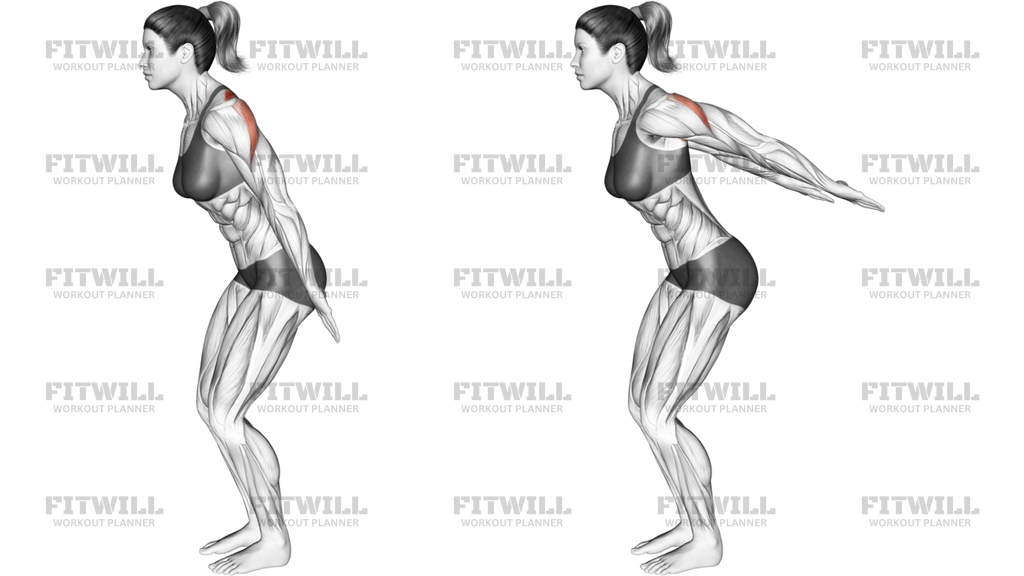
Backhand Raise is a standing, hip-hinged bodyweight shoulder-extension drill that trains the back of the shoulders, upper back, and the stabilizers that keep your torso steady while the arms travel behind you. The movement looks small, but it asks for a clean hinge, a fixed ribcage, and enough shoulder control to move the arms without turning the set into a lower-back swing. Because the load is created by your body position rather than external weight, the exercise works best when every rep is deliberate.
The main training emphasis is on the posterior shoulder line and the muscles that help organize the shoulder blades as the arms sweep backward. When the hinge is set correctly, you should feel the work across the rear delts and upper back, with the trunk and hips holding the position so the torso does not dump forward or snap upright. If you stand too tall, the motion becomes tiny and loses value; if you hinge too deeply or arch to chase range, the lower back starts doing the job the shoulders should own.
A good setup starts with soft knees, feet planted, and a pelvis angle that lets the spine stay long. The chest stays open, the neck relaxed, and the arms begin hanging slightly behind the thighs so the shoulders are not jammed forward. From there, the hands travel back in a controlled arc until the upper arms are roughly in line with the torso, then return slowly to the start without letting the weight of the arms pull the body out of position.
Backhand Raise fits well as a posture-focused accessory, warmup drill, or a light finishing movement when you want posterior shoulder and upper-back tension without heavy loading. It is also useful when you need to practice keeping the shoulder blades stable while the arms move behind the body. The safest version is the one that stays smooth, symmetrical, and pain-free, with no swinging, no shrugging, and no extra lumbar extension to fake more range.
[ Workout Log & Planner ]
Put your next workout in Fitwill
Keep your plan and training log ready when you are.


Instructions
- Stand hip-width with a slight knee bend and hinge forward from the hips until your torso is inclined, letting your arms hang slightly behind your thighs.
- Set your neck long, chest open, and gaze down and a few feet ahead so the spine stays neutral instead of craning upward.
- Turn the palms inward or slightly back, keep the elbows mostly straight, and let the shoulders sit away from the ears.
- Brace your abdomen and keep your ribs stacked over your pelvis before the first rep starts.
- Sweep the straight arms backward and slightly outward until the hands reach about shoulder height or the highest position you can hold without twisting.
- Pause briefly at the top and squeeze the rear shoulders and upper back without arching the lower back or shrugging.
- Lower the arms slowly along the same path until they hover just behind the thighs again.
- Exhale as the arms lift and inhale on the return so the trunk stays steady through the full range.
- Reset the hinge and posture between reps if the torso angle or shoulder position starts to change.
Tips & Tricks
- Keep the hinge fixed; the rep should come from the shoulders, not from straightening your torso.
- Stop the upward range when your hands can no longer rise without rib flare or lower-back extension.
- Imagine sliding the shoulder blades down the back pockets before each rep so the traps do not take over.
- A slower lowering phase usually makes the rear shoulder work harder than adding more speed or a bigger swing.
- If you feel the neck taking over, let the shoulders stay lower and reduce the hand height.
- Keep the knees soft, not locked, so the hamstrings can hold the hinge without pulling the pelvis around.
- Watch for side-to-side drift; both arms should travel through the same arc and finish at the same height.
- Choose a range that lets the hands trace a smooth path instead of a jerky kickback.
- If the lower back starts to tense first, shorten the hinge and reduce the arm travel.
Frequently Asked Questions
What muscles does Backhand Raise work?
It mainly trains the rear shoulders and upper back, with the core and hips helping you hold the hinge.
Is this more of a rear delt exercise or a back exercise?
It is mainly a posterior shoulder drill, but the upper back helps keep the arm path controlled and stable.
How far back should my arms go?
Only as far as you can keep the torso still; for most people that is around shoulder height or slightly below.
Why does my lower back feel this more than my shoulders?
You are probably arching to chase more range or standing too upright, which shifts the work away from the shoulders.
Should my elbows stay straight?
Keep them long with only a soft bend; a lot of elbow flexion turns the movement into a different exercise.
Can beginners do Backhand Raise?
Yes, because it is bodyweight and easy to scale by reducing the hinge depth and the arm height.
What is the most common mistake?
Swinging the torso or shrugging the shoulders instead of keeping the hinge and arm path controlled.
Can I use this as a warmup?
Yes, it works well before pulling or shoulder sessions because it wakes up the rear shoulder and upper-back pattern.