Dumbbell Bench Dip
Dumbbell Bench Dip is a bench-based triceps exercise that uses your bodyweight plus a dumbbell on the lap to increase the challenge. The setup is simple, but the details matter: your hands stay on the bench behind you, your hips travel just in front of the bench edge, and the added load sits securely across the thighs so the set feels stable instead of awkward.
This movement mainly trains the triceps, with the front shoulders and chest helping to control the press. It is useful when you want a direct arm-focused pushing exercise without needing a cable station or dip bars. Because the shoulders are placed behind the torso, the bottom position can feel demanding quickly, so a clean setup and a controlled range of motion are more important here than forcing a deep descent.
The bench itself is the anchor for the exercise. Press your palms into the edge, keep the shoulders organized, and let the elbows bend back rather than splaying wide. The dumbbell on the lap adds resistance and also encourages the legs to stay active, which helps keep the hips from drifting or the load from sliding as you lower and press.
At the bottom of Dumbbell Bench Dip, the goal is to create tension through the triceps without collapsing into the shoulders. Lower only as far as you can keep the chest lifted and the upper arms controlled, then press the body back up by straightening the elbows. A smooth rep should look deliberate, with the hips rising and lowering in one controlled line rather than bouncing off the bottom.
Dumbbell Bench Dip works well as an accessory movement after bigger presses or as a direct arm finisher when you want extra triceps volume. It is also a good option for home training because a flat bench and one dumbbell are enough to load it. If the shoulders feel pinchy or the dumbbell shifts too much, shorten the range, bend the knees more, or reduce the load until the rep feels stable and repeatable.
Fitwill
Log Workouts, Track Progress & Build Strength.
Achieve more with Fitwill: explore over 9600 exercises with images and videos, access built-in and custom workouts, perfect for both gym and home sessions, and see real results.
Start your journey. Download today!




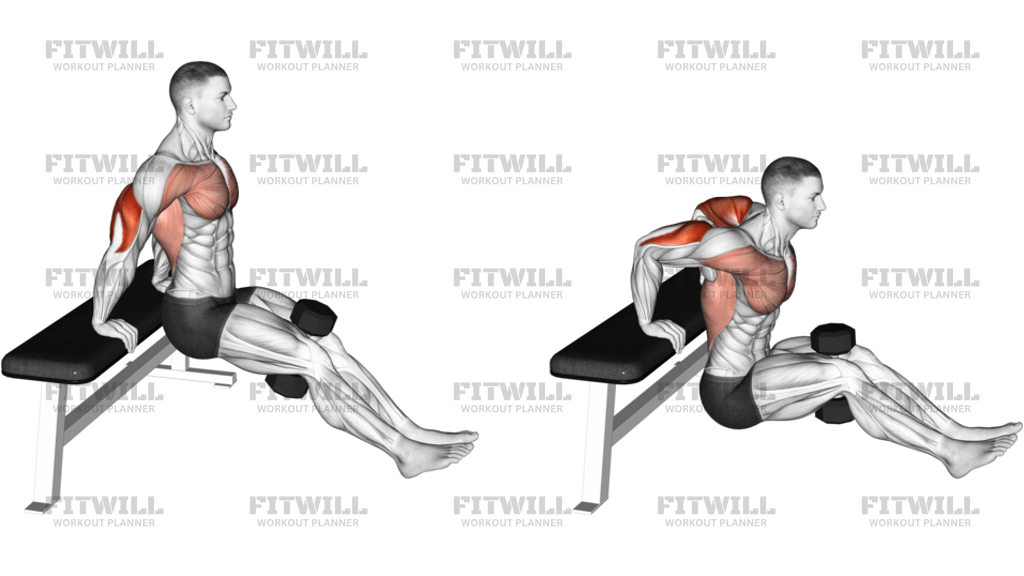
Instructions
- Sit on the front edge of a flat bench and place your hands on the bench beside your hips, fingers pointing forward and palms flat.
- Set a dumbbell across the top of your thighs, then extend your legs forward with your heels on the floor or keep your knees bent if that helps the dumbbell stay secure.
- Scoot your hips just off the bench so your weight is supported by your hands, and keep your chest lifted with your shoulders down and back.
- Brace your torso, squeeze the dumbbell lightly between your thighs, and keep the bench close behind your hips before you start the first rep.
- Bend your elbows and lower your hips straight down toward the floor, keeping your upper arms close to your sides and your elbows tracking behind you.
- Stop the descent when your shoulders still feel controlled and your upper arms are near parallel to the floor, rather than forcing extra depth.
- Press firmly through your palms to straighten your elbows and lift your hips back up until your arms are nearly locked out.
- Exhale as you press up, inhale as you lower, and keep the dumbbell steady on your lap throughout the set.
- After the final rep, lower your hips to the floor, place the dumbbell down safely, and stand up without letting it roll.
Tips & Tricks
- If the dumbbell feels unstable, bend your knees more and keep the weight cradled on the upper thighs instead of the lower legs.
- Keep your elbows pointing behind you, not flared wide, so the triceps do more of the work and the shoulders stay quieter.
- A slightly more upright torso biases the triceps; a bigger forward lean shifts more demand into the front shoulders and chest.
- Do not chase a deep bottom position if the front of the shoulder tightens or the bench edge starts to slide under your hands.
- Pressing the hands closer to the bench edge makes the rep feel shorter and often easier to control; reaching too far back can strain the shoulders.
- Lower slowly enough that the dumbbell does not bounce on your lap or shift as your hips descend.
- Keep your wrists stacked over your hands at the top so the press finishes through the palms instead of the heel of the hand.
- If the set turns into a shoulder shrug, reset your shoulders down before the next rep and reduce the load or the depth.
Frequently Asked Questions
What muscles does Dumbbell Bench Dip work most?
Dumbbell Bench Dip mainly works the triceps. The chest and front shoulders assist during the press, especially if you lean a little forward.
Where should the dumbbell sit during Dumbbell Bench Dip?
Place it across the top of your thighs, usually just above the knees. That position helps keep the load centered while you lower and press.
Is Dumbbell Bench Dip beginner-friendly?
Yes, but most beginners should start with bodyweight or a very light dumbbell first. The shoulder position is the part that usually limits range, not strength alone.
How deep should I go on Dumbbell Bench Dip?
Lower only until your shoulders still feel stacked and the upper arms stay controlled. If the front of the shoulder pinches, shorten the range immediately.
Should my elbows flare out on Dumbbell Bench Dip?
No. Keep them tracking back behind you so the triceps stay loaded and the shoulders are not forced into an awkward position.
What is the main mistake people make with this bench dip?
Going too deep and letting the shoulders roll forward is the biggest issue. That usually turns a triceps exercise into an uncomfortable shoulder movement.
Can I do Dumbbell Bench Dip without a dumbbell?
Yes. The bodyweight version is the simplest substitution if you want to practice the bench position before adding load.
How do I make Dumbbell Bench Dip harder?
Straighten your legs more, slow the lowering phase, or add load on the lap. You can also elevate your feet, but only if the bench position stays stable.