Dumbbell Standing Arms Rotate
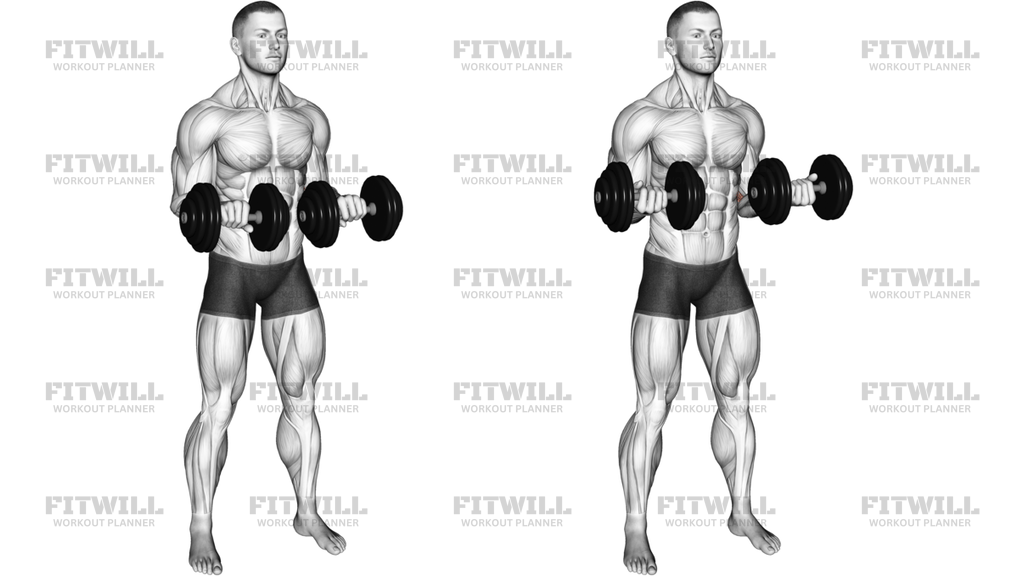
Dumbbell Standing Arms Rotate is a standing forearm rotation drill performed with a dumbbell in each hand. The movement shifts the forearms from one rotational position to another while the upper arms stay close to the torso, so the work stays on the forearms instead of turning into a shoulder raise or a curl. It is a small-range strength and control exercise that rewards patience, clean alignment, and light loading.
This exercise mainly trains the forearm rotators and the grip, with the shoulders and upper arms acting as stabilizers. Because the dumbbells are held away from the body, the wrists and elbows have to stay organized through the whole range. That makes Dumbbell Standing Arms Rotate useful when you want more forearm control, better wrist-position awareness, or a controlled accessory movement that does not require heavy weight.
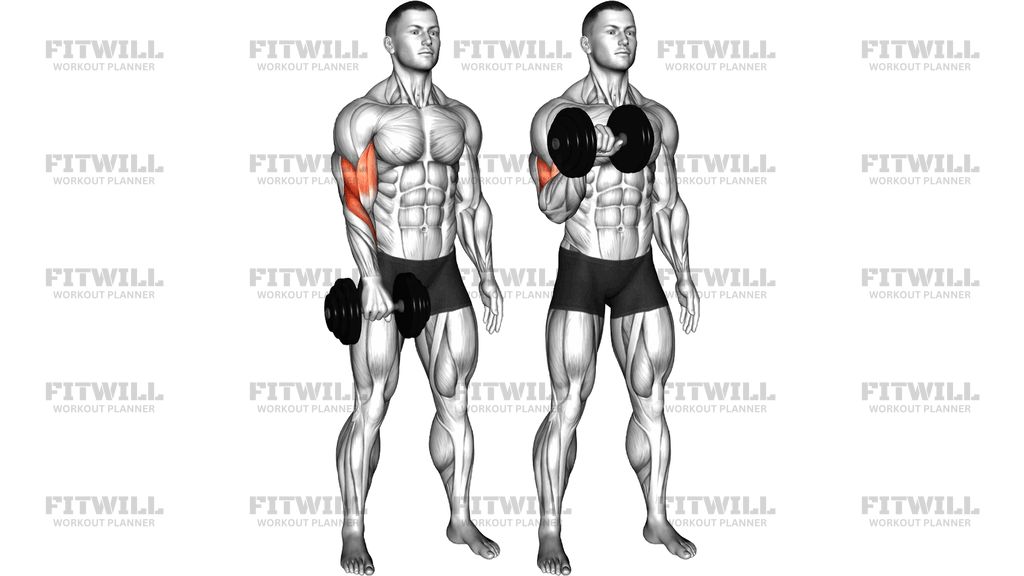
The standing setup matters. Keep the feet about hip-width apart, stack the ribs over the pelvis, and let the elbows sit near the sides with the forearms lifted in front of the torso. From there, rotate both dumbbells smoothly without letting the elbows drift forward or the shoulders shrug up. The motion should look deliberate and even on both sides, not like the torso is helping to twist the weight around.
Use a light load and think about turning the dumbbells rather than swinging them. The easiest way to lose the exercise is by bending the wrists, moving the elbows, or using momentum to force the rotation. A clean rep has steady tension on the forearms, a quiet torso, and a controlled return to the starting position.
Dumbbell Standing Arms Rotate works well as a forearm accessory, a warm-up for pulling sessions, or a low-load control drill between heavier lifts. It is also a practical choice for lifters who want to build tolerance around the wrists and elbows without adding a lot of fatigue. Keep the range pain-free and stop the set if the motion turns into a shrug, a curl, or a twist through the spine.
[ Workout Log & Planner ]
Put your next workout in Fitwill
Keep your plan and training log ready when you are.


Instructions
- Stand tall with a dumbbell in each hand, elbows bent about 90 degrees, and upper arms tucked close to your ribs.
- Hold the forearms in front of your torso with the wrists straight and the dumbbells level at about lower-chest height.
- Set your feet hip-width apart and keep your ribs stacked over your pelvis before the first rep.
- Rotate both forearms smoothly so the palms turn from one position to the other without letting the elbows leave your sides.
- Keep the shoulders down and the torso still as the dumbbells rotate through the middle of the rep.
- Pause briefly at the end of the turn, then reverse the motion with the same control.
- Lower or turn the dumbbells back under tension instead of letting the wrists snap open or shut.
- Breathe out as you rotate through the working phase and inhale as you return to the start.
- Finish the set when you can no longer keep the elbows pinned and the wrists aligned.
Tips & Tricks
- Use very light dumbbells; this exercise gets difficult fast because the lever arm is long.
- Keep the elbows fixed at your sides so the movement comes from the forearms, not the shoulders.
- Rotate the dumbbells as one smooth motion instead of twisting the torso to help the turn.
- Hold the wrists straight. Bending them back usually turns the drill into a grip and wrist irritation exercise.
- A slower turn exposes control issues better than trying to spin the dumbbells quickly.
- If the shoulders start shrugging, reduce the load and shorten the range before fatigue builds.
- Stop just short of any sharp elbow or wrist discomfort; the goal is controlled rotation, not forcing range.
- Use the same tempo on both sides so the dumbbells finish each rep at the same angle.
Frequently Asked Questions
What does Dumbbell Standing Arms Rotate work?
It mainly trains the forearm rotators and grip, with the shoulders and upper arms working as stabilizers.
Is Dumbbell Standing Arms Rotate the same as a curl?
No. The elbows stay mostly fixed and the forearms rotate instead of flexing and extending like a curl.
Should my elbows stay glued to my sides?
Yes. Keeping the upper arms close to your ribs prevents the shoulders from taking over the movement.
How heavy should the dumbbells be for this exercise?
Start much lighter than you would for a curl. If the wrists bend or the torso sways, the load is too heavy.
Can beginners do Dumbbell Standing Arms Rotate?
Yes, as long as they start with light dumbbells and keep the rotation smooth and pain-free.
Why do my shoulders get tired during Dumbbell Standing Arms Rotate?
That usually means the shoulders are shrugging or the elbows are drifting forward. Lower the load and keep the upper arms still.
Should I rotate both arms at the same time?
This version is usually performed with both dumbbells rotating together so the timing and end positions stay even.
When should I use Dumbbell Standing Arms Rotate in a workout?
It fits well as a warm-up, accessory drill, or light finisher after pulling work or other forearm-heavy training.
What should I do if my wrists feel strained?
Reduce the load, shorten the range a little, and keep the wrists neutral so the forearms do the turning instead of the joints getting cranked.