Dumbbell Hip Thrust
Dumbbell Hip Thrust is a glute-dominant bridge variation that uses a flat bench for upper-back support and a dumbbell placed across the hip crease. It is a strong choice when you want to train hip extension with more load than a bodyweight bridge, while still keeping the movement simple enough to control rep by rep. The bench gives you a fixed upper-body anchor, so the quality of the set depends on how well you set your feet, brace your trunk, and keep the dumbbell stable over the hips.
The main work comes from the glutes, with the hamstrings and core helping to keep the pelvis from tipping and the ribs from flaring. Because the load sits low and forward on the body, the exercise rewards clean positioning more than sheer effort. If your feet are too far away, you will often feel the hamstrings take over; if they are too close, you may lose force at the top or overextend the lower back.
Dumbbell Hip Thrust is especially useful as a lower-body accessory movement in glute-focused sessions, posterior-chain work, or warmups before heavier squats, deadlifts, or lunges. It is also a practical option for home training, since all you need is a bench, a dumbbell, and enough floor space to plant your feet. The fixed bench position lets you focus on producing force through the hips without worrying about balancing a barbell across the pelvis.
Each repetition should feel like a smooth hip drive rather than a back bend. From the seated setup, press through your heels, lift the hips until your torso and thighs form a strong line, then lower under control until the dumbbell returns to a comfortable starting depth. A brief pause at the top can make the glutes work harder, but only if you can keep the rib cage down and avoid leaning back over the bench. The goal is a powerful lockout with the pelvis level and the chin relaxed.
Use a load you can keep centered on the hip crease for every rep, and consider a pad or folded towel if the dumbbell digs into the pelvis. This exercise usually works best in moderate to higher rep ranges with deliberate tempo, because the setup favors tension and glute recruitment over maximal barbell-style loading. When it is performed well, Dumbbell Hip Thrust builds strong hip extension mechanics that carry over to running, jumping, sprinting, and general lower-body strength without needing a complicated setup.
[ Workout Log & Planner ]
Put your next workout in Fitwill
Keep your plan and training log ready when you are.


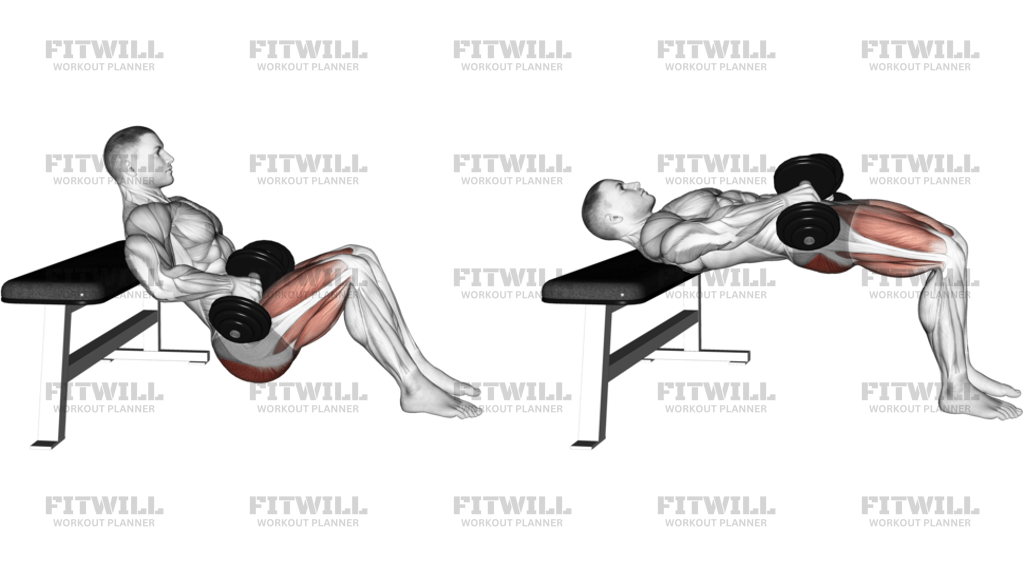
Instructions
- Sit on the floor with your upper back against the edge of a flat bench and a dumbbell resting across the hip crease.
- Bend your knees and plant both feet flat, about hip-width apart, so your shins are close to vertical at the top.
- Hold the dumbbell steady with both hands and tuck your chin slightly so your ribs stay down.
- Brace your core before you drive the hips upward.
- Press through your heels and squeeze your glutes to lift the hips until your torso and thighs form a straight line.
- Keep the dumbbell level and avoid letting your lower back take over at the top.
- Pause for a moment in the lockout if you can keep the pelvis level and the chin relaxed.
- Lower the hips under control until you return to the starting depth with tension still on the glutes.
- Reset your feet and the dumbbell before the next rep if the load starts to drift or roll.
Tips & Tricks
- Keep your shoulder blades anchored on the bench edge; sliding too high turns the rep into an awkward back extension.
- If your hamstrings cramp, move your feet a little closer to your hips and try again.
- If you feel the movement mostly in the front of the hip, move your feet slightly farther away and finish with the glutes, not the lower back.
- A towel or hip pad helps if the dumbbell presses hard into the pelvis and makes you shorten the set.
- Do not bounce off the bottom; the first inch of every rep should still be controlled.
- Hold the dumbbell with both hands so it cannot tilt or slide as the hips rise.
- Exhale as you drive up, then keep the top position short and crisp instead of over-squeezing into a lumbar arch.
- Choose a bench height that lets your upper back stay supported without forcing your head to crane backward.
Frequently Asked Questions
What muscles does Dumbbell Hip Thrust train most?
It mainly targets the glutes, with the hamstrings and core helping stabilize the pelvis and trunk.
Where should the dumbbell sit during Dumbbell Hip Thrust?
Rest it across the hip crease, not on the lower stomach or thighs, and keep it centered with both hands.
How high should my hips come up in Dumbbell Hip Thrust?
Lift until your torso and thighs make a straight line, then stop before your lower back starts to arch harder than your glutes are working.
Why are my hamstrings taking over in Dumbbell Hip Thrust?
Your feet are probably too far from the bench. Bring them a little closer so the shins stay close to vertical at the top and the glutes finish the rep.
Can beginners do Dumbbell Hip Thrust safely?
Yes. Start with a light dumbbell or even bodyweight until you can keep the bench contact, pelvis level, and dumbbell stable through every rep.
Do I need a pad under the dumbbell?
A pad or folded towel is useful if the dumbbell digs into your hips and makes you cut the set short or shift the load.
Is Dumbbell Hip Thrust better than a glute bridge?
The bench-supported version usually gives you a bigger hip range and a stronger lockout, while a floor bridge is shorter and easier to set up.
What is the most common mistake in Dumbbell Hip Thrust?
Letting the lower back take over at the top is the big one. Keep the ribs down and finish by squeezing the glutes, not by leaning farther back.