Pull-Up Negative
Pull-Up Negative is the lowering phase of a pull-up done as its own strength drill. It is useful for building the pulling strength, shoulder control, and grip endurance needed for full pull-ups, especially when you can already reach the top position but cannot yet own the descent.
This movement puts a strong emphasis on the lats, upper back, biceps, forearms, and the small stabilizers that keep the shoulders centered around the bar. The box under the bar is not just there for convenience; it lets you start every rep in a clean top position instead of wasting energy jumping, swinging, or muscling your way into place.
Set the grip first, then make the body quiet before you lower. With an overhand grip, step or hop to the top so your chin is above the bar, your ribs are stacked, and your shoulders are set rather than shrugged. From there, the exercise is about resisting gravity with control, not fighting for speed.
A good Pull-Up Negative should feel smooth from the first inch to the last. The descent should be slow enough that you can keep your torso steady, your elbows tracking in a natural line, and your neck relaxed. If you drop fast, kick the legs, or lose shoulder position at the bottom, the rep turns into a test of momentum instead of a useful strength builder.
Use Pull-Up Negative as a progression tool, an accessory after heavier pulling work, or a focused bodyweight strength exercise when you want better control through the hardest part of the pull-up. Keep the reps crisp, reset on the box between attempts, and stop the set as soon as you can no longer control the lowering phase without turning it into a fall.
Fitwill
Log Workouts, Track Progress & Build Strength.
Achieve more with Fitwill: explore over 9600 exercises with images and videos, access built-in and custom workouts, perfect for both gym and home sessions, and see real results.
Start your journey. Download today!




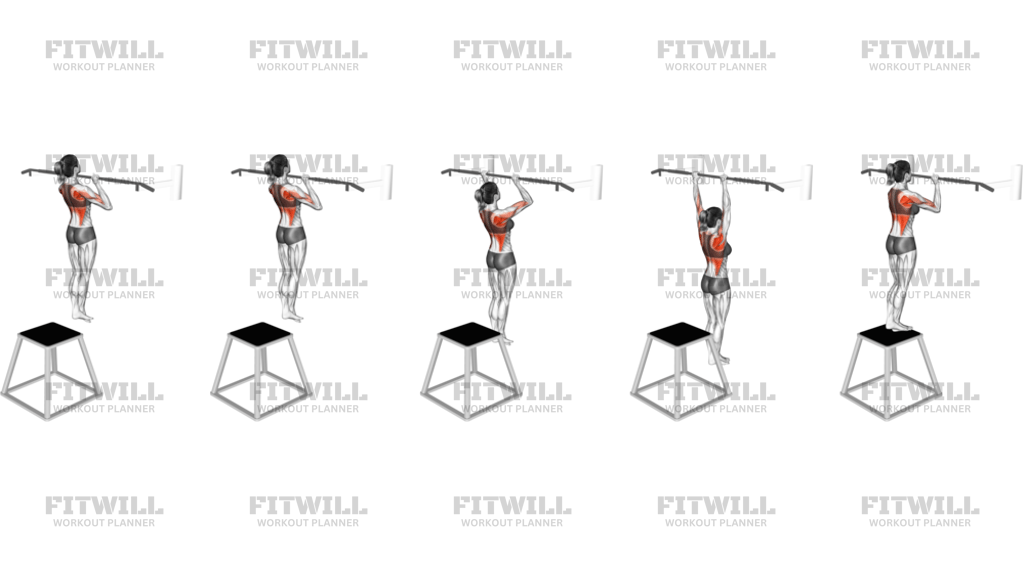
Instructions
- Place a sturdy box or bench under the pull-up bar so you can reach the top position without jumping.
- Stand on the box and take an overhand grip on the bar, slightly wider than shoulder width.
- Step or hop until your chin is clearly above the bar, then hold the top with your chest tall.
- Set your shoulders down and back, squeeze the bar, and keep your ribs stacked over your pelvis.
- Brace your core and keep your legs still so the rep starts without swinging.
- Lower yourself slowly for 3 to 6 seconds until your elbows are fully straight.
- Keep your shoulders controlled as you pass the midpoint and resist collapsing into the bottom.
- Touch the box with your feet, reset your grip and body position, and repeat for the planned reps.
Tips & Tricks
- Use a box height that lets you start in the top position without having to jump or shrug to the bar.
- If the descent turns into a drop, shorten the count and keep the rep slow enough to own the whole path.
- Keep your chest slightly lifted as you lower so the shoulders do not dump forward at the halfway point.
- A grip that is too wide usually makes the bottom position sloppy; stay just outside shoulder width unless the bar setup forces otherwise.
- Do not let your legs kick behind you on the way down; quiet feet make the negative much more useful.
- Think about pulling your elbows toward your ribs on the way down even though gravity is doing the work.
- Reset fully on the box between reps instead of stringing ugly negatives together.
- Stop the set when you cannot hold the shoulders and torso in place for the full lowering phase.
Frequently Asked Questions
What muscles does Pull-Up Negative train most?
It mainly trains the lats and upper back, with strong help from the biceps, forearms, and shoulder stabilizers.
Can beginners perform this exercise?
Yes. It is a common pull-up progression because you can use the box to get to the top and focus on the lowering phase.
How slow should the lowering phase be in Pull-Up Negative?
Aim for about 3 to 6 seconds on each rep. If you cannot keep the descent smooth, reduce the count and stop before control breaks.
Why is there a box under the bar for Pull-Up Negative?
The box lets you reach the top position safely and reset between reps without wasting energy on jumping or climbing.
Should my chin start above the bar?
Yes. Start each rep with your chin clearly above the bar so the set begins from the strongest part of the pull-up.
What is the most common mistake in Pull-Up Negative?
Dropping too quickly is the big one. The rep should look controlled all the way to the bottom, not like a fall with a brief pause at the top.
Do I need to keep my legs still during Pull-Up Negative?
Yes. Quiet legs keep the rep honest and stop you from using a kip or swing to fake the lowering phase.
How do I progress Pull-Up Negative over time?
Slow the lowering phase, add a rep or two per set, or reduce how much help you get from the box between reps.