Reverse Flutter Kick On Floor Hand Under Head
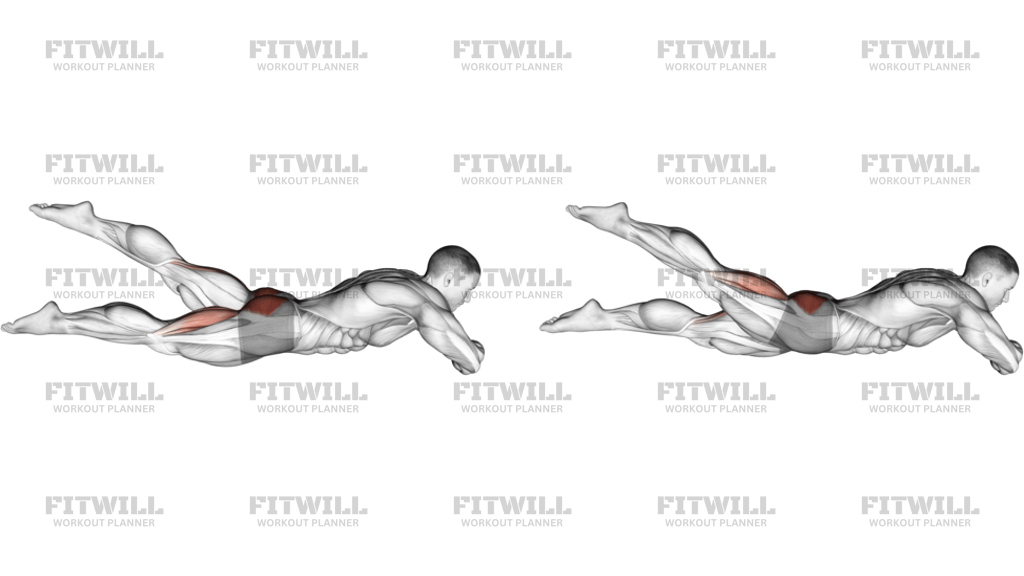
Reverse Flutter Kick On Floor (hand Under Head) is a bodyweight floor drill performed face down with the head supported by the hands or forearms while the legs alternate in a short flutter kick. It is used to train hip extension control, posterior-chain endurance, and trunk stability without loading the spine. The exercise looks simple, but its value comes from keeping the pelvis quiet while the legs move.
This movement mainly challenges the glutes and hamstrings while the abs and deep core muscles work to stop the lower back from taking over. Because the body is already supported on the floor, the setup matters more than on many other exercises: if the hips are jammed into the mat or the chest is lifted too high, the kick turns into a low-back arch instead of a clean hip-driven pattern.
The best reps are small and deliberate. Each leg should lift only as high as you can control while the other leg lowers, with the knees staying long and the pelvis staying square to the floor. Think about lengthening the leg back and up from the hip rather than throwing the foot upward. That keeps tension where it belongs and prevents momentum from hiding poor control.
This drill is useful as accessory work in core sessions, posterior-chain conditioning, warm-ups, or rehab-style training where you want low load and precise repetition. It can also help people who need better awareness of pelvic position during prone hip work or running prep. The exercise should feel controlled, not sloppy or fast, and the neck should stay relaxed so the upper body does not fight the floor position.
If the lower back starts to pinch or the pelvis rocks side to side, shorten the range and slow the tempo immediately. The goal is a steady alternating rhythm with clean hip movement, not a high kick or a rapid bicycle motion. Done well, the exercise builds endurance and control in the hips, glutes, and core with very little equipment or joint stress.
Fitwill
Log Workouts, Track Progress & Build Strength.
Achieve more with Fitwill: explore over 9600 exercises with images and videos, access built-in and custom workouts, perfect for both gym and home sessions, and see real results.
Start your journey. Download today!




Instructions
- Lie face down on the floor or a mat with your legs straight behind you and your hands stacked under your forehead or lightly supporting your head.
- Keep your chest down, neck long, and hips heavy on the floor so your lower back stays neutral before you start kicking.
- Brace your abs gently and set your feet a few inches off the floor to start the alternating motion from a stable base.
- Lift one straight leg just a few inches as the other leg lowers, keeping both knees extended and the movement small.
- Alternate the legs in a smooth flutter-kick rhythm without letting the hips roll or the torso shift side to side.
- Keep the kick coming from the hip joint, not from a big swing of the knee or a sharp arch through the low back.
- Breathe steadily through the set and exhale as each leg lifts or switches position.
- Continue for the planned reps or time, then lower both legs to the floor and relax the body.
Tips & Tricks
- Keep the kicks low. If the feet are traveling high above the floor, the hips are probably rotating and the low back is helping too much.
- Press the front of the pelvis gently into the mat so the glutes do the work instead of turning the rep into a lumbar extension drill.
- Rest the forehead on the hands only if it keeps the neck relaxed; if the neck cranes upward, flatten the head position.
- Use a tighter, faster rhythm only after you can control the pelvis. Sloppy speed hides poor hip control.
- Think about reaching the heel long behind you rather than lifting the whole leg upward.
- If the hamstrings cramp, reduce the kick height and slow the tempo until the cramp settles.
- Keep the knees nearly straight but not locked so the legs can alternate without tension dumping into the joints.
- A thin mat or folded towel under the hips can make the prone position more comfortable on a hard floor.
Frequently Asked Questions
What muscles does Reverse Flutter Kick On Floor (Hand Under Head) work?
It mainly works the glutes and hamstrings, with the abs and deeper core muscles helping keep the pelvis steady.
Should my hands stay under my head during the set?
Yes, the head-supported setup helps keep the neck relaxed as long as you do not crank the chin up or press hard into the hands.
How high should each leg lift off the floor?
Only a few inches. The goal is a small, controlled kick from the hip, not a big lift that twists the pelvis or arches the back.
Is this the same as a regular flutter kick?
No. A regular flutter kick is usually done on your back, while this version is done face down and emphasizes the posterior chain.
Can beginners do this exercise safely?
Yes. Beginners usually do best with short sets, small kicks, and a slow tempo so the low back stays quiet.
What if I feel it mostly in my lower back?
Lower the legs less, tighten the abs, and keep the chest and hips heavy on the floor so the movement shifts back to the glutes.
Should my knees bend during the kick?
Keep the legs long with only a very soft bend if needed. Bending the knees too much turns it into a different pattern.
How do I make the exercise harder without weights?
Use slower alternating reps, longer holds at the top of each kick, or longer total time under tension while keeping the pelvis still.