Table Top Bridge Rotation
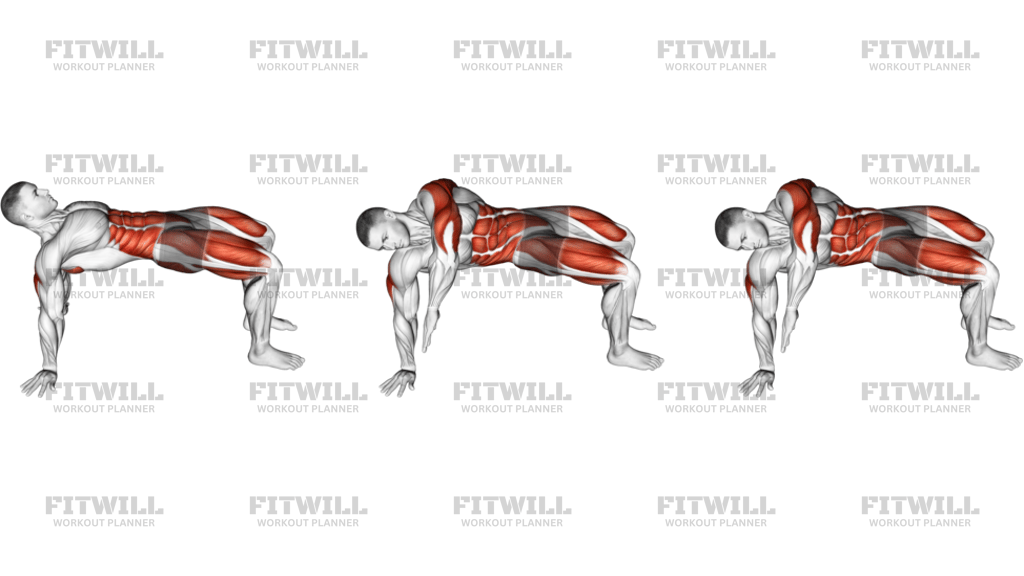
Table Top Bridge Rotation is a bodyweight bridge variation that combines a reverse tabletop hold with controlled trunk rotation. It trains the hips, glutes, shoulders, triceps, and deep core at the same time, so the exercise is useful when you want strength and stability rather than pure speed or load. The position is demanding because your upper body has to support your weight while your pelvis stays lifted and organized through the turn.
The setup matters a lot. When your hands are placed behind you and your feet are planted, the exercise starts from a very open shoulder position and a tight hip extension position. That means the wrists, shoulders, and glutes all need to cooperate before the first rotation begins. If the hips start sagging early or the chest collapses, the movement turns into a shoulder shrug and a low-back twist instead of a clean bridge rotation.
From the top position, keep the hips high and rotate the rib cage toward one side while reaching the free hand down or across the body. The goal is to let the shoulders and trunk turn without dumping the pelvis to the floor. Think about staying tall through the chest, pressing the floor away with the supporting hand, and controlling the return through center before you rotate to the other side.
This exercise works well as a warm-up drill, accessory core work, or a shoulder-and-hip stability finisher. It can also help lifters practice body awareness in a closed-chain position, where the hands and feet stay fixed while the torso has to manage the rotation. Because the load is your own body weight, the value comes from position quality, pause control, and even reps on both sides.
Keep the range smooth and honest. If the wrists feel irritated, the shoulders lose position, or the hips drop as you rotate, shorten the turn and reset the tabletop shape before each rep. Table Top Bridge Rotation should feel like a controlled full-body stabilization drill with a clear rotational component, not a fast side-to-side swing.
Fitwill
Log Workouts, Track Progress & Build Strength.
Achieve more with Fitwill: explore over 9600 exercises with images and videos, access built-in and custom workouts, perfect for both gym and home sessions, and see real results.
Start your journey. Download today!




Instructions
- Sit on the floor with your knees bent, feet flat, and your hands placed on the floor just behind your hips, slightly wider than shoulder width.
- Turn your fingers to a wrist-friendly angle, then press through your palms and heels to lift your hips into a tabletop bridge.
- Stack your shoulders over your hands and keep your knees bent so your torso, thighs, and arms are ready to support the hold.
- Squeeze your glutes and draw your ribs down so your pelvis stays level before you start rotating.
- Shift a little more weight into one hand and both feet, then rotate your chest toward the opposite side.
- Reach the free hand down or across your body while keeping your hips lifted and your supporting shoulder strong.
- Pause briefly at the rotated end position without letting your lower back sag or your hips collapse.
- Rotate back through the center with control, then repeat on the other side for the planned number of reps.
- Exhale as you rotate and reach, inhale as you return to the center, and lower your hips only after the set is complete.
Tips & Tricks
- Keep the tabletop shape high before you rotate; if your hips drop, shorten the reach and reset.
- Press the supporting hand firmly into the floor so the shoulder stays packed instead of sinking toward the ear.
- Turn the fingers out a little more if the wrists feel pinched in the reverse tabletop position.
- Rotate through the rib cage, not by yanking the low back from side to side.
- Use the glutes to keep the pelvis lifted while the torso turns.
- Let the free hand reach only as far as you can keep both feet rooted and the hips square enough to control.
- Pause for a beat in each rotated position to remove momentum and make the drill more challenging.
- If the shoulders shake or the chest collapses, reduce the range before adding more repetitions.
- Move at a steady pace so each side looks the same instead of rushing one direction and wobbling back.
- Stop the set when the bridge height fades, because that usually means the core and shoulders are losing position.
Frequently Asked Questions
What muscles does Table Top Bridge Rotation work?
It mainly challenges the glutes, shoulders, triceps, and deep core while the hips stay lifted and the torso rotates.
Is Table Top Bridge Rotation suitable for beginners?
Yes, if you keep the rotation small and focus on a stable reverse tabletop position first. Beginners should treat it as a control drill, not a speed exercise.
Should my hips stay level during Table Top Bridge Rotation?
They should stay as level as you can manage. A little shift is normal, but if one hip drops hard, shorten the reach and rebuild the tabletop hold.
How far should I rotate in Table Top Bridge Rotation?
Only as far as you can keep the shoulders supported and the hips high. A smaller, cleaner rotation is better than twisting so far that the bridge collapses.
What if my wrists hurt in the bridge position?
Turn your hands slightly outward, spread your fingers, or elevate your hands on a stable surface if needed. If wrist pain continues, reduce the time under tension or choose a different core drill.
What is the most common mistake in Table Top Bridge Rotation?
The biggest mistake is letting the pelvis sag while the chest over-rotates. Keep the bridge tall and let the rib cage move without losing the tabletop shape.
Can I use Table Top Bridge Rotation as a warm-up?
Yes, it works well before core, glute, or shoulder work because it wakes up the hips, trunk, and stabilizers at the same time.
How do I make Table Top Bridge Rotation harder?
Slow the tempo, add a brief pause at each side, or reach the free hand a little farther while keeping the hips lifted.